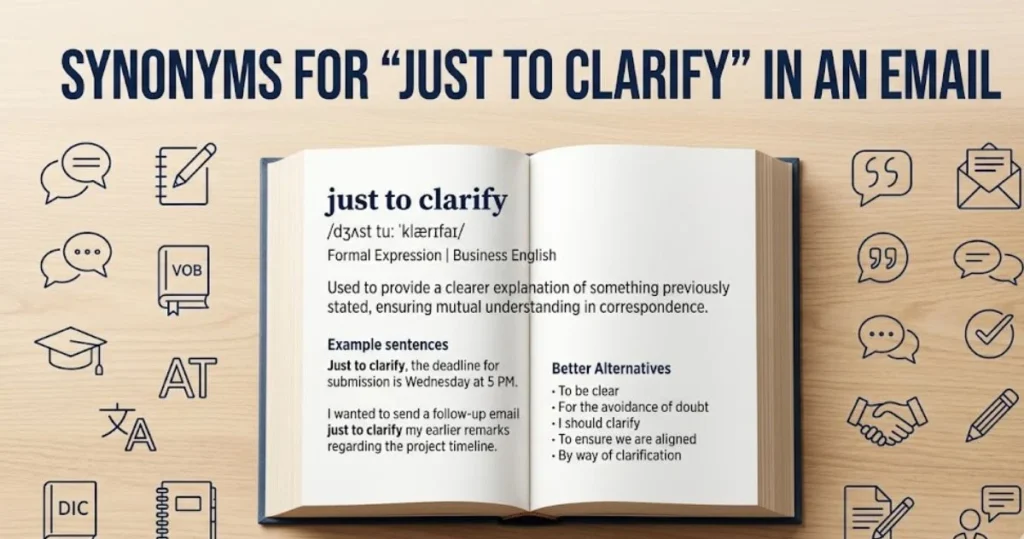
“Just to clarify” is one of the most common phrases in professional emails when you want to restate, confirm, or make something clearer. But using the same phrase repeatedly can sound repetitive or slightly informal in business communication.
That’s why many professionals search for synonyms for just to clarify in an email. You need alternatives that fit different tones—formal, friendly, corporate, or client-facing—without changing meaning.
In email writing, clarity builds trust. The right phrasing helps you avoid confusion, reduce back-and-forth messages, and maintain a professional tone in workplace communication.
This guide gives you 50+ email-ready alternatives with examples, tone breakdowns, and real-world usage so you can communicate like a top-tier professional.
Meaning of “Just to Clarify”
Literal Meaning
“Just to clarify” means:
- I want to make something clearer
- I want to confirm understanding
- I want to avoid confusion
Tone
- Neutral
- Slightly informal
- Polite and cooperative
Emotional Context
- Prevents misunderstanding
- Shows attention to detail
- Signals professionalism and care
Example
Just to clarify, is the deadline Friday or Monday?
When to Use “Just to Clarify” in Professional Communication
You can use clarification phrases in:
Emails
To confirm details or instructions.
Workplace Communication
To avoid misinterpretation in tasks or meetings.
Client Communication
To ensure expectations match deliverables.
Networking
To politely confirm intent or details.
Customer Service
To reduce confusion and improve accuracy.
50+ Professional Alternatives to “Just to Clarify”
Below are structured alternatives grouped by tone and usage.
1. Professional Alternatives (15+)
These fit corporate emails and business communication.
1. To clarify
- Tone: Neutral, direct
- Use: Standard business emails
- Example: To clarify, do you need the report by end of day?
2. For clarification
- Tone: Formal
- Use: Documentation, client emails
- Example: For clarification, the scope includes revisions only.
3. Just to confirm
- Tone: Professional
- Use: Confirming details
- Example: Just to confirm, the meeting is at 10 AM.
4. To ensure clarity
- Tone: Formal
- Use: Complex instructions
- Example: To ensure clarity, please follow the attached steps.
5. To avoid confusion
- Tone: Neutral
- Use: Prevent misunderstandings
- Example: To avoid confusion, we will use the updated template.
6. I would like to clarify
- Tone: Polite formal
- Use: Respectful communication
- Example: I would like to clarify the payment terms.
7. Allow me to clarify
- Tone: Formal, assertive
- Use: Leadership tone
- Example: Allow me to clarify the project timeline.
8. To make this clear
- Tone: Direct
- Use: Instructional emails
- Example: To make this clear, approvals are required first.
9. For the sake of clarity
- Tone: Formal
- Use: Policy or legal writing
- Example: For the sake of clarity, all changes must be documented.
10. Let me clarify
- Tone: Professional but approachable
- Use: Team communication
- Example: Let me clarify the next steps.
11. To be clear
- Tone: Direct
- Use: Emphasis in explanation
- Example: To be clear, no additional costs apply.
12. In order to clarify
- Tone: Formal
- Use: Structured communication
- Example: In order to clarify, we need final approval.
13. To provide clarity
- Tone: Corporate
- Use: Reports, updates
- Example: To provide clarity, here is the breakdown.
14. To clarify further
- Tone: Professional
- Use: Follow-up explanations
- Example: To clarify further, revisions are unlimited.
15. For better understanding
- Tone: Neutral
- Use: Educational context
- Example: For better understanding, see the diagram below.
2. Formal Alternatives (10+)
Use these in legal, corporate, or high-stakes communication.
16. I wish to clarify
- Tone: Very formal
- Example: I wish to clarify the contract terms.
17. It is important to clarify
- Tone: Authoritative
- Example: It is important to clarify the responsibilities.
18. Please allow clarification
- Tone: Formal polite
- Example: Please allow clarification regarding the clause.
19. To eliminate ambiguity
- Tone: Legal/formal
- Example: To eliminate ambiguity, all terms are defined.
20. To remove any doubt
- Tone: Formal reassurance
- Example: To remove any doubt, payments are fixed.
21. For precise understanding
- Tone: Corporate
- Example: For precise understanding, refer to section 3.
22. I would like to provide clarity
- Tone: Professional
- Example: I would like to provide clarity on timelines.
23. To ensure accurate understanding
- Tone: Formal
- Example: To ensure accurate understanding, review the notes.
24. For absolute clarity
- Tone: Strong formal
- Example: For absolute clarity, no exceptions apply.
25. To clarify the matter
- Tone: Legal/business
- Example: To clarify the matter, we need documentation.
3. Friendly Alternatives
These work for team chats, internal emails, or casual workplace tone.
26. Just so we’re on the same page
- Tone: Friendly
- Example: Just so we’re on the same page, the call is tomorrow.
27. Just to double-check
- Tone: Casual
- Example: Just to double-check, is this correct?
28. Quick clarification
- Tone: Friendly
- Example: Quick clarification on the schedule.
29. Just making sure
- Tone: Soft informal
- Example: Just making sure I understood correctly.
30. To keep things clear
- Tone: Friendly
- Example: To keep things clear, let’s use Slack.
31. So we’re aligned
- Tone: Collaborative
- Example: So we’re aligned on next steps.
32. Just confirming
- Tone: Neutral friendly
- Example: Just confirming the meeting time.
33. A quick note to clarify
- Tone: Warm
- Example: A quick note to clarify the deadline.
34. To clear things up
- Tone: Casual
- Example: To clear things up, here’s the update.
35. Just to be clear here
- Tone: Informal
- Example: Just to be clear here, no delays allowed.
4. Email-Specific Alternatives
These are optimized for email etiquette and structure.
36. For email clarity
- Example: For email clarity, I’ve attached instructions.
37. To clarify via email
- Example: To clarify via email, here are the details.
38. In this email, I would like to clarify
- Example: In this email, I would like to clarify expectations.
39. To clarify in writing
- Example: To clarify in writing, deadlines remain unchanged.
40. This is to clarify
- Example: This is to clarify the previous message.
41. To clarify the previous email
- Example: To clarify the previous email, please note updates.
42. For written clarity
- Example: For written clarity, see attached scope.
43. To clarify the details below
- Example: To clarify the details below, see points 1–3.
44. To clarify our discussion
- Example: To clarify our discussion, here is a summary.
45. To clarify the request
- Example: To clarify the request, we need approval.
5. Workplace Alternatives
Best for internal teams and project communication.
46. To align expectations
- Example: To align expectations, deadlines are fixed.
47. To ensure alignment
- Example: To ensure alignment, please review the plan.
48. To sync understanding
- Example: To sync understanding, here’s the update.
49. To confirm understanding
- Example: To confirm understanding, please reply.
50. To validate details
- Example: To validate details, check the document.
51. To refine understanding
- Example: To refine understanding, we need feedback.
52. To standardize clarity
- Example: To standardize clarity, we use templates.
53. To finalize understanding
- Example: To finalize understanding, approve the scope.
54. To ensure mutual understanding
- Example: To ensure mutual understanding, here are steps.
55. To clarify responsibilities
- Example: To clarify responsibilities, roles are listed below.
Quick Comparison Table
| Alternative | Tone | Best Use |
|---|---|---|
| To clarify | Neutral | General emails |
| Just to confirm | Professional | Confirmation |
| For clarification | Formal | Client/legal |
| Just so we’re aligned | Friendly | Teams |
| To eliminate ambiguity | Formal | Legal docs |
| Quick clarification | Casual | Internal chat |
| To ensure clarity | Formal | Instructions |
| Let me clarify | Professional | Team emails |
| So we’re aligned | Friendly | Collaboration |
| To avoid confusion | Neutral | Process updates |
Email Examples
Client Email
To clarify, the project scope includes three revisions only.
Manager Email
Let me clarify the timeline for the next sprint.
Colleague Email
Just so we’re aligned, the meeting is at 2 PM.
Customer Email
To ensure clarity, your subscription renews monthly.
Networking Email
Just to confirm, we met at the marketing event last week.
Meeting Follow-up
To clarify our discussion, here are the action points.
Common Mistakes
- Overusing “just to clarify” in every email
- Using formal phrases in casual chats
- Mixing tones in one message
- Being unclear even after “clarification”
- Using overly complex wording in simple emails
Related Phrases (With Examples)
- To confirm understanding → Please confirm the timeline
- For your reference → For your reference, see attached file
- To reiterate → To reiterate, deadline is Friday
- As discussed → As discussed, we will proceed
- To summarize → To summarize, here are the points
- To highlight → To highlight key changes below
- To emphasize → To emphasize priority tasks
- For transparency → For transparency, costs increased
- To note → Please note the updated policy
- In summary → In summary, everything is approved
- To restate → To restate, scope remains unchanged
- To recap → To recap our call, here are notes
- To outline → To outline the process steps
- For clarity purposes → For clarity purposes, here is data
- To break down → To break down the requirements
Phrase Comparison
“Just to clarify” vs Alternatives
- Tone: Neutral but slightly informal
- Best alternatives: “To clarify,” “For clarification”
- Most formal: “To eliminate ambiguity”
- Most friendly: “Just so we’re aligned”
- Best email-safe: “To ensure clarity”
Cultural Usage
US English
- Direct, simple: “To clarify,” “Just to confirm”
UK English
- Slightly more formal: “For clarification,” “I would like to clarify”
Corporate Communication
- Structured: “To ensure alignment,” “To eliminate ambiguity”
Customer Service
- Polite reassurance: “To ensure clarity,” “To avoid confusion”
Networking
- Friendly tone: “Just so we’re aligned,” “Just to confirm”
FAQs
1. What is a professional way to say “just to clarify”?
To clarify, for clarification, or to ensure clarity.
2. Is “just to confirm” formal?
Yes, it is professional and widely used in emails.
3. What is a formal alternative?
“To eliminate ambiguity” or “for precise understanding.”
4. Can I use it in emails?
Yes, it is very common in business emails.
5. What is a friendly alternative?
“Just so we’re on the same page.”
6. What is the best workplace version?
“To ensure alignment” or “let’s confirm understanding.”
7. Is it polite to say “just to clarify”?
Yes, it is polite and neutral.
8. What is a customer service alternative?
“To ensure clarity” or “to avoid confusion.”
9. What is a short alternative?
“To clarify.”
10. What is a softer version?
“Just making sure” or “quick clarification.”
11. What is a formal email phrase?
“For clarification purposes.”
12. Can it sound rude?
Only if overused or written in a sharp tone.
13. What is the best synonym overall?
“To clarify” works in most contexts.
14. What is a legal alternative?
“To eliminate ambiguity.”
15. What is a teamwork phrase?
“So we’re aligned” or “to sync understanding.”
Final Summary
If you want a simple professional option, use “to clarify”.
If you want formal tone, use “for clarification” or “to eliminate ambiguity.”
If you want friendly tone, use “just so we’re on the same page.”
If you want email-safe clarity, use “to ensure clarity” or “just to confirm.”
Choosing the right phrase improves tone, reduces confusion, and strengthens workplace communication. Always match your wording to your audience, especially in client and corporate emails.
Conclusion
Choosing the right synonym for “just to clarify” improves email clarity, tone, and professionalism. Simple phrases like “to clarify” work best in most situations, while formal options such as “for clarification” or “to eliminate ambiguity” suit corporate and legal communication. Friendly alternatives like “just so we’re on the same page” fit team discussions. Each variation helps you control tone and avoid misunderstandings in workplace communication. Use these alternatives strategically based on context, audience, and intent. Strong email etiquette builds trust, reduces confusion, and enhances your professional communication across clients, teams, and business environments.