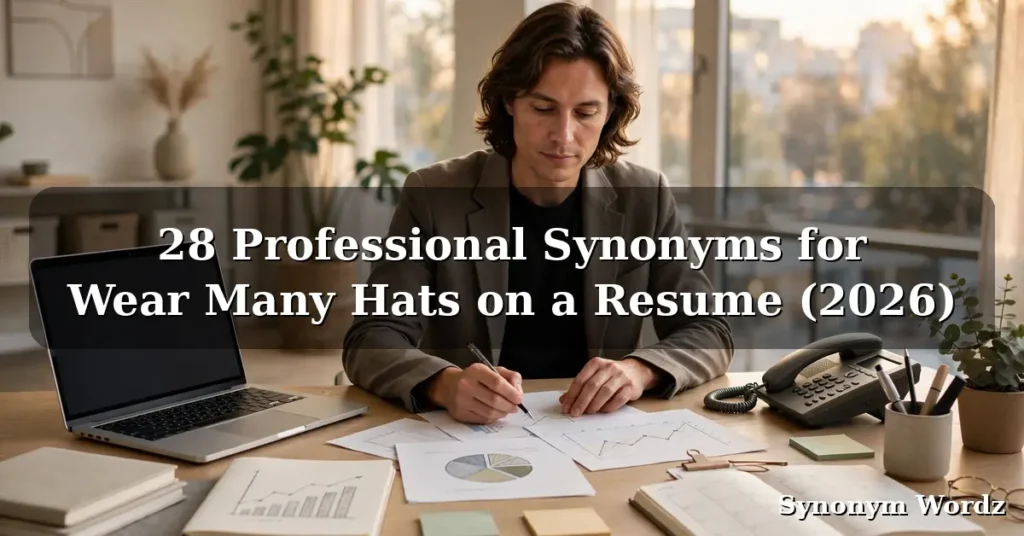
28 Professional Synonyms for Wear Many Hats on a Resume (2026)
Looking for strong synonyms for “wear many hats” on a resume? You are in the right place. The phrase “wear many hats” means you handle many different jobs or roles, but it sounds casual and a bit overused. Hiring managers read hundreds of resumes, so the words you choose matter. A professional way to say “wear many hats” on a resume can show your range of skills in a sharper, more polished light. In this guide, you will find 28 formal, friendly, and email-ready alternatives with examples, plus tips on when to use each one. Whether you are updating your resume, writing a cover letter, or describing yourself in a job interview, these options will help you sound capable and confident.
What Does “Wear Many Hats” Mean?
The phrase “wear many hats” comes from the idea that different jobs need different hats. If you wear many hats, you take on several roles or duties, often at the same time. For example, a small business manager might handle sales, hiring, and customer support in one day. That person wears many hats.
Literal meaning: Doing many different tasks or jobs, usually for one employer or role.
Tone: Friendly and informal. It sounds warm but not very formal.
Purpose: People use it to show they are flexible, skilled, and willing to help in many areas. If you want to highlight teamwork too, you might also like these professional synonyms for team player.
Emotional context: It often carries pride. People who wear many hats want you to know they can handle pressure and learn fast. But on a resume, pride should come through in polished language, not slang.
Examples:
- “At my last job, I wore many hats, from bookkeeping to client onboarding.”
- “She wears many hats on our team, including marketing and product testing.”
When to Use These Alternatives in Professional Settings
In Emails
Use polished phrases like “comfortable handling multiple responsibilities” when you write to recruiters or hiring managers. Good email etiquette means keeping your tone respectful and clear. Avoid slang such as “jack of all trades” in a first email to a stranger.
In the Workplace
At work, you can use a mix of friendly and professional terms. “Utility player” works well with close colleagues. In meetings with leadership, choose “cross-functional team member” or “versatile professional” instead.
With Clients
Clients want to feel they are in good hands. Saying “I bring a comprehensive skill set to this project” builds trust. It sounds stronger than saying you wear many hats.
In Networking
At networking events, short and warm phrases work best. “I am a bit of an all-rounder” is friendly and easy to remember. Follow up with a clear example of the roles you have handled.
In Customer Service
Customer service roles need people who can switch tasks quickly. Phrases like “adaptable team member” show you can handle calls, emails, and in-person help without stress. Pair it with strong communication skills on your resume for a winning combination.
28 Professional Synonyms for “Wear Many Hats” on a Resume

Below are 28 alternatives grouped by style. Each one includes its tone, the best place to use it, and an example sentence you can adapt for your own resume or cover letter.
Professional Alternatives
1. Versatile professional
Tone: Confident and polished.
Best use: Resume summary or LinkedIn headline.
Example: “Versatile professional with 6 years of experience in marketing and operations.”
2. Multifaceted contributor
Tone: Sophisticated and professional.
Best use: Cover letters and executive summaries.
Example: “A multifaceted contributor who has led sales, training, and project delivery.”
3. Adaptable team member
Tone: Warm and professional.
Best use: Resumes for customer-facing or fast-changing roles.
Example: “Adaptable team member known for stepping into new roles without missing a beat.”
4. Cross-functional team member
Tone: Corporate and modern.
Best use: Tech, product, and operations resumes.
Example: “Cross-functional team member collaborating across engineering and design.”
5. Multiskilled specialist
Tone: Strong and expert.
Best use: Resumes where you want to stress real skills, not just flexibility.
Example: “Multiskilled specialist in data analysis, reporting, and client presentations.”
6. Resourceful professional
Tone: Positive and capable.
Best use: Startup or small-company resumes.
Example: “Resourceful professional who built the onboarding process from scratch.”
7. Dynamic professional
Tone: Energetic and confident.
Best use: Sales, marketing, and leadership roles.
Example: “Dynamic professional driving growth across three business units.”
Formal Alternatives
8. Broad range of responsibilities
Tone: Formal and factual.
Best use: Resume bullet points and job descriptions.
Example: “Managed a broad range of responsibilities, including budgeting and vendor relations.”
9. Diverse professional background
Tone: Formal and impressive.
Best use: Executive bios and cover letters.
Example: “Brings a diverse professional background spanning finance and hospitality.”
10. Comprehensive skill set
Tone: Formal and strong.
Best use: Resume summaries and skills sections.
Example: “Offers a comprehensive skill set in project management and team leadership.”
11. Wide-ranging expertise
Tone: Formal and authoritative.
Best use: Consulting and senior roles.
Example: “Wide-ranging expertise in compliance, auditing, and risk management.”
12. Multi-disciplinary experience
Tone: Academic and formal.
Best use: Education, research, and technical resumes.
Example: “Multi-disciplinary experience across software development and UX design.”
13. Extensive operational experience
Tone: Formal and serious.
Best use: Operations and management resumes.
Example: “Extensive operational experience running daily workflows for a team of 40.”
14. Varied professional competencies
Tone: Very formal.
Best use: Government, legal, or corporate applications.
Example: “Demonstrates varied professional competencies in policy and administration.”
Friendly Alternatives
15. Jack of all trades
Tone: Friendly and casual.
Best use: Conversations with colleagues, not formal resumes.
Example: “I am a bit of a jack of all trades around the office.”
16. Utility player
Tone: Warm and sporty.
Best use: Team introductions and internal emails.
Example: “Think of me as the utility player. I can fill in wherever the team needs me.”
17. All-rounder
Tone: Friendly and positive.
Best use: Networking and casual professional chats.
Example: “She is a true all-rounder, great with clients and numbers alike.”
18. Go-to person
Tone: Warm and trusted.
Best use: Recommendation letters and team bios.
Example: “He became the go-to person for everything from IT issues to event planning.”
19. Swiss army knife of the team
Tone: Playful and memorable.
Best use: Casual workplace talk only.
Example: “Our office manager is the Swiss army knife of the team.”
If you want to show this kind of reliability in writing, it helps to present yourself as a great asset to the team using the right words for the setting.
Email Alternatives
20. Comfortable handling multiple responsibilities
Tone: Professional and calm.
Best use: Emails to recruiters and hiring managers.
Example: “I am comfortable handling multiple responsibilities and tight deadlines.”
21. Experienced across several roles
Tone: Professional and factual.
Best use: Cover letters and job applications.
Example: “I am experienced across several roles, including support, sales, and training.”
22. Happy to take on diverse tasks
Tone: Positive and willing.
Best use: Follow-up emails after interviews.
Example: “I am happy to take on diverse tasks as the team grows.”
23. Flexible and adaptable to changing needs
Tone: Professional and reassuring.
Best use: Emails to clients or new managers.
Example: “I stay flexible and adaptable to changing needs during busy seasons.”
Workplace Alternatives
24. Multitasker
Tone: Direct and modern.
Best use: Resume skills sections.
Example: “Proven multitasker managing five client accounts at once.”
25. Multi-role contributor
Tone: Professional and clear.
Best use: Performance reviews and internal profiles.
Example: “A multi-role contributor supporting both the sales and support teams.”
26. Cross-trained team member
Tone: Practical and professional.
Best use: Retail, hospitality, and healthcare roles.
Example: “Cross-trained team member able to cover the front desk and the warehouse.”
27. Versatile asset
Tone: Confident and strong.
Best use: Resume summaries and recommendation letters.
Example: “A versatile asset who improved both customer satisfaction and team output.”
28. Hands-on generalist
Tone: Practical and honest.
Best use: Startup and small-business resumes.
Example: “Hands-on generalist with experience in hiring, payroll, and daily operations.”
Quick Comparison Table
| Alternative | Tone | Best Use |
|---|---|---|
| Versatile professional | Professional | Resume summary, LinkedIn |
| Multifaceted contributor | Professional | Cover letters |
| Adaptable team member | Professional | Customer-facing roles |
| Cross-functional team member | Professional | Tech and operations |
| Multiskilled specialist | Professional | Skill-heavy resumes |
| Resourceful professional | Professional | Startups |
| Dynamic professional | Professional | Sales and leadership |
| Broad range of responsibilities | Formal | Resume bullets |
| Diverse professional background | Formal | Executive bios |
| Comprehensive skill set | Formal | Skills sections |
| Wide-ranging expertise | Formal | Consulting roles |
| Multi-disciplinary experience | Formal | Technical resumes |
| Extensive operational experience | Formal | Management roles |
| Varied professional competencies | Formal | Corporate applications |
| Jack of all trades | Friendly | Casual conversation |
| Utility player | Friendly | Team introductions |
| All-rounder | Friendly | Networking |
| Go-to person | Friendly | Recommendations |
| Swiss army knife of the team | Friendly | Casual workplace talk |
| Comfortable handling multiple responsibilities | Recruiter emails | |
| Experienced across several roles | Job applications | |
| Happy to take on diverse tasks | Interview follow-ups | |
| Flexible and adaptable to changing needs | Client emails | |
| Multitasker | Workplace | Skills sections |
| Multi-role contributor | Workplace | Performance reviews |
| Cross-trained team member | Workplace | Retail and healthcare |
| Versatile asset | Workplace | Recommendations |
| Hands-on generalist | Workplace | Small businesses |
Email Examples

Good business email phrases help you sound professional without trying too hard. Here are short examples for common situations.
To a Client
“Thank you for your message. I bring a comprehensive skill set to this project and will personally manage both the design and the reporting.”
To a Manager
“Hi Sarah, I am comfortable handling multiple responsibilities on the launch. I can cover the timeline, the budget, and the vendor calls.”
To a Colleague
“Hey Tom, think of me as your utility player this week. I can help with the presentation and the client demo.”
To a Customer
“Thanks for reaching out. As an adaptable team member, I can help with your billing question and set up your new account today.”
Networking
“It was great meeting you. I am a versatile professional working across marketing and operations, and I would love to stay in touch.”
Meeting Follow-Up
“Thanks for the productive meeting. To recap, I will take on the research, the draft, and the stakeholder updates. I stay flexible and adaptable to changing needs as we move forward.”
Common Mistakes to Avoid

Overuse
Do not repeat the same phrase in every section of your resume. If your summary says “versatile professional,” your bullet points should show proof, not repeat the word. Use a mix of two or three alternatives at most.
Wrong Tone
Using “jack of all trades” in a formal banking application can hurt your chances. It may suggest you are not a specialist. Match the tone to the industry: formal words for formal fields, friendly words for creative ones.
Too Formal or Too Casual Mismatch
“Varied professional competencies” sounds stiff in a startup cover letter, while “Swiss army knife of the team” sounds out of place in a legal application. Read the job post first and mirror its language level.
Email Etiquette Issues
In emails, keep it short. A long list of every role you have ever done looks like bragging. Pick one or two relevant roles per email. Also, never use all caps or slang when writing to someone you have not met. Clean workplace communication builds trust faster than clever phrases.
Related Phrases
These related expressions can add variety to your resume, cover letter, and interviews:
- Juggle multiple roles: Handling several jobs at once. Example: “I juggle multiple roles during our busy season.”
- Jack of all trades: Skilled in many areas. Example: “He is a jack of all trades in our workshop.”
- Multitasker: Someone who does many tasks at the same time. Example: “She is a strong multitasker under pressure.”
- Cross-functional: Working across different teams or departments. Example: “I led a cross-functional project last year.”
- Versatile: Able to adapt to many tasks. Example: “A versatile employee who learns new tools fast.”
- Adaptable: Able to adjust to change. Example: “Adaptable to new systems and workflows.”
- Hands-on: Directly involved in the work. Example: “Hands-on manager who joins the team on the floor.”
- All-rounder: Good at many things. Example: “An all-rounder in both design and coding.”
- Utility player: Fills gaps wherever needed. Example: “Our utility player covers shifts across departments.”
- Go-to person: The one people ask for help. Example: “She is the go-to person for client escalations.”
- Multi-hyphenate: A person with several professional titles. Example: “A multi-hyphenate working as a writer and editor.”
- Generalist: Broad skills rather than one specialty. Example: “A marketing generalist with copy and SEO skills.”
- Resourceful: Finds smart ways to solve problems. Example: “Resourceful with limited budgets and tight timelines.”
- Flexible: Open to change and new tasks. Example: “Flexible with shift changes and new duties.”
- Dynamic: Energetic and full of ideas. Example: “A dynamic leader who motivates the whole team.”
- Broad skill set: Many useful abilities. Example: “Brings a broad skill set to the role.”
“Wear Many Hats” vs. Its Alternatives: A Quick Comparison
The original phrase is friendly but vague. It tells the reader you do many things without saying what those things are. The alternatives fix this problem in different ways.
Tone: “Wear many hats” is casual. “Comprehensive skill set” and “wide-ranging expertise” are formal. “Utility player” and “all-rounder” stay friendly. Choose based on who will read your words.
Formality: For resumes and official applications, formal options win. Hiring software and recruiters both respond better to clear, standard terms like “cross-functional team member” than to idioms.
Best use: Use the casual phrase in conversation, where warmth matters. Use the professional alternatives in writing, where clarity matters. The strongest resumes replace the idiom with a specific phrase plus proof, such as “managed a broad range of responsibilities, including payroll and vendor contracts.”
Cultural Usage
US English
“Wear many hats” is common in American workplaces, especially in startups and small businesses. Americans also use “utility player” and “jack of all trades” freely. On resumes, though, US recruiters prefer concrete terms like “versatile professional” or “multitasker.”
UK English
British professionals use the phrase too, but “all-rounder” is more common in the UK than in the US. Formal British applications favor phrases like “diverse professional background” and “comprehensive skill set.”
Corporate Communication
In large companies, idioms can sound out of place. “Cross-functional team member” and “multi-disciplinary experience” fit corporate style guides best. They sound measured and precise.
Customer Service
Customer service teams value flexibility. “Adaptable team member” and “cross-trained team member” are the top picks here. They reassure both managers and customers that you can handle anything the day brings.
Networking
When you meet people in person, warmth beats formality. “I am a bit of an all-rounder” opens a conversation. Save the formal phrases for the follow-up email you send the next day.
FAQs
1. Is “wear many hats” unprofessional on a resume?
It is not rude, but it is too casual for most resumes. Recruiters prefer specific, professional terms like “versatile professional” or “broad range of responsibilities.” Save the idiom for interviews, where a friendly tone helps.
2. What is a more formal way to say “wear many hats”?
“Comprehensive skill set,” “wide-ranging expertise,” and “diverse professional background” are strong formal choices. They sound polished and work well in executive and corporate applications.
3. Can I use “jack of all trades” on a resume?
It is better to avoid it. The full saying is “jack of all trades, master of none,” and some hiring managers may think of that ending. Use “versatile professional” or “multiskilled specialist” instead.
4. What is a good synonym for “wear many hats” in a cover letter?
“Multifaceted contributor” and “experienced across several roles” work well in cover letters. They sound professional and lead naturally into examples of your work.
5. How do I show versatility without saying “wear many hats”?
List the actual roles or skills: “managed payroll, led onboarding, and handled vendor contracts.” Proof is stronger than any phrase. Then add one polished term like “hands-on generalist” to sum it up.
6. Is “multitasker” a good resume word?
Yes, for roles where speed and volume matter, such as support, retail, or operations. Pair it with results, like “proven multitasker managing five client accounts with a 98% satisfaction rate.”
7. What does “wear many hats” mean in a job interview?
It means the candidate handles many duties. Interviewers may ask for examples, so be ready to name the specific roles you covered and what you achieved in each.
8. Which synonym works best for entry-level resumes?
“Adaptable team member” and “flexible and adaptable to changing needs” are great for entry-level candidates. They show willingness to learn without claiming senior-level expertise.
9. Can “wear many hats” hurt my job application?
It can make your resume look less polished, especially in formal industries like law or finance. It rarely costs you the job on its own, but a stronger phrase gives you an edge over other candidates.
10. What is the best one-word synonym for “wear many hats”?
“Versatile” is the best single-word option. It is professional, widely understood, and fits almost any industry. “Adaptable” is a close second.
Final Summary
The best professional options are “versatile professional,” “multifaceted contributor,” and “cross-functional team member.” For formal applications, choose “comprehensive skill set,” “wide-ranging expertise,” or “diverse professional background.” In casual settings, “all-rounder,” “utility player,” and “go-to person” sound warm and natural. For emails, “comfortable handling multiple responsibilities” and “experienced across several roles” strike the right tone. Whatever you pick, back it up with real examples of the roles you have handled. To check the exact meaning of “versatile” and use it with confidence, see the Merriam-Webster definition of versatile. The right words, plus real proof, will make your resume stand out.