
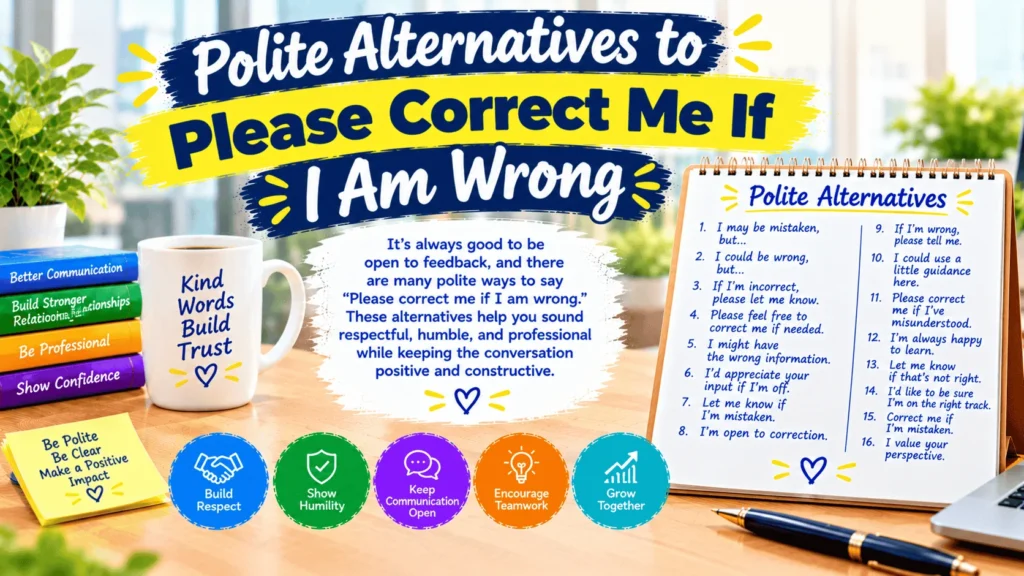
Finding polite alternatives to please correct me if I am wrong can help you sound more confident, respectful, and professional in emails and workplace conversations. The phrase is useful when you want someone to verify information without sounding demanding, but it can sometimes sound overly cautious or repetitive.
In professional communication, your choice of words matters. A manager, client, colleague, or business partner may respond better to a phrase that clearly invites clarification while maintaining a confident tone.
For example, instead of repeatedly writing “Please correct me if I am wrong,” you could say:
- “Please let me know if I have misunderstood.”
- “I would appreciate any clarification.”
- “Please let me know if I have this right.”
- “I welcome any corrections or clarification.”
- “Kindly let me know if my understanding is incorrect.”
These alternatives work well in business emails, meetings, client communication, networking, customer service, and everyday workplace communication.
What Does “Please Correct Me If I Am Wrong” Mean?
Literal Meaning
“Please correct me if I am wrong” means:
I believe this information is accurate, but I am open to being corrected if my understanding is incorrect.
The speaker makes a statement and gives the other person an opportunity to confirm, clarify, or correct it.
Tone
The phrase usually sounds:
- Polite
- Respectful
- Humble
- Cautious
- Collaborative
- Slightly formal
It shows that you do not want to assume that your understanding is completely accurate.
Purpose
People commonly use the expression to:
- Confirm information.
- Avoid making an incorrect assumption.
- Invite clarification.
- Show respect for another person’s knowledge.
- Keep a conversation collaborative.
- Reduce the risk of misunderstanding.
Emotional Context
The phrase can communicate intellectual humility. You are essentially saying, “This is my current understanding, but I am willing to reconsider it.”
For example:
“The deadline is Friday, please correct me if I am wrong.”
This tells the reader that you believe Friday is the deadline but want confirmation.
Another example:
“My understanding is that the revised contract will be ready next week. Please correct me if I am wrong.”
This sounds respectful, but a more polished business email might say:
“My understanding is that the revised contract will be ready next week. Please let me know if I have misunderstood.”
25 Polite Alternatives to “Please Correct Me If I Am Wrong”
The best alternative depends on your relationship with the reader and the situation. Some options sound formal, while others feel warmer and more conversational.
Professional Alternatives
1. Please let me know if I have misunderstood.
Tone: Professional and respectful
Best use: Business emails, clients, managers
This is one of the strongest alternatives because it focuses on your understanding rather than directly saying that you might be wrong.
Example:
My understanding is that the project will begin on Monday. Please let me know if I have misunderstood.
2. Please let me know if my understanding is incorrect.
Tone: Formal and precise
Best use: Workplace communication and official emails
This option works especially well when discussing policies, deadlines, procedures, or instructions.
Example:
My understanding is that the report is due by 5 p.m. Please let me know if my understanding is incorrect.
3. Please let me know if I have this right.
Tone: Professional and conversational
Best use: Emails, meetings, and colleague communication
This is less formal than the original phrase and sounds natural in everyday business communication.
Example:
To confirm, the meeting has been moved to Thursday. Please let me know if I have this right.
4. I would appreciate any clarification.
Tone: Polite and professional
Best use: Formal emails and client communication
Use this when you want clarification without directly suggesting that your information may be wrong.
Example:
I understand that the new policy applies from January 1. I would appreciate any clarification if this is not correct.
5. Please feel free to correct me if I have misunderstood.
Tone: Warm and respectful
Best use: Professional relationships and collaborative discussions
This sounds particularly useful when you want to make correction feel easy and welcome.
Example:
I believe the next phase begins after the approval meeting. Please feel free to correct me if I have misunderstood.
Formal Alternatives
6. Kindly advise if my understanding is incorrect.
Tone: Formal
Best use: Formal business emails
Example:
Kindly advise if my understanding is incorrect regarding the revised payment terms.
7. I would welcome any corrections or clarification.
Tone: Formal and open
Best use: Reports, presentations, professional correspondence
Example:
Based on the information available, I understand that the contract expires in June. I would welcome any corrections or clarification.
8. I would be grateful if you could clarify this point.
Tone: Very polite and formal
Best use: Clients, senior professionals, formal correspondence
Example:
I understand that the warranty covers the replacement cost. I would be grateful if you could clarify this point.
9. Please advise if I have misunderstood anything.
Tone: Formal and concise
Best use: Business emails
Example:
I understand that no further action is required at this stage. Please advise if I have misunderstood anything.
10. I would appreciate confirmation that my understanding is correct.
Tone: Formal and precise
Best use: Important business matters
Example:
I understand that the revised agreement will take effect next month. I would appreciate confirmation that my understanding is correct.
Friendly Alternatives
11. Let me know if I have that right.
Tone: Friendly and professional
Best use: Colleagues and familiar business contacts
Example:
So, we’re planning to launch the campaign next Tuesday. Let me know if I have that right.
12. Let me know if I missed anything.
Tone: Friendly and collaborative
Best use: Meetings and project discussions
Example:
Those are the main action items from today’s meeting. Let me know if I missed anything.
13. Please let me know if I’m mistaken.
Tone: Polite and simple
Best use: General workplace communication
Example:
I believe Sarah will handle the presentation. Please let me know if I’m mistaken.
14. Let me know if I’m off track.
Tone: Friendly and conversational
Best use: Brainstorming and teamwork
Example:
I’m thinking we should focus on existing customers first. Let me know if I’m off track.
15. Does that sound right to you?
Tone: Friendly and conversational
Best use: Meetings, chats, and informal emails
Example:
We can finish the first draft by Wednesday and review it Thursday. Does that sound right to you?
Email-Ready Alternatives
16. My understanding is that… Please let me know if this is incorrect.
Tone: Professional
Best use: Business emails
Example:
My understanding is that the proposal needs to be submitted by Friday. Please let me know if this is incorrect.
17. As I understand it, …
Tone: Professional and concise
Best use: Email summaries
Example:
As I understand it, the client has approved the first stage of the project.
You can then add:
Please let me know if anything needs to be clarified.
18. Based on my understanding, …
Tone: Professional and neutral
Best use: Formal emails and reports
Example:
Based on my understanding, the revised terms apply to all new contracts.
19. Please let me know if I have interpreted this correctly.
Tone: Formal and precise
Best use: Instructions, policies, contracts, and technical discussions
Example:
Please let me know if I have interpreted the updated requirements correctly.
20. I understand this to mean that…
Tone: Formal and thoughtful
Best use: Business correspondence
Example:
I understand this to mean that the existing agreement will remain in place until December.
Workplace Alternatives
21. Have I understood this correctly?
Tone: Professional and direct
Best use: Meetings and workplace discussions
Example:
Have I understood this correctly? We will need approval before proceeding with the next stage.
22. Is my understanding correct?
Tone: Professional and concise
Best use: Workplace and email communication
Example:
Is my understanding correct that the deadline has been extended to Friday?
23. Please let me know if I’m missing anything.
Tone: Collaborative
Best use: Team discussions and project updates
Example:
These are the three priorities I noted from our meeting. Please let me know if I’m missing anything.
24. I’d appreciate your confirmation.
Tone: Polite and professional
Best use: Emails and important decisions
Example:
I understand that the final approval is expected tomorrow. I’d appreciate your confirmation.
25. Please let me know if there is anything I should reconsider.
Tone: Respectful and open-minded
Best use: Feedback, proposals, and workplace discussions
Example:
This is the approach I recommend for the project. Please let me know if there is anything I should reconsider.
Quick Comparison Table
| Alternative | Tone | Best Use |
|---|---|---|
| Please let me know if I have misunderstood. | Professional | Business emails |
| Please let me know if my understanding is incorrect. | Formal | Clients and managers |
| Please let me know if I have this right. | Conversational | Colleagues |
| I would appreciate any clarification. | Formal | Professional correspondence |
| Please feel free to correct me if I have misunderstood. | Warm | Collaborative communication |
| Kindly advise if my understanding is incorrect. | Very formal | Formal emails |
| I would welcome any corrections or clarification. | Formal | Reports and meetings |
| Please advise if I have misunderstood anything. | Formal | Business emails |
| Let me know if I have that right. | Friendly | Colleagues |
| Let me know if I missed anything. | Friendly | Meetings |
| Please let me know if I’m mistaken. | Neutral | General workplace use |
| Does that sound right to you? | Casual | Team conversations |
| As I understand it, … | Professional | Email summaries |
| Based on my understanding, … | Neutral | Reports and emails |
| Have I understood this correctly? | Professional | Meetings |
| Is my understanding correct? | Direct | Workplace |
| Please let me know if I’m missing anything. | Collaborative | Teamwork |
| I’d appreciate your confirmation. | Polite | Client communication |
| I understand this to mean that… | Formal | Contracts and policies |
| Please let me know if I have interpreted this correctly. | Formal | Technical matters |
Email Examples
1. Client Email
Subject: Project Timeline Confirmation
My understanding is that the implementation will begin on October 15. Please let me know if I have misunderstood or if there have been any changes to the timeline.
This version sounds professional without being overly cautious.
2. Email to a Manager
I understand that I should prioritize the client presentation before completing the weekly report. Please let me know if I have this right.
This sounds respectful while remaining natural.
3. Email to a Colleague
I believe we agreed to review the document tomorrow afternoon. Let me know if I have that right.
This is friendly and appropriate for a colleague.
4. Customer Service Email
I understand that your replacement order has already been processed. Please let me know if I have misunderstood the status.
This keeps the language professional and customer-focused.
5. Networking Email
As I understand it, your team is currently exploring new partnerships in the technology sector. Please let me know if I have misunderstood.
This avoids sounding too casual while keeping the conversation open.
6. Meeting Follow-Up
Thank you for the productive discussion today. My understanding is that we agreed to complete the initial draft by Friday and review the results next Monday. Please let me know if I have missed anything.
This is an excellent example of professional email etiquette because it confirms the action items without sounding demanding.
Common Mistakes to Avoid
1. Using the Phrase Too Often
“Please correct me if I am wrong” is useful, but repeating it in every email can make your writing sound hesitant.
Instead, rotate your business email phrases:
- “Please let me know if I have misunderstood.”
- “Is my understanding correct?”
- “I’d appreciate your confirmation.”
- “Please advise if anything needs clarification.”
2. Sounding Too Uncertain
There is a difference between inviting correction and undermining your own credibility.
Weak:
I think this might possibly be the deadline, but please correct me if I am wrong.
Better:
My understanding is that the deadline is Friday. Please let me know if this has changed.
The second version sounds confident while still allowing room for correction.
3. Using an Overly Formal Expression
A phrase such as “Kindly advise if my understanding is incorrect” may be suitable for formal correspondence, but it can sound stiff in a quick message to a colleague.
For casual workplace communication, use:
“Let me know if I have that right.”
4. Using Casual Language With Clients
“Am I right?” may sound too informal in some client-facing situations.
Instead, try:
“Please let me know if my understanding is correct.”
5. Asking for Correction Without Providing Context
Avoid sending:
Please correct me if I am wrong.
by itself.
Instead, identify the information you want the reader to verify:
My understanding is that the revised contract will take effect on November 1. Please let me know if I have misunderstood.
This makes the email clearer and easier to answer.
Related Phrases for Professional Communication
Here are useful expressions related to asking someone to verify or correct your understanding.
1. “Please confirm.”
Ask someone to verify information.
Example:
Please confirm that the meeting is still scheduled for Monday.
2. “Please clarify.”
Ask someone to explain something.
Example:
Could you please clarify the final requirement?
3. “Is my understanding correct?”
Ask directly for confirmation.
Example:
Is my understanding correct that the project will start next week?
4. “As I understand it…”
Introduce your current understanding.
Example:
As I understand it, the proposal requires two approvals.
5. “Based on my understanding…”
Show that your statement comes from available information.
Example:
Based on my understanding, the new process begins next month.
6. “Please let me know if I have misunderstood.”
Invite correction politely.
Example:
Please let me know if I have misunderstood the instructions.
7. “Please advise if anything has changed.”
Check whether information remains current.
Example:
Please advise if anything has changed since our last discussion.
8. “I’d appreciate your confirmation.”
Ask politely for verification.
Example:
I’d appreciate your confirmation of the revised timeline.
9. “Have I understood this correctly?”
Useful during meetings.
Example:
Have I understood this correctly? We need approval before moving forward.
10. “Please let me know if I’m missing anything.”
Invite additional information.
Example:
These are the main action items. Please let me know if I’m missing anything.
11. “Does that align with your understanding?”
Useful in collaborative professional settings.
Example:
That is my understanding of the agreement. Does that align with your understanding?
12. “I’d welcome your feedback.”
Invite an opinion or correction.
Example:
I’d welcome your feedback on the proposed approach.
13. “Please let me know if you see it differently.”
Respectfully acknowledge another viewpoint.
Example:
This seems like the most practical solution. Please let me know if you see it differently.
14. “Please correct any inaccuracies.”
Useful for documents and formal materials.
Example:
Please review the summary and correct any inaccuracies.
15. “I’d appreciate any clarification.”
Invite additional explanation.
Example:
I’d appreciate any clarification regarding the payment schedule.
“Please Correct Me If I Am Wrong” vs. Its Alternatives
| Phrase | Formality | Confidence | Best Context |
|---|---|---|---|
| Please correct me if I am wrong. | Medium | Medium | General professional use |
| Please let me know if I have misunderstood. | High | High | Business emails |
| Is my understanding correct? | High | High | Managers and clients |
| Please let me know if my understanding is incorrect. | High | High | Formal communication |
| Let me know if I have that right. | Medium | High | Colleagues |
| Does that sound right to you? | Low-Medium | High | Friendly discussions |
| Kindly advise if my understanding is incorrect. | Very High | Medium | Formal correspondence |
| I’d appreciate your confirmation. | High | High | Client communication |
| Please let me know if I’m missing anything. | Medium | High | Teamwork |
| Have I understood this correctly? | High | High | Meetings |
| Please feel free to correct me if I have misunderstood. | High | Medium | Collaborative discussions |
Which one should you choose?
If you want the best professional way to say “please correct me if I am wrong,” use:
Please let me know if I have misunderstood.
If you need a more formal alternative:
Please let me know if my understanding is incorrect.
For a friendly workplace conversation:
Let me know if I have that right.
For a direct confirmation:
Is my understanding correct?
For a meeting:
Have I understood this correctly?
Cultural and Professional Usage
US English
In American business communication, direct but polite language is usually preferred. Phrases such as “Please let me know if I have misunderstood” and “Is my understanding correct?” work well because they are clear without being excessively formal.
For colleagues, “Let me know if I have that right” sounds natural.
UK English
British professional communication may favor slightly more indirect wording in formal situations.
Examples include:
“Please let me know if I have misunderstood.”
and:
“I would appreciate any clarification.”
However, modern UK business communication also values concise and direct language, particularly in fast-moving workplaces.
Corporate Communication
Corporate communication requires a balance between confidence and openness.
Instead of:
“I may be wrong, but I think perhaps we should…”
Try:
“My understanding is that we should proceed with Option A. Please let me know if you see it differently.”
The second version shows confidence without closing the door to feedback.
Customer Service
Customer service communication should avoid making assumptions.
Instead of:
“Please correct me if I am wrong.”
Use:
“Please let me know if I have misunderstood your request.”
This keeps the focus on understanding the customer’s needs.
Networking
Networking messages should sound confident but collaborative.
For example:
“As I understand it, your company is expanding its partnership program. Please let me know if I have misunderstood.”
This sounds more polished than repeatedly using “Please correct me if I am wrong.”
Frequently Asked Questions
1. What is a professional way to say “please correct me if I am wrong”?
A strong professional alternative is:
“Please let me know if I have misunderstood.”
It sounds respectful, confident, and appropriate for business emails.
2. What is a formal alternative to “please correct me if I am wrong”?
You can say:
“Please let me know if my understanding is incorrect.”
Another formal option is:
“I would appreciate confirmation that my understanding is correct.”
3. Is “please correct me if I am wrong” polite?
Yes. The phrase is generally polite because it invites another person to correct or clarify information without demanding a response.
However, frequent use can make your writing sound overly cautious.
4. What is a synonym for “please correct me if I am wrong”?
There is no single perfect synonym because the phrase performs several functions. Good alternatives include:
- “Please let me know if I have misunderstood.”
- “Is my understanding correct?”
- “Please let me know if I’m mistaken.”
- “Have I understood this correctly?”
- “I’d appreciate your confirmation.”
5. How do I say it politely in an email?
Try:
“My understanding is that the meeting will take place on Thursday. Please let me know if I have misunderstood.”
This provides context and makes the request easier to answer.
6. How do I ask my manager to correct me politely?
Use:
“My understanding is that we should prioritize the client presentation. Please let me know if I have misunderstood.”
This sounds respectful without making you appear uncertain.
7. What is a friendly alternative for colleagues?
A natural option is:
“Let me know if I have that right.”
You can also say:
“Please let me know if I’m missing anything.”
8. What should I say instead of “correct me if I am wrong” in a meeting?
Good choices include:
“Have I understood this correctly?”
or:
“Is my understanding correct?”
Both are concise and easy to use during a live discussion.
9. How can I sound confident instead of uncertain?
State your understanding first, then invite correction.
Instead of:
“I think the deadline might be Friday. Please correct me if I am wrong.”
Say:
“My understanding is that the deadline is Friday. Please let me know if this has changed.”
This approach communicates confidence while remaining open to feedback.
10. Is “please advise if I am wrong” professional?
It can be understood, but “Please let me know if I have misunderstood” usually sounds more natural and polished.
“Please advise” is more formal and can sometimes sound stiff, depending on the audience.
Final Summary
The best polite alternatives to “please correct me if I am wrong” depend on your audience, purpose, and level of formality. For most professional emails, “Please let me know if I have misunderstood” is the strongest all-purpose choice. For formal communication, use “Please let me know if my understanding is incorrect.” For colleagues, “Let me know if I have that right” sounds natural and friendly. In meetings, “Have I understood this correctly?” works well. The key is to state your understanding confidently, invite clarification, and choose wording that fits the relationship. Good professional communication should sound confident, respectful, clear, and open to correction.




