
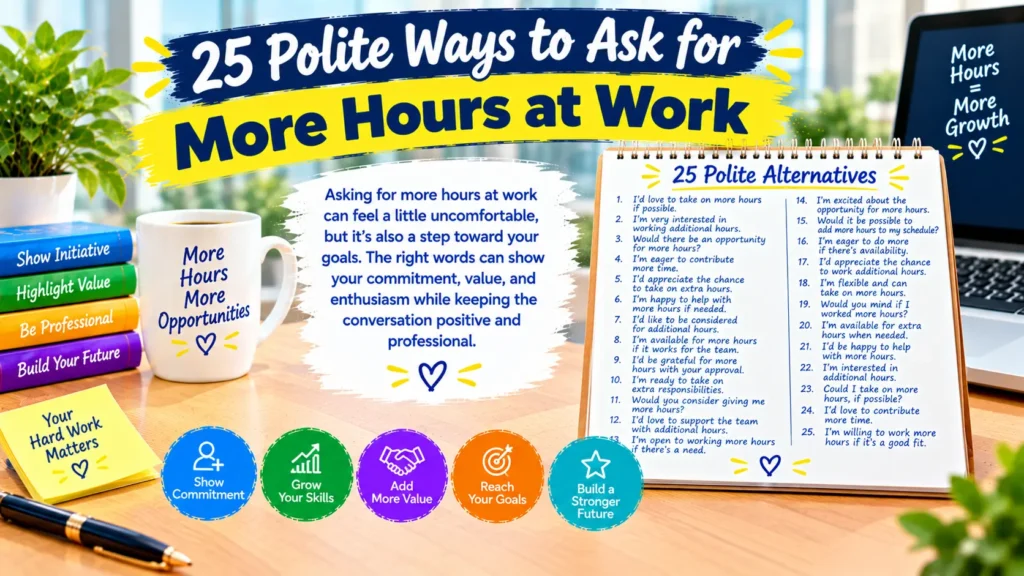
Asking your boss for more hours at work can feel uncomfortable, especially when you want to earn more, take on extra responsibilities, or show that you are ready to contribute. The key is to make your request politely, clearly, and professionally.
There are many polite ways to ask your boss for more hours at work without sounding demanding or putting pressure on your manager. You can ask during a one-on-one meeting, send a professional email, or bring it up in a casual workplace conversation.
The best approach shows that you are willing to help, respects your manager’s scheduling decisions, and explains your availability. Whether you work part-time, have a flexible schedule, or want additional shifts, the right words can make your request easier to understand.
In this guide, you will find 25 professional, formal, friendly, and email-ready alternatives, along with practical examples, complete email templates, common mistakes, and answers to frequently asked questions.
What Does It Mean to Ask Your Boss for More Hours?
Asking your boss for more hours means expressing your interest in working additional hours, accepting extra shifts, or increasing your regular weekly schedule.
The request may relate to your financial needs, career goals, workload, or availability. For example, a part-time employee might want to work 30 hours instead of 20, while a shift worker might want to cover additional evening or weekend shifts.
Literal meaning
The phrase means asking your manager or supervisor to schedule you for more working hours than you currently have.
Example: “Would it be possible for me to work a few more hours each week?”
Tone and purpose
The tone depends on how you phrase your request. A direct question can sound professional, while a demanding statement may sound pushy.
Your main goals should be to:
- Express your interest in additional work.
- Explain your availability clearly.
- Show that you are willing to support the team.
- Ask whether more hours are available.
- Respect staffing needs and company policies.
Emotional context
You may need more hours to increase your income, build experience, or make better use of your availability. You might also want to show your boss that you are dependable and interested in growing with the company.
You do not need to share personal financial details unless you feel comfortable doing so. A simple, respectful request is often enough to start the conversation.
For example:
“I’m enjoying my role and would appreciate the opportunity to work additional hours if any are available.”
This wording communicates interest without creating pressure.
When Is It Appropriate to Ask Your Boss for More Hours?
Timing and context can influence how your request is received. Choose a moment when your manager can consider your availability and staffing needs.
1. In a professional email
Email works well when you want to make a clear request, document your availability, or ask about future scheduling.
Example: “I wanted to ask whether there may be opportunities for me to increase my weekly hours.”
2. During a workplace conversation
A brief conversation is useful when you have a good relationship with your supervisor or regularly discuss your schedule.
Example: “If any extra shifts become available, I’d be happy to take them.”
3. When the team needs additional support
If your department has a busy period or coworkers need shift coverage, you can offer to help. Focus on the team’s needs rather than assuming extra hours are guaranteed.
Example: “I noticed the team has been busy lately. I’d be available to help with additional hours if needed.”
4. During a performance or scheduling review
A scheduled meeting gives you time to discuss your availability, performance, and interest in a larger role.
Example: “I’d like to discuss whether there is an opportunity to increase my regular working hours.”
5. When your availability changes
If your studies, family commitments, or other responsibilities leave you with more free time, tell your manager when you can work.
Example: “My availability has recently increased, and I’d be interested in taking on more hours.”
25 Polite Ways to Ask Your Boss for More Hours at Work
The following alternatives cover professional emails, formal requests, friendly conversations, and workplace scheduling discussions. Choose the phrase that fits your relationship with your manager and the reason you want additional hours.
Professional Ways to Ask for More Hours
These phrases work well for regular workplace communication, scheduling discussions, and conversations with your supervisor.
1. “Would it be possible for me to work more hours?”
Tone: Professional, polite, and respectful.
Best use: When you want to ask directly without sounding demanding.
Example: “Would it be possible for me to work more hours next week? I’m available on Tuesday and Thursday.”
This is one of the safest options because it makes your request clear while leaving the decision to your manager.
2. “I’d be interested in taking on additional hours.”
Tone: Confident and professional.
Best use: When you want to show initiative and a willingness to contribute more.
Example: “I’d be interested in taking on additional hours if the department needs extra support.”
This phrase emphasizes your interest in helping the business rather than focusing only on your personal needs.
3. “Are there any opportunities to increase my weekly hours?”
Tone: Professional and straightforward.
Best use: When you want a more regular schedule instead of occasional extra shifts.
Example: “I’m enjoying my current role and wanted to ask whether there are any opportunities to increase my weekly hours.”
It is especially useful for part-time employees who want a more consistent workload.
4. “I’d welcome the opportunity to work additional shifts.”
Tone: Positive and proactive.
Best use: Retail, hospitality, healthcare support, and other shift-based roles.
Example: “I’d welcome the opportunity to work additional shifts during the holiday period if coverage is needed.”
This wording shows flexibility without assuming your manager can offer extra work.
5. “Please let me know if any extra hours become available.”
Tone: Courteous and practical.
Best use: When extra work may become available in the future.
Example: “My schedule is flexible next month. Please let me know if any extra hours become available.”
This is a good choice if your manager cannot increase your hours immediately.
Formal Ways to Request More Working Hours
Use these expressions when communicating with senior managers, department heads, or supervisors in a more formal workplace.
6. “I would appreciate the opportunity to increase my working hours.”
Tone: Formal and respectful.
Best use: Written requests or scheduled meetings with management.
Example: “I would appreciate the opportunity to increase my working hours, should staffing requirements allow.”
The phrase sounds considerate and professional, making it suitable for a formal email.
7. “I would like to discuss the possibility of extending my current schedule.”
Tone: Formal and diplomatic.
Best use: When you want to discuss a longer shift or a more extensive weekly schedule.
Example: “I would like to discuss the possibility of extending my current schedule from 20 to 28 hours per week.”
Mentioning your preferred schedule makes the request easier for your manager to evaluate.
8. “Could we review my current hours and discuss possible adjustments?”
Tone: Collaborative and formal.
Best use: Scheduling reviews or one-on-one meetings.
Example: “Could we review my current hours and discuss possible adjustments for the upcoming month?”
This phrase invites a discussion rather than demanding a specific outcome.
9. “I would be grateful for consideration for additional shifts.”
Tone: Respectful and formal.
Best use: When extra shifts are assigned through a supervisor or scheduling team.
Example: “I would be grateful for consideration for additional shifts during periods of high demand.”
Use this when you want to sound especially courteous without becoming overly formal.
10. “I would like to explore opportunities to expand my working hours.”
Tone: Formal and forward-looking.
Best use: When seeking a longer-term change to your work schedule.
Example: “I would like to explore opportunities to expand my working hours and contribute more consistently to the team.”
This option works well when you want to show that you are thinking about your future with the organization.
Friendly Ways to Ask Your Boss for More Hours
These phrases are ideal when you have a comfortable working relationship with your manager.
11. “I’d be happy to pick up some extra hours if needed.”
Tone: Friendly and helpful.
Best use: Informal workplace conversations or team scheduling messages.
Example: “I’d be happy to pick up some extra hours this weekend if anyone needs coverage.”
It sounds natural and offers help without putting pressure on your boss.
12. “Do you think there might be any extra shifts available?”
Tone: Casual and polite.
Best use: When asking about upcoming shifts.
Example: “Do you think there might be any extra shifts available next week? I’m free most afternoons.”
This is a friendly way to start the conversation without making the request sound too formal.
13. “I’d love to help out with more hours.”
Tone: Warm and enthusiastic.
Best use: When your team is busy or your manager needs additional support.
Example: “I’d love to help out with more hours during the busy season if you need an extra pair of hands.”
This expression works best when your enthusiasm is genuine and the workplace has a relaxed communication style.
14. “If you need someone to cover extra shifts, I’m available.”
Tone: Helpful and direct.
Best use: Shift coverage, staff absences, and last-minute scheduling needs.
Example: “If you need someone to cover extra shifts next week, I’m available on Wednesday and Friday.”
Specific availability makes it easier for your manager to match you with open shifts.
15. “I’d be glad to work a few more hours each week.”
Tone: Friendly and positive.
Best use: When you want a small increase in your regular schedule.
Example: “I’d be glad to work a few more hours each week if that fits the team’s schedule.”
This wording is approachable and clear, particularly when speaking with a manager you know well.
Email Phrases to Ask Your Boss for More Hours
Use these expressions when you want to make a written request that is clear, respectful, and easy to respond to.
16. “I’m writing to ask whether additional hours may be available.”
Tone: Professional and neutral.
Best use: A first email to your manager about increasing your hours.
Example: “I’m writing to ask whether additional hours may be available over the next few weeks.”
It establishes the purpose of your email immediately.
17. “I wanted to check whether there is room to increase my scheduled hours.”
Tone: Polite and conversational.
Best use: Following up about your existing schedule.
Example: “I wanted to check whether there is room to increase my scheduled hours from 24 to 30 per week.”
This is a natural choice when you want a schedule adjustment without sounding overly formal.
18. “Please consider me for any additional hours that become available.”
Tone: Courteous and direct.
Best use: When your manager assigns extra shifts as they arise.
Example: “Please consider me for any additional hours that become available in the coming weeks.”
The phrase keeps the door open even if no hours are available right now.
19. “I have some additional availability and would be interested in working more.”
Tone: Professional and practical.
Best use: When your personal schedule has changed.
Example: “I have some additional availability on weekday evenings and would be interested in working more if the team needs support.”
This approach is effective because it gives your boss a practical reason to consider you for extra shifts.
20. “Could we discuss options for increasing my hours?”
Tone: Respectful and collaborative.
Best use: When the change may require a longer conversation.
Example: “Could we discuss options for increasing my hours at our next check-in? I’d appreciate the chance to review my availability.”
This phrase is useful when you want to explore different options rather than request a single fixed schedule.
Workplace Phrases for Requesting Additional Hours
These expressions work particularly well when you want to connect your request to team needs, responsibilities, or career development.
21. “I’m available to support the team with additional hours.”
Tone: Team-focused and professional.
Best use: Busy periods, deadlines, or temporary staffing shortages.
Example: “I’m available to support the team with additional hours during the upcoming project.”
This wording highlights your willingness to help the team meet its goals.
22. “I’d be interested in taking on more responsibilities and hours.”
Tone: Ambitious and constructive.
Best use: When you want more hours as well as opportunities to grow.
Example: “I’d be interested in taking on more responsibilities and hours if there is an opportunity to support another part of the department.”
It communicates interest in professional growth rather than simply working longer.
23. “Is there an opportunity for me to move to a longer weekly schedule?”
Tone: Clear and professional.
Best use: When you want a permanent increase in contracted or scheduled hours.
Example: “Is there an opportunity for me to move to a longer weekly schedule, perhaps from 25 to 32 hours?”
Use this wording when you are seeking a lasting change rather than occasional overtime.
24. “I’d be happy to help cover any staffing gaps.”
Tone: Cooperative and solution-focused.
Best use: When the team is short-staffed or colleagues need coverage.
Example: “I’d be happy to help cover any staffing gaps next month. I’m available on weekends and two evenings each week.”
This phrase connects your request to an immediate workplace need.
25. “Could you keep me in mind if more hours open up?”
Tone: Friendly, polite, and low-pressure.
Best use: When your manager has no extra hours to offer at present.
Example: “I understand that the schedule is full right now. Could you keep me in mind if more hours open up?”
It ends the conversation positively and leaves room for future opportunities.
Quick Comparison Table
Use this table to choose the best synonym or alternative based on your situation.
| Alternative | Tone | Best Use |
|---|---|---|
| Would it be possible for me to work more hours? | Professional | General request |
| I’d be interested in taking on additional hours. | Confident | Showing initiative |
| Are there any opportunities to increase my weekly hours? | Direct | Regular schedule increase |
| I’d welcome the opportunity to work additional shifts. | Positive | Shift-based jobs |
| Please let me know if any extra hours become available. | Courteous | Future opportunities |
| I would appreciate the opportunity to increase my working hours. | Formal | Formal email |
| Could we review my current hours? | Collaborative | Scheduling meeting |
| I’d be happy to pick up some extra hours. | Friendly | Casual conversation |
| I’m writing to ask whether additional hours may be available. | Professional | First email |
| I have some additional availability. | Practical | Availability change |
| I’m available to support the team with additional hours. | Team-focused | Busy periods |
| Could you keep me in mind if more hours open up? | Low-pressure | No immediate vacancies |
6 Email Examples: How to Ask Your Boss for More Hours
A well-written email should explain why you are writing, state your request, and make your availability clear. Keep it brief enough for your manager to read quickly.
Email 1: Asking Your Manager for More Hours
Hi [Manager’s Name],
I hope you’re doing well. I wanted to ask whether there may be an opportunity for me to increase my weekly working hours.
I’m enjoying my role and would welcome the chance to contribute more to the team. I’m available on [days or times] and would be happy to discuss any options that fit the team’s schedule.
Thank you for your time and consideration.
Best regards,
[Your Name]
Why it works: The message is clear, positive, and respectful. It shows interest in additional work without assuming that more hours are available.
Email 2: Asking for More Hours Because You Need Additional Income
Hi [Manager’s Name],
I wanted to check whether any additional shifts might be available in the coming weeks. I’m hoping to increase my working hours and would appreciate the opportunity to take on more shifts if staffing needs allow.
I’m available on [days and times] and can be flexible where possible.
Thank you for considering my request.
Kind regards,
[Your Name]
Why it works: It communicates your goal without requiring you to disclose personal financial details. You can mention your financial situation if you have a comfortable relationship with your boss, but you do not need to.
Email 3: Asking for More Hours at a Part-Time Job
Hi [Manager’s Name],
I’m writing to ask whether there might be an opportunity to increase my weekly hours from [current hours] to [preferred hours].
I have additional availability and would be glad to support the team where needed. Please let me know if we could discuss the available options.
Thank you for your consideration.
Best,
[Your Name]
Why it works: Specific numbers help your manager understand exactly what you want. They can assess the request against staffing needs and any applicable scheduling rules.
Email 4: Asking for Extra Hours During a Busy Period
Hi [Manager’s Name],
I know the team has a busy period coming up, so I wanted to let you know that I’m available to help with additional hours if needed.
I’m available on [days and times] and would be happy to cover extra shifts where possible.
Please keep me in mind when preparing the schedule.
Thanks,
[Your Name]
Why it works: It connects your request to the team’s workload and gives your manager a practical reason to consider you.
Email 5: Asking for More Hours During a Meeting Follow-Up
Hi [Manager’s Name],
Thank you for taking the time to speak with me about my schedule.
As discussed, I’d be interested in increasing my working hours if an opportunity becomes available. My current availability is [days and times], and I’m happy to consider different shifts where possible.
Please let me know if you need any further information from me.
Best regards,
[Your Name]
Why it works: The email documents your interest after a conversation and gives your manager a clear record of your availability.
Email 6: A Short Message to Your Boss
Hi [Manager’s Name], I wanted to check whether any extra hours or shifts might be available soon. I’d be happy to take on more work, and I’m available [days/times]. Please let me know if anything opens up. Thanks!
Why it works: This short version is suitable for workplace chat or text messages when your manager normally communicates that way.
Common Mistakes to Avoid When Asking for More Hours
Even a polite request can be less effective if the wording is unclear or the timing is poor. These are the most common mistakes to avoid.
1. Sounding demanding
Avoid phrases such as:
- “You need to give me more hours.”
- “I should be getting more shifts.”
- “Why am I not getting enough hours?”
These statements may sound confrontational, even if your concern is reasonable.
Better: “I’d appreciate the opportunity to discuss whether additional hours are available.”
2. Being too vague
Simply saying, “I want more hours,” does not tell your manager how many hours you want or when you can work.
Better: “I’d be interested in increasing my weekly hours from 20 to 28, if scheduling needs allow.”
A clear request makes it easier for your boss to consider practical options.
3. Giving too much personal information
You may need extra income, but you do not have to explain your full financial situation to your manager.
Instead of focusing on personal financial pressure, you can state your request directly and professionally.
Better: “I’m hoping to increase my working hours and would appreciate consideration for any additional shifts.”
4. Choosing the wrong tone
A very formal message can feel unnatural in a casual workplace. On the other hand, overly casual wording may not suit a senior manager or a formal scheduling request.
Match your tone to your company’s communication style and your relationship with your supervisor.
5. Asking at a stressful moment
If your manager is handling an urgent issue, a long conversation about scheduling may not be appropriate.
Ask whether they have time to discuss your schedule, or send a concise email requesting a convenient meeting.
6. Assuming extra hours are guaranteed
Your boss may have limited staffing budgets, fixed contracts, or scheduling restrictions.
Instead of expecting an immediate yes, ask about availability and possible future opportunities.
7. Following up too often
Repeatedly asking the same question can make your request feel pressuring.
If your manager says they will check the schedule, allow a reasonable amount of time before following up. If they give you a specific date, use that as your guide.
Related Phrases for Asking About Work Hours
These related business email phrases can help you discuss availability, schedules, overtime, and additional responsibilities professionally.
| Related phrase | Meaning | Example |
|---|---|---|
| Request additional shifts | Ask to work more scheduled shifts | “I’d like to request additional shifts next month.” |
| Increase my weekly hours | Work more hours each week | “I’d like to increase my weekly hours if possible.” |
| Pick up extra shifts | Accept shifts beyond your usual schedule | “I’m available to pick up extra shifts this weekend.” |
| Take on additional work | Accept more tasks or responsibilities | “I’d be happy to take on additional work.” |
| Extend my availability | Make more time available for work | “I’ve extended my availability to include Friday evenings.” |
| Adjust my schedule | Change existing working times | “Could we discuss adjusting my schedule?” |
| Explore scheduling options | Consider possible schedule changes | “I’d like to explore scheduling options for next month.” |
| Cover a shift | Work a shift for someone else | “I can cover a shift on Thursday if needed.” |
| Provide extra coverage | Help ensure enough staff are available | “I can provide extra coverage during busy periods.” |
| Work overtime | Work beyond normal hours, subject to applicable rules | “I’d be interested in working overtime if it’s available.” |
| Increase my availability | Become available for more work periods | “My availability has increased since my last schedule review.” |
| Discuss my workload | Talk about the amount of work assigned | “Could we discuss my workload and schedule?” |
| Request a schedule review | Ask management to reconsider your schedule | “I’d appreciate a review of my current schedule.” |
| Be considered for open shifts | Ask to be included when shifts become available | “Please consider me for open shifts.” |
| Take on a longer shift | Work for a longer period on a particular day | “I’d be available to take on a longer shift on Monday.” |
| Move to full-time hours | Seek a full-time schedule | “I’d like to discuss moving to full-time hours.” |
| Work additional weekends | Offer to work more weekend shifts | “I can work additional weekends if required.” |
| Support peak periods | Help during the busiest business times | “I’d be happy to support peak periods with extra hours.” |
These expressions are useful when you want to avoid repeating the same request in every conversation. However, remember that some terms have specific meanings: overtime may be subject to different pay rules, and full-time hours may depend on your employer’s policies and local employment law.
Primary Phrase vs. Professional Alternatives
The best phrase depends on whether you want occasional shifts, a permanent increase in hours, or a chance to discuss your schedule.
| Phrase | Formality | Tone | Best use |
|---|---|---|---|
| Can I get more hours? | Casual | Direct | Informal workplace conversation |
| Could I work more hours? | Neutral | Polite | General request |
| Would it be possible for me to work more hours? | Professional | Respectful | Email or conversation |
| I would appreciate the opportunity to increase my hours. | Formal | Diplomatic | Formal written request |
| I’d be happy to pick up extra shifts. | Casual | Friendly | Shift-based workplace |
| Could we discuss increasing my weekly hours? | Professional | Collaborative | Schedule review |
| Please consider me for additional shifts. | Formal | Courteous | Shift allocation |
| I’m available to support the team with extra hours. | Professional | Team-focused | Busy periods |
| Could you keep me in mind if more hours open up? | Neutral | Low-pressure | Future opportunities |
| I’d like to explore a move to full-time hours. | Professional | Career-focused | Long-term schedule change |
Best overall choice: “Would it be possible for me to work more hours?” It is clear, polite, and appropriate for most workplaces.
Best formal alternative: “I would appreciate the opportunity to increase my working hours.”
Best casual alternative: “I’d be happy to pick up some extra hours if needed.”
Best email phrase: “I’m writing to ask whether additional hours may be available.”
Best option when no shifts are available: “Please keep me in mind if more hours become available.”
Cultural Usage: Asking for More Hours in Different Workplaces
Professional communication varies by country, industry, and company culture. The goal is to sound respectful while making your request easy to understand.
US English
In the United States, straightforward, friendly language often works well. Employees may ask about extra shifts, additional hours, or opportunities to increase their weekly schedule.
Examples:
- “Would it be possible to pick up a few extra shifts?”
- “I’d be interested in increasing my weekly hours.”
- “Please let me know if any additional hours become available.”
In US workplaces, the words extra shifts and pick up hours are common in retail, hospitality, and other hourly jobs. Check your employer’s policies regarding overtime, scheduling, and changes to your regular hours.
UK English
In the United Kingdom, phrases such as additional hours, extra shifts, and increase my contracted hours may be useful, depending on your employment arrangement.
Examples:
- “Would it be possible to take on some additional hours?”
- “I’d be interested in increasing my contracted hours, if possible.”
- “Please let me know if any extra shifts become available.”
Use contracted hours when you are discussing the hours specified in your employment agreement. If you simply want occasional shifts, extra hours or additional shifts is usually more suitable.
Corporate communication
In an office or corporate setting, it often helps to connect your request to your workload, project needs, or professional development.
Examples:
- “I’d welcome the opportunity to contribute additional hours to the project.”
- “Could we discuss the possibility of expanding my working schedule?”
- “I’m available to provide additional support during the upcoming deadline period.”
Avoid implying that longer hours automatically mean better performance. Focus on the work you can contribute and the value you can bring.
Customer service and shift-based roles
In retail, restaurants, hotels, and customer support, scheduling language should be specific and practical.
Examples:
- “I’m available to cover additional shifts this weekend.”
- “I’d be happy to help with evening coverage.”
- “Please consider me for any open shifts next week.”
If possible, list the days and times when you are available. This gives your manager useful information when arranging coverage.
Networking and career development
If you want more hours because you hope to grow within the organization, frame the conversation around your interest in learning and contributing.
Examples:
- “I’d welcome the chance to take on more responsibilities and increase my hours.”
- “I’m interested in supporting other projects if additional hours are available.”
- “I’d appreciate the opportunity to discuss how I could contribute more to the team.”
This approach works particularly well when you want to build a long-term professional relationship with your manager.
FAQs: Polite Ways to Ask Your Boss for More Hours
1. How do I politely ask my boss for more hours at work?
Be direct, respectful, and specific. Explain that you are interested in working more hours and share your availability.
Example: “Would it be possible for me to work more hours next week? I’m available on Tuesday, Thursday, and Friday.”
2. How do I ask my boss for more hours in an email?
Use a clear subject line, briefly state your request, and explain when you are available.
Example: “I’m writing to ask whether additional hours may be available over the next few weeks. I’d be happy to take on extra shifts and can work weekday evenings.”
End by thanking your manager for considering your request.
3. How do I ask for more hours without sounding desperate?
Keep the focus on your availability, interest in the role, and willingness to help. You do not need to share personal financial details or apologize for asking.
Example: “I’d be interested in increasing my weekly hours if there is an opportunity.”
4. Should I tell my boss that I need more money?
You can, particularly if you have a comfortable relationship with your manager, but you are not required to explain your financial situation.
A neutral alternative is: “I’m hoping to increase my working hours and would appreciate consideration for any additional shifts.”
This keeps the conversation focused on the practical request.
5. How do I ask for more hours at a part-time job?
Explain how many hours you currently work, how many you would prefer, and when you are available.
Example: “I’m currently scheduled for 18 hours a week and would like to increase that to around 25 hours if possible.”
Your manager can then assess whether the schedule can accommodate the change.
6. When is the best time to ask my boss for extra shifts?
A good time is when schedules are being prepared, the team expects a busy period, or your manager has time for a brief conversation. You can also ask when coworkers need shift coverage.
Avoid interrupting urgent work. If your manager is busy, request a convenient time to discuss your availability.
7. How do I ask my boss for more hours when I’m already part-time?
Use a phrase that focuses on increasing your regular schedule.
Example: “I’m enjoying my part-time role and wanted to ask whether there is an opportunity to increase my weekly hours.”
If possible, state your preferred schedule and the days you can work.
8. What should I say if my boss says there are no extra hours available?
Respond positively and leave the door open for future opportunities.
Example: “I understand. Thank you for letting me know. Please keep me in mind if additional hours become available.”
This shows that you respect the decision and remain interested.
9. How often should I follow up after asking for more hours?
Follow up after a reasonable interval if your manager has not given you a timeline. If they promise an update by a specific date, wait until that date has passed.
Example: “Hi [Manager’s Name], I wanted to follow up on my request about additional hours. Please let me know if there are any updates when you have a chance.”
Avoid sending repeated messages within a short period.
10. Can I ask my boss for more hours because I want to become full-time?
Yes. Explain that you are interested in a more consistent schedule and ask whether full-time opportunities exist.
Example: “I’d like to discuss the possibility of moving to full-time hours if a suitable opportunity becomes available.”
You can also ask about the requirements, expected timeline, and whether a formal application is necessary.
Final Summary
Asking your boss for more hours at work does not have to feel awkward. The best approach is to be polite, explain your availability, and show that you are willing to contribute more to the team. Choose professional phrases such as “Would it be possible for me to work more hours?” for everyday requests, or “I would appreciate the opportunity to increase my working hours” for formal emails. For casual conversations, “I’d be happy to pick up some extra shifts” sounds natural and friendly. Keep your message clear, respect scheduling limits, and remain open to future opportunities.




