
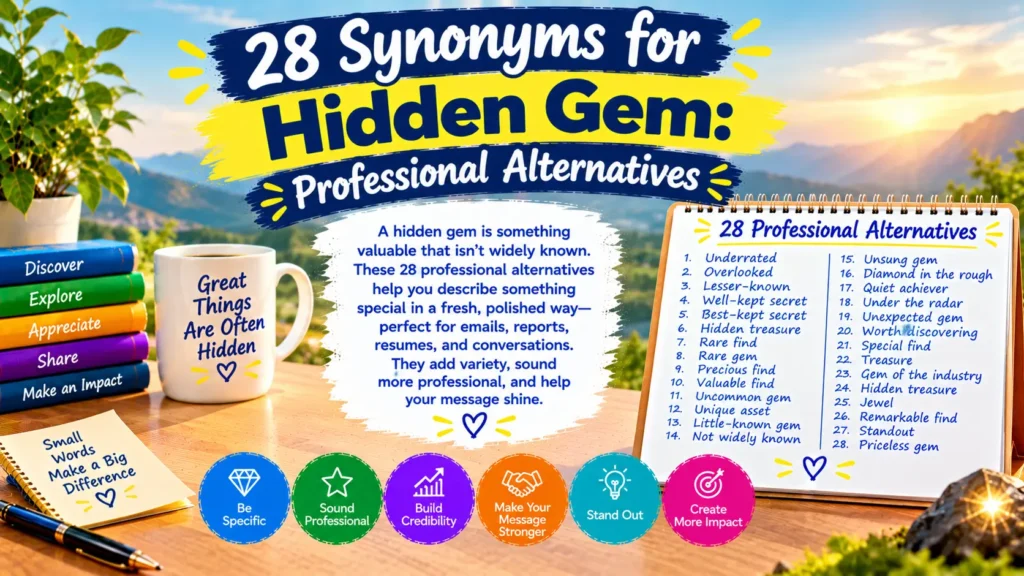
Have you ever discovered a small business, talented colleague, excellent product, or useful resource that deserves more attention? The phrase “hidden gem” describes something valuable, special, or impressive that few people know about. However, you may want to use a more professional expression in a business email, workplace conversation, client presentation, or networking message.
Finding the right synonyms for hidden gem helps you share your appreciation without sounding too casual or vague. For example, you might describe a company as an “underrated business,” a colleague as an “exceptional talent,” or a useful tool as an “underrecognized resource.”
The best alternative depends on your audience and purpose. Some expressions work well in formal reports, while others sound natural in friendly emails or conversations with clients.
In this guide, you will discover 28 alternatives to “hidden gem,” learn when to use each one, and explore practical examples for professional communication.
What Does “Hidden Gem” Mean?
A hidden gem is a person, place, product, service, or idea with special value that most people have not discovered or fully appreciated.
The phrase combines two ideas. A “gem” represents something precious or valuable, while “hidden” suggests that people have overlooked it or have not yet found it.
Literal Meaning
A gem is a precious or valuable stone. When someone calls something a hidden gem, they use the word figuratively to suggest that it has qualities worth discovering.
For example:
- “This small restaurant is a hidden gem.” The restaurant offers excellent food but may not attract much attention.
- “She is a hidden gem on our team.” The employee has valuable skills that others may overlook.
- “We found a hidden gem in this software.” The software includes a useful feature that few people know about.
Tone and Purpose
“Hidden gem” usually has a positive, warm, and enthusiastic tone. It communicates admiration and encourages others to explore something worthwhile.
However, it can sound informal in certain business settings. A more precise phrase may work better when writing a formal report, evaluating an employee, or recommending a product to a client.
Emotional Context
The expression often conveys excitement, surprise, and appreciation. It suggests that you have found something valuable and want other people to recognize its worth.
For example:
Casual: “This little agency is a hidden gem.”
Professional: “This agency is an underrecognized provider with strong expertise in its field.”
Both sentences express appreciation, but the second sounds more suitable for a formal business discussion.
When Should You Use Alternatives to “Hidden Gem”?
Choosing an appropriate synonym helps you match your message to your audience.
1. In Professional Emails
Use a clear, specific expression when recommending a service, resource, or business opportunity.
Example:
“I would recommend exploring this lesser-known provider. Its service quality and response times are excellent.”
2. In Workplace Communication
When describing a colleague, focus on their skills, contribution, or potential instead of using a vague compliment.
Example:
“Jordan is an underrecognized talent who consistently delivers excellent results.”
3. In Client Communication
Clients usually appreciate language that explains the value of a recommendation.
Example:
“This solution is an excellent option for teams looking to improve their workflow without increasing costs.”
4. In Networking
A friendly expression can help you introduce an emerging business, talented professional, or promising opportunity.
Example:
“I recently connected with an impressive independent consultant who deserves more recognition.”
5. In Customer Service
Use positive but credible language when recommending a product, service, or feature.
Example:
“This feature is one of our most valuable resources, although many customers have not discovered it yet.”
28 Synonyms for Hidden Gem: Professional and Polite Alternatives
The following alternatives cover formal business writing, workplace conversations, networking, client recommendations, and friendly messages.
Professional Alternatives
These expressions work well when you want to highlight value, quality, or potential without sounding overly casual.
1. Underrated
Tone: Professional, positive, and direct.
Best use: Describing a business, product, service, employee, or idea that deserves more recognition.
Example: “This is an underrated solution that could improve our team’s productivity.”
“Underrated” is one of the closest synonyms for hidden gem because both suggest that something has more value than people realize.
2. Underrecognized
Tone: Professional and appreciative.
Best use: Recognizing employees, experts, organizations, or achievements that receive too little attention.
Example: “She is an underrecognized contributor whose research has helped shape our strategy.”
Use this expression when the main point is that someone or something deserves greater recognition.
3. Overlooked Opportunity
Tone: Business-focused and strategic.
Best use: Presentations, planning meetings, business proposals, and market analysis.
Example: “This partnership represents an overlooked opportunity for expanding our customer base.”
This phrase emphasizes potential rather than simply describing something as special.
4. Exceptional Find
Tone: Positive and professional.
Best use: Recommending a vendor, service provider, product, or business resource.
Example: “We found an exceptional supplier that offers reliable service at competitive rates.”
Use it when you want to express enthusiasm while maintaining a professional tone.
5. Valuable Discovery
Tone: Neutral, informative, and polished.
Best use: Research, product development, business analysis, and project discussions.
Example: “The customer feedback revealed a valuable discovery that could guide our next product update.”
This alternative focuses on the importance of what you discovered.
6. Standout Performer
Tone: Professional and appreciative.
Best use: Employee recognition, performance reviews, and team discussions.
Example: “Maya has become a standout performer because of her attention to detail and consistent results.”
This phrase works especially well for people who demonstrate strong performance.
7. Promising Prospect
Tone: Professional and forward-looking.
Best use: Sales, recruiting, partnerships, and business development.
Example: “The new client appears to be a promising prospect for our enterprise services.”
Unlike “hidden gem,” this phrase emphasizes future potential rather than established value.
Formal Alternatives
These options suit reports, proposals, business presentations, and formal correspondence.
8. Underappreciated Asset
Tone: Formal and analytical.
Best use: Describing an employee, department, resource, or business capability.
Example: “The customer support team is an underappreciated asset that contributes directly to client retention.”
This phrase is particularly effective when discussing resources that provide value but receive limited attention.
9. Undiscovered Talent
Tone: Formal, encouraging, and people-focused.
Best use: Recruitment, mentoring, employee development, and professional recommendations.
Example: “The program helps organizations identify undiscovered talent in emerging markets.”
Use this expression when discussing ability that has not yet received sufficient attention.
10. Unrecognized Potential
Tone: Formal and thoughtful.
Best use: Strategic planning, performance discussions, and development opportunities.
Example: “The proposal highlights the unrecognized potential of our existing customer data.”
This phrase focuses on what something could achieve rather than what it has already accomplished.
11. Distinctive Offering
Tone: Formal and business-oriented.
Best use: Product descriptions, sales proposals, and service recommendations.
Example: “The company provides a distinctive offering for small businesses seeking affordable automation.”
Choose this phrase when a product or service stands out from competing options.
12. Valuable Asset
Tone: Formal, neutral, and confident.
Best use: Business reports, project reviews, and organizational discussions.
Example: “Her expertise in customer research has made her a valuable asset to the organization.”
This expression works well when you want to emphasize measurable or practical value.
13. Notable Discovery
Tone: Formal and informative.
Best use: Research reports, professional presentations, and project updates.
Example: “The team made a notable discovery that may reduce processing time.”
Use it when a discovery deserves attention because of its importance or potential impact.
14. Hidden Opportunity
Tone: Strategic and professional.
Best use: Business development, marketing, sales, and planning.
Example: “The customer survey revealed a hidden opportunity to improve our subscription service.”
This phrase is particularly useful when the value lies in an opportunity that people have not yet recognized.
Friendly Alternatives
Use these expressions when you want to sound natural, warm, and approachable.
15. Little-Known Treasure
Tone: Warm, enthusiastic, and informal.
Best use: Recommending a local business, useful website, book, or service.
Example: “This little-known treasure offers some of the most practical resources for new entrepreneurs.”
It preserves the sense of discovery that makes “hidden gem” appealing.
16. A Real Find
Tone: Friendly and conversational.
Best use: Informal work chats, networking messages, and recommendations.
Example: “Your new graphic designer sounds like a real find for the team.”
This is a natural alternative when you want to praise something without sounding too formal.
17. A Pleasant Surprise
Tone: Friendly and positive.
Best use: Describing an unexpectedly good experience, service, or result.
Example: “The new reporting tool was a pleasant surprise because it made our weekly reviews much easier.”
Use this expression when the discovery exceeded your expectations.
18. A Rare Find
Tone: Appreciative and conversational.
Best use: Describing an excellent service provider, employee, or resource.
Example: “A consultant with this level of experience and flexibility is a rare find.”
It emphasizes that something has qualities that are difficult to find elsewhere.
19. A Hidden Treasure
Tone: Warm and expressive.
Best use: Friendly recommendations, informal presentations, and community discussions.
Example: “This independent bookstore is a hidden treasure for readers looking for unusual titles.”
This expression is close in meaning to “hidden gem,” so it is best for situations where a friendly tone is appropriate.
Email-Friendly Alternatives
These expressions are useful when writing recommendations, sharing discoveries, or explaining why something deserves attention.
20. Worth Exploring
Tone: Polite, measured, and professional.
Best use: Suggesting a product, business, idea, or resource without making an exaggerated claim.
Example: “I believe this platform is worth exploring because it offers several features that match our needs.”
This phrase is excellent when you want to encourage someone to investigate an option.
21. Worth Considering
Tone: Professional, balanced, and diplomatic.
Best use: Client emails, business proposals, and decision-making discussions.
Example: “This supplier is worth considering given its competitive pricing and strong service record.”
It communicates potential value without suggesting that the option is automatically the best choice.
22. A Valuable Resource
Tone: Professional and informative.
Best use: Sharing tools, research, contacts, training materials, or reference documents.
Example: “I found a valuable resource that may help us prepare for the upcoming client presentation.”
This is one of the safest alternatives for business email phrases.
23. An Excellent Option
Tone: Positive and straightforward.
Best use: Recommending products, services, vendors, or possible solutions.
Example: “The revised plan is an excellent option for meeting our goals within the current budget.”
Choose it when you want to focus on suitability rather than obscurity.
24. An Underrated Resource
Tone: Professional and appreciative.
Best use: Internal tools, reference materials, training platforms, and workplace systems.
Example: “Our internal knowledge base is an underrated resource for resolving common customer issues.”
It works particularly well when people already have access to something useful but rarely use it.
Workplace and Networking Alternatives
These phrases help you recognize talent, highlight promising ideas, and introduce useful connections.
25. Emerging Talent
Tone: Professional and encouraging.
Best use: Recruitment, mentoring, career development, and networking.
Example: “The conference provides an opportunity to connect with emerging talent in the technology sector.”
Use it for people whose skills are developing or beginning to attract attention.
26. Unsung Hero
Tone: Appreciative and human-centered.
Best use: Team recognition, employee appreciation, and workplace celebrations.
Example: “Our operations coordinator is an unsung hero who keeps every project organized.”
This phrase emphasizes contributions that often go unnoticed.
27. Untapped Potential
Tone: Strategic and forward-looking.
Best use: Business planning, employee development, marketing, and innovation.
Example: “We believe the regional market has untapped potential for our premium services.”
Use it when a person, resource, or market could deliver more value than it currently does.
28. A Promising Opportunity
Tone: Professional and optimistic.
Best use: Networking, partnerships, business proposals, and project discussions.
Example: “The proposed collaboration presents a promising opportunity to reach a broader audience.”
This phrase is suitable when you want to highlight the potential value of a new possibility.
Quick Comparison Table
| Alternative | Tone | Best Use |
|---|---|---|
| Underrated | Professional | Products and businesses |
| Underrecognized | Appreciative | People and achievements |
| Overlooked opportunity | Strategic | Business planning |
| Exceptional find | Positive | Vendor recommendations |
| Valuable discovery | Informative | Research and projects |
| Standout performer | Professional | Employee recognition |
| Promising prospect | Business-focused | Sales and recruitment |
| Underappreciated asset | Formal | Reports and evaluations |
| Undiscovered talent | Encouraging | Recruitment and mentoring |
| Unrecognized potential | Analytical | Strategy and development |
| Distinctive offering | Formal | Products and services |
| Valuable asset | Formal | Workplace discussions |
| Notable discovery | Formal | Research and presentations |
| Hidden opportunity | Strategic | Business development |
| Little-known treasure | Friendly | Informal recommendations |
| A real find | Casual | Work chats |
| A pleasant surprise | Friendly | Unexpected successes |
| A rare find | Appreciative | People and services |
| A hidden treasure | Warm | Personal recommendations |
| Worth exploring | Polite | Emails and suggestions |
| Worth considering | Diplomatic | Decisions and proposals |
| A valuable resource | Professional | Tools and information |
| An excellent option | Direct | Recommendations |
| An underrated resource | Professional | Workplace tools |
| Emerging talent | Encouraging | Networking and recruitment |
| Unsung hero | Appreciative | Team recognition |
| Untapped potential | Strategic | Growth opportunities |
| A promising opportunity | Optimistic | Partnerships and planning |
Email Examples: How to Use Alternatives Naturally
Here are six practical examples you can adapt for professional communication.
1. Email to a Client
Subject: A Resource Worth Exploring
Hi Alex,
I wanted to share a resource that may be useful for your team. This platform offers several features that align with the goals we discussed, and I believe it is worth exploring.
Please let me know if you would like a brief overview of its main benefits.
Best regards,
Taylor
Why it works: “Worth exploring” encourages the client to consider the option without putting pressure on them.
2. Email to Your Manager
Subject: A Potential Improvement Opportunity
Hi Morgan,
During my review of our current workflow, I identified an overlooked opportunity to simplify our reporting process. The proposed change could reduce manual work and improve consistency.
I would be happy to share the details at our next meeting.
Best,
Jordan
Why it works: “Overlooked opportunity” sounds analytical and connects the discovery to a business benefit.
3. Email to a Colleague
Subject: A Useful Resource for the Project
Hi Sam,
I found a valuable resource that could help us prepare for the next project phase. It includes practical examples and guidance that may save us some time.
I have included the link below for you to review.
Thanks,
Chris
Why it works: “Valuable resource” explains the item’s usefulness without relying on casual praise.
4. Email to a Customer
Subject: Recommended Solution for Your Needs
Hello Jamie,
Based on your requirements, I believe this plan is an excellent option. It offers the main features you need while keeping the process straightforward.
Please feel free to contact me if you would like more information.
Kind regards,
Customer Support Team
Why it works: “Excellent option” sounds clear, helpful, and customer-focused.
5. Networking Email
Subject: An Introduction to a Promising Professional
Hi Riley,
I recently met a consultant whose experience in digital strategy impressed me. They are an underrecognized professional with practical insights that could be valuable to teams in our industry.
I thought an introduction might be useful, if you are open to connecting.
Best regards,
Casey
Why it works: “Underrecognized professional” conveys appreciation while keeping the message business-appropriate.
6. Meeting Follow-Up Email
Subject: Follow-Up on Our Discussion
Hi Team,
Thank you for the productive discussion today. We identified a promising opportunity to improve the customer onboarding process.
I will summarize the proposed next steps and share them with everyone by Friday.
Best,
Morgan
Why it works: “Promising opportunity” keeps the focus on the team’s next steps rather than simply expressing excitement.
Common Mistakes to Avoid
Even a good synonym can sound awkward if you use it in the wrong context. Keep these common mistakes in mind.
1. Overusing the Same Expression
Repeating “hidden gem,” “rare find,” and “hidden treasure” throughout a report can make your writing feel repetitive.
Better approach: Choose words that explain the specific value.
Instead of: “This is a hidden gem. It is a hidden gem for our team and a hidden gem for customers.”
Write: “This tool offers valuable features for our team and a practical solution for customers.”
2. Using Casual Language in Formal Reports
Expressions such as “a real find” or “little-known treasure” can sound too informal in executive reports.
Better approach: Use “underappreciated asset,” “valuable resource,” or “notable discovery.”
3. Making Unsupported Claims
Calling a product “the best-kept secret in the industry” can sound exaggerated if you cannot support the claim.
Better approach: Explain what makes it valuable.
For example: “This platform offers reliable reporting tools at a competitive price.”
4. Confusing Value With Potential
“Underrated” describes something that people do not appreciate enough. “Untapped potential” describes value that has not yet been fully realized.
Better approach: Choose the phrase that matches your point.
- Use “underrated” for proven quality.
- Use “untapped potential” for future possibilities.
5. Ignoring the Audience
A friendly recommendation may work well with a close colleague but sound vague to a client who needs evidence.
Better approach: Pair the phrase with a reason, benefit, or example.
6. Forgetting Email Etiquette
A recommendation should not make the recipient feel that they must agree with your opinion.
Instead of: “This is a hidden gem, and you need to use it.”
Write: “This resource may be worth considering based on your team’s current needs.”
This wording respects the recipient’s judgment and supports professional communication.
Related Phrases: 18 Expressions With Meanings and Examples
These related expressions can help you expand your vocabulary and choose the right wording for different situations.
- Best-kept secret — Something valuable that few people know about.
Example: “The company’s training program is one of the industry’s best-kept secrets.” - Sleeper hit — Something that becomes unexpectedly successful.
Example: “The new product became a sleeper hit among small businesses.” - Diamond in the rough — A person or thing with strong potential that needs development or refinement.
Example: “The candidate is a diamond in the rough with excellent technical instincts.” - Hidden strength — An ability or advantage that others may not notice.
Example: “Customer research is one of our team’s hidden strengths.” - Untapped resource — Something useful that people have not fully used.
Example: “Our existing customer database is an untapped resource.” - Under-the-radar success — An achievement that has received little public attention.
Example: “The regional campaign was an under-the-radar success.” - Unsung contributor — Someone whose work deserves more recognition.
Example: “She is an unsung contributor to the team’s success.” - Valuable insight — Information that helps people understand or decide something.
Example: “The survey provided valuable insight into customer preferences.” - Standout feature — A quality that makes something particularly impressive.
Example: “The platform’s standout feature is its automated reporting.” - Rare opportunity — A chance that does not arise often.
Example: “The partnership presents a rare opportunity to enter a new market.” - Unexpected benefit — A useful result that was not anticipated.
Example: “The new process delivered the unexpected benefit of faster approvals.” - Promising newcomer — A new person or organization with strong potential.
Example: “The startup is a promising newcomer in the renewable energy sector.” - Valuable connection — A relationship that provides useful knowledge or opportunities.
Example: “The event helped us establish a valuable connection with an industry expert.” - Niche specialist — Someone who has expertise in a focused area.
Example: “We hired a niche specialist to improve our cybersecurity strategy.” - Breakthrough idea — An idea that offers a major improvement or new direction.
Example: “The team developed a breakthrough idea for simplifying onboarding.” - Competitive advantage — A quality that helps a business perform better than competitors.
Example: “Our responsive customer support gives us a competitive advantage.” - Worth a closer look — Something that deserves further investigation.
Example: “The proposal is worth a closer look before we finalize the budget.” - A welcome discovery — Something useful or positive that you did not expect to find.
Example: “The new integration was a welcome discovery during testing.”
“Hidden Gem” vs. Its Alternatives: Which Phrase Is Best?
Although many alternatives share the same general meaning, they do not always communicate the same message.
| Phrase | Formality | Main Meaning | Best Context |
|---|---|---|---|
| Hidden gem | Casual to neutral | Valuable but little-known | General recommendations |
| Underrated | Neutral to professional | Not appreciated enough | Reviews and evaluations |
| Underrecognized | Professional | Not given enough recognition | Employee recognition |
| Valuable resource | Professional | Useful and beneficial | Emails and reports |
| Overlooked opportunity | Professional | A possibility people have missed | Strategy and planning |
| Exceptional find | Neutral to professional | An unusually good discovery | Vendor or product recommendations |
| Untapped potential | Professional | Capacity for future growth | Business development |
| Rare find | Casual to neutral | Unusually difficult to find | People and services |
| Worth considering | Professional | Deserves evaluation | Proposals and decisions |
| Standout performer | Professional | Someone who performs especially well | Workplace discussions |
Which Synonym Is Closest to “Hidden Gem”?
“Underrated” is often the closest professional alternative. Both phrases suggest that something deserves more attention or appreciation than it currently receives.
However, “underrated” does not always imply that something is unknown. It can describe a popular product that people still undervalue.
Which Alternative Sounds Most Formal?
“Underappreciated asset,” “notable discovery,” and “valuable asset” suit formal business writing. Choose the phrase based on whether you are discussing a person, resource, or discovery.
Which Alternative Is Best for Emails?
“Worth exploring,” “worth considering,” and “a valuable resource” are particularly useful because they sound polite, practical, and natural in business email phrases.
Which Alternative Is Best for Describing a Person?
Use “underrecognized talent,” “standout performer,” “emerging talent,” or “unsung hero.” Each phrase highlights a different quality, from overlooked skill to consistent contribution.
Cultural Usage: How “Hidden Gem” Sounds in Different Settings
US English
In American English, “hidden gem” is common in reviews, recommendations, travel writing, and everyday conversation. It also appears in business discussions, especially when people describe startups, tools, or emerging professionals.
For a formal US business email, “underrated,” “valuable resource,” or “worth considering” may communicate the point more directly.
UK English
British English speakers also use “hidden gem” in travel, hospitality, reviews, and casual recommendations. Expressions such as “a real find” can sound natural in conversational British English.
In formal correspondence, “a valuable resource” or “an overlooked opportunity” often provides a more precise alternative.
Corporate Communication
In corporate settings, clear evidence matters more than colorful wording. A manager may respond better to a statement about measurable value than to an unsupported claim that something is a hidden gem.
For example:
Less precise: “This software is a hidden gem.”
More precise: “This software offers useful automation features that could reduce manual reporting.”
Customer Service
Customer service teams should focus on the customer’s needs rather than using language that sounds like a sales pitch.
For example:
“Based on your requirements, this plan may be worth considering because it includes the features you requested.”
This approach is helpful, respectful, and informative.
Networking
Networking messages benefit from warmth and specific praise. “Underrecognized expert,” “promising professional,” and “valuable connection” can help you introduce someone without exaggerating their achievements.
For example:
“I recently met an underrecognized expert in supply chain planning whose insights may be useful for your team.”
The strongest wording describes why the connection matters.
Frequently Asked Questions
1. What is another word for “hidden gem”?
“Underrated” is one of the closest alternatives. Other options include “rare find,” “valuable discovery,” “underrecognized asset,” and “little-known treasure.” The best choice depends on the context.
2. What is a professional way to say “hidden gem”?
Use “underrated,” “underrecognized,” “valuable resource,” or “overlooked opportunity.” For example, “This is an underrated solution with strong potential to improve our workflow.”
3. What is a formal alternative to “hidden gem”?
“Underappreciated asset,” “notable discovery,” and “valuable asset” are suitable formal alternatives. Use “underappreciated asset” when discussing a resource or person whose value deserves greater recognition.
4. What is a synonym for hidden gem when describing a person?
“Undiscovered talent,” “underrecognized professional,” “standout performer,” and “unsung hero” work well. Choose “standout performer” for proven results and “undiscovered talent” for ability that has not received much attention.
5. How do you describe a hidden gem in a business email?
Explain the value and why the recipient should care. For example: “I found a valuable resource that could help us streamline the reporting process.”
6. Is “hidden gem” professional?
Yes, in many contexts. It can sound natural in friendly business conversations and informal recommendations. For formal reports or client proposals, more specific expressions such as “valuable resource” or “overlooked opportunity” may work better.
7. What is a better word than “hidden gem” for a business?
Consider “underrated business,” “promising company,” “underrecognized provider,” or “exceptional find.” Use “promising company” when emphasizing future growth and “underrated business” when highlighting quality that deserves more recognition.
8. What is another way to say “hidden gem” in a review?
You could write “a rare find,” “an unexpected discovery,” “a little-known treasure,” or “an underrated option.” For a professional review, explain what makes the product or service valuable.
9. What is the difference between “hidden gem” and “underrated”?
A “hidden gem” is valuable but not widely known or discovered. “Underrated” means people do not appreciate something as much as they should. Something can be well-known and still be underrated.
10. Can I use “hidden gem” on LinkedIn?
Yes. It can work in a friendly LinkedIn post about a business, resource, or professional discovery. For a more polished tone, consider “underrecognized talent,” “valuable resource,” or “promising opportunity,” and explain why the subject deserves attention.
Final Summary: Choosing the Best Synonym for Hidden Gem
The best synonym for “hidden gem” depends on what you want to communicate and who will read your message. For professional communication, “underrated,” “underrecognized,” and “valuable resource” are strong choices. For formal reports, use “underappreciated asset” or “notable discovery.” For friendly conversations, “a real find” and “little-known treasure” sound natural. In business emails, “worth exploring” and “worth considering” help you recommend an option without putting pressure on the recipient.
Ultimately, clear and specific language creates stronger communication. Explain what makes the person, product, or opportunity valuable, and choose a phrase that fits the situation. This approach makes your recommendations more credible, useful, and memorable.




