
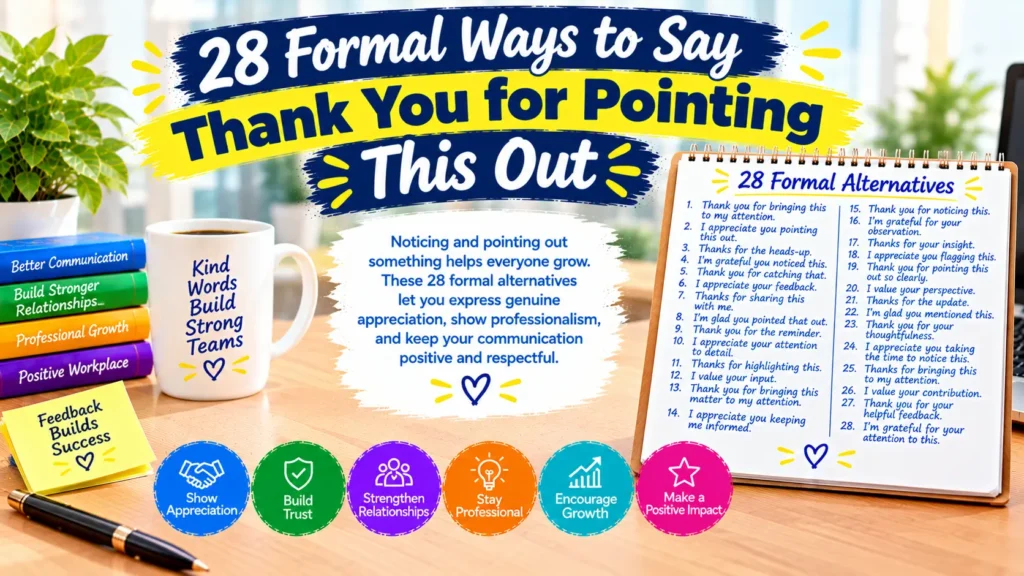
Knowing how to say thank you for pointing this out in a professional way can help you build stronger workplace relationships. Whether a colleague corrects a mistake, a manager highlights an issue, or a client brings an important detail to your attention, the right response shows that you value their input.
The phrase “thank you for pointing this out” is polite, professional, and easy to understand. However, using it repeatedly in business emails can make your communication sound predictable. Choosing a suitable alternative helps you express appreciation, acknowledge feedback, and respond with confidence.
In this guide, you will discover 28 formal ways to say thank you for pointing this out, along with professional synonyms, email examples, and practical advice. These expressions work well in emails, meetings, customer service, client communication, and everyday workplace conversations.
What Does “Thank You for Pointing This Out” Mean?
“Thank you for pointing this out” means you appreciate someone for bringing something important to your attention. They may have identified an error, shared useful information, raised a concern, or noticed a detail you missed.
The phrase combines gratitude with acknowledgment. It shows that you recognize the other person’s contribution and appreciate their effort.
Literal Meaning
- Thank you: You express appreciation for someone’s help or input.
- Pointing this out: You acknowledge that the person identified or highlighted something important.
For example:
“Thank you for pointing this out. I noticed that the report included an incorrect figure, and I will correct it today.”
This response thanks the person, confirms that you understand the issue, and explains what you will do next.
Tone and Purpose
The phrase usually sounds polite, professional, and respectful. You can use it when someone:
- Identifies an error in your work.
- Highlights a missing detail.
- Shares information you did not know.
- Provides constructive feedback.
- Raises a concern before it becomes a larger problem.
- Suggests an improvement to a process or project.
Emotional Context
This expression can also help you respond positively to feedback. Instead of becoming defensive, you show that you are willing to listen and learn.
For instance:
“Thank you for bringing this to my attention. I appreciate your help in making sure we get everything right.”
This response communicates gratitude while supporting a culture of teamwork and continuous improvement.
When Should You Use This Phrase in Professional Communication?
The best expression depends on your relationship with the recipient, the seriousness of the issue, and the purpose of your message.
1. In Professional Emails
Use the phrase when someone identifies an error, shares an important update, or gives you information that affects your work.
Example:
“Thank you for highlighting this in your email. I will review the details and update the document accordingly.”
This response sounds professional and explains the next step.
2. In Workplace Conversations
When a colleague notices something you missed, a simple acknowledgment can maintain a positive working relationship.
Example:
“Good catch. Thanks for bringing that to my attention.”
This option works well in everyday conversations and team discussions.
3. In Client Communication
Clients appreciate responses that show you take their concerns seriously. Choose wording that acknowledges their input without sounding defensive.
Example:
“Thank you for bringing this matter to our attention. We will review it and follow up with an update.”
This works well when a client identifies a problem, requests a correction, or highlights a service issue.
4. When Responding to Your Manager
When your manager highlights an issue, use a respectful response that shows accountability.
Example:
“Thank you for highlighting this. I will review the issue and make the necessary adjustments.”
This wording acknowledges the feedback without adding unnecessary explanations.
5. In Networking and Professional Relationships
When someone shares useful advice, an industry insight, or a detail that improves your understanding, express appreciation warmly.
Example:
“Thank you for sharing that perspective. It gives me a clearer understanding of the situation.”
This response helps build trust and encourages further discussion.
6. In Customer Service
When a customer points out a problem, thank them for helping you identify it. If appropriate, explain how you will address it.
Example:
“Thank you for bringing this issue to our attention. We appreciate the opportunity to review it and improve your experience.”
Avoid thanking customers without addressing the concern they raised.
28 Formal Ways to Say Thank You for Pointing This Out
Below are 28 professional alternatives grouped by tone and purpose. Each option includes its meaning, best use case, and an example you can adapt to your own communication.
Professional Alternatives
These expressions work well in business emails, meetings, reports, and everyday workplace communication.
1. Thank You for Bringing This to My Attention
Tone: Professional and respectful.
Best use: When someone identifies an issue, mistake, or important detail.
Example:
“Thank you for bringing this to my attention. I will review the figures and correct any errors.”
This is one of the best general alternatives because it acknowledges the person’s input without sounding overly formal.
2. Thank You for Highlighting This
Tone: Clear and professional.
Best use: When someone emphasizes a concern, key detail, or area that needs attention.
Example:
“Thank you for highlighting this. I will make sure we address it before the final submission.”
Choose this expression when you want to show that you recognize the importance of the information.
3. I Appreciate You Bringing This Up
Tone: Professional and approachable.
Best use: Team discussions, workplace meetings, and collaborative projects.
Example:
“I appreciate you bringing this up during the meeting. We should consider it before making a final decision.”
This phrase works especially well when someone raises a concern or introduces a useful idea.
4. Thank You for Drawing My Attention to This
Tone: Polished and slightly formal.
Best use: Emails to managers, clients, and senior colleagues.
Example:
“Thank you for drawing my attention to this discrepancy. I will investigate it and provide an update.”
This expression emphasizes that the other person helped you notice something important.
5. I Appreciate You Flagging This
Tone: Professional and direct.
Best use: Project updates, risk management, quality checks, and internal emails.
Example:
“I appreciate you flagging this issue before the report went out. We can now correct it in time.”
In corporate communication, “flagging” means identifying something that may need attention.
6. Thank You for Identifying This Issue
Tone: Professional and specific.
Best use: When someone finds an error, technical problem, or process gap.
Example:
“Thank you for identifying this issue. Our team will review the cause and implement a correction.”
This alternative works particularly well when the person has identified a problem rather than simply shared information.
Formal Alternatives
Use these expressions when communicating with senior leaders, external partners, clients, or people you do not know well.
7. Thank You for Bringing This Matter to My Attention
Tone: Formal and respectful.
Best use: Official correspondence and sensitive workplace matters.
Example:
“Thank you for bringing this matter to my attention. I will review the circumstances and respond accordingly.”
The word “matter” gives the sentence a more formal tone than “this.”
8. I Am Grateful for Your Observation
Tone: Formal and appreciative.
Best use: Reports, professional discussions, and thoughtful feedback.
Example:
“I am grateful for your observation regarding the proposed timeline. We will consider it during our review.”
Use this phrase when the person has offered a useful observation or insight.
9. Thank You for Calling This to My Attention
Tone: Formal and direct.
Best use: Business correspondence and discussions about errors or overlooked details.
Example:
“Thank you for calling this to my attention. I will verify the information before sharing the revised document.”
This expression is a strong choice when someone has helped you notice a detail that requires action.
10. I Appreciate Your Attention to This Detail
Tone: Formal and appreciative.
Best use: Quality control, document reviews, compliance, and project management.
Example:
“I appreciate your attention to this detail. Your careful review helps us maintain accuracy.”
Choose this option when you want to recognize the person’s care and thoroughness.
11. Thank You for Your Valuable Feedback
Tone: Formal and positive.
Best use: Performance reviews, project reviews, presentations, and client feedback.
Example:
“Thank you for your valuable feedback. I will incorporate your suggestions into the next version.”
This alternative works best when the person offers advice or constructive criticism rather than simply pointing out a factual detail.
12. Thank You for Making Me Aware of This
Tone: Formal and neutral.
Best use: When someone shares information you did not previously know.
Example:
“Thank you for making me aware of this change. I will update the project schedule to reflect the new deadline.”
This wording is useful when the main purpose of the message is to share new information.
Friendly and Collaborative Alternatives
These expressions sound warm and natural while remaining suitable for professional relationships.
13. Good Catch, Thank You!
Tone: Friendly and appreciative.
Best use: When a colleague spots an error or catches something you missed.
Example:
“Good catch, thank you! I will correct the formula before sending the spreadsheet.”
This is a natural choice for internal communication and informal team chats.
14. Thanks for Noticing That
Tone: Friendly and conversational.
Best use: Everyday workplace discussions and quick messages.
Example:
“Thanks for noticing that. I had overlooked the missing attachment.”
Use this phrase with colleagues or people you know well. For formal client emails, consider a more polished alternative.
15. I’m Glad You Brought This Up
Tone: Warm and collaborative.
Best use: Brainstorming sessions, team meetings, and project discussions.
Example:
“I’m glad you brought this up. We should discuss the potential impact before moving forward.”
This phrase shows that you welcome open communication and thoughtful questions.
16. Thanks for Sharing Your Perspective
Tone: Friendly and respectful.
Best use: Discussions involving opinions, feedback, or different viewpoints.
Example:
“Thanks for sharing your perspective. It helps us look at the challenge from another angle.”
Use this option when the person contributes an opinion or interpretation rather than pointing out a simple error.
17. I Appreciate the Heads-Up
Tone: Friendly and informal-professional.
Best use: Quick updates about deadlines, changes, risks, or potential problems.
Example:
“I appreciate the heads-up about the revised deadline. I will adjust my schedule accordingly.”
A “heads-up” is an advance warning or helpful notice. It is less formal than “bringing this to my attention.”
Email-Ready Alternatives
These expressions fit naturally into written communication and make it easy to acknowledge the sender’s contribution.
18. Thank You for Sharing This Information
Tone: Neutral and professional.
Best use: When someone sends facts, updates, documents, or relevant details.
Example:
“Thank you for sharing this information. I will review it and incorporate the relevant details into our proposal.”
This is a useful choice when you want to acknowledge information without implying that it involves a problem.
19. Thank You for Clarifying This Point
Tone: Professional and precise.
Best use: When someone explains a confusing detail or corrects a misunderstanding.
Example:
“Thank you for clarifying this point. I now understand how the revised process will work.”
Use “clarifying” when the person has made something easier to understand.
20. I Appreciate You Bringing This to My Notice
Tone: Formal, but less natural in some varieties of English.
Best use: Some regional business contexts where this expression sounds familiar.
Example:
“I appreciate you bringing this to my notice. I will review the updated figures.”
For international business emails, “bringing this to my attention” generally sounds more natural and widely accepted.
21. Thank You for Sharing This Observation
Tone: Professional and thoughtful.
Best use: When someone comments on a trend, pattern, or possible improvement.
Example:
“Thank you for sharing this observation. It gives us another factor to consider in our analysis.”
This option is useful for research, strategy, planning, and review discussions.
22. Thank You for the Helpful Reminder
Tone: Polite and appreciative.
Best use: When someone reminds you about a requirement, deadline, or overlooked task.
Example:
“Thank you for the helpful reminder. I will submit the updated document by the agreed deadline.”
Choose this phrase when the person reminds you of something rather than identifying a new issue.
Workplace and Action-Oriented Alternatives
These options acknowledge the person’s contribution while showing that you intend to respond constructively.
23. Thank You for Identifying the Discrepancy
Tone: Precise and professional.
Best use: Financial reports, data reviews, audits, and document checks.
Example:
“Thank you for identifying the discrepancy between the two reports. I will verify the figures and correct the record.”
Use “discrepancy” when two pieces of information do not match.
24. I Appreciate You Raising This Concern
Tone: Respectful and collaborative.
Best use: When someone raises a risk, objection, or potential problem.
Example:
“I appreciate you raising this concern. We will review the risks before approving the proposal.”
This wording shows that you take the person’s concern seriously.
25. Thank You for Helping Us Catch This
Tone: Collaborative and positive.
Best use: Team projects, quality assurance, and shared work.
Example:
“Thank you for helping us catch this before launch. Your input has helped us avoid a potential issue.”
This expression emphasizes the benefit to the whole team.
26. Thank You for Your Careful Review
Tone: Professional and appreciative.
Best use: Reviewing contracts, reports, proposals, and presentations.
Example:
“Thank you for your careful review. Your comments helped us identify several areas that needed clarification.”
This is particularly useful when someone has reviewed a document in detail.
27. I Appreciate You Pointing Out the Oversight
Tone: Professional and accountable.
Best use: When someone identifies something you or your team missed.
Example:
“I appreciate you pointing out the oversight. I will update the document and ensure the missing information is included.”
This phrase directly acknowledges an omission. Use it when the issue genuinely involves something that was overlooked.
28. Thank You for Helping Us Improve This
Tone: Positive and collaborative.
Best use: Process improvements, editing, product development, and team projects.
Example:
“Thank you for helping us improve this. Your suggestions will make the final version clearer and more useful.”
This alternative focuses on improvement rather than the mistake itself.
Quick Comparison Table
| Alternative | Tone | Best Use |
|---|---|---|
| Thank you for bringing this to my attention | Professional | General emails |
| Thank you for highlighting this | Direct | Important details |
| I appreciate you bringing this up | Collaborative | Meetings |
| Thank you for drawing my attention to this | Formal | Client or manager emails |
| I appreciate you flagging this | Businesslike | Project risks |
| Thank you for identifying this issue | Precise | Errors and problems |
| Thank you for bringing this matter to my attention | Very formal | Official correspondence |
| I am grateful for your observation | Formal | Reviews and analysis |
| Thank you for your valuable feedback | Appreciative | Constructive criticism |
| Thank you for making me aware of this | Neutral | New information |
| Good catch, thank you! | Friendly | Team chats |
| Thanks for noticing that | Casual | Everyday conversations |
| I’m glad you brought this up | Warm | Discussions |
| Thanks for sharing your perspective | Friendly | Ideas and opinions |
| I appreciate the heads-up | Informal-professional | Quick warnings |
| Thank you for sharing this information | Neutral | Updates |
| Thank you for clarifying this point | Precise | Misunderstandings |
| Thank you for sharing this observation | Thoughtful | Analysis |
| Thank you for the helpful reminder | Polite | Deadlines and tasks |
| Thank you for identifying the discrepancy | Technical | Reports and data |
| I appreciate you raising this concern | Respectful | Risks and objections |
| Thank you for helping us catch this | Collaborative | Quality checks |
| Thank you for your careful review | Professional | Document reviews |
| I appreciate you pointing out the oversight | Accountable | Missed details |
| Thank you for helping us improve this | Positive | Process improvements |
Email Examples: How to Thank Someone for Pointing Something Out
The following examples show how to use these phrases in realistic business situations.
1. Email to a Client
Subject: Re: Project Proposal Feedback
Dear [Client Name],
Thank you for bringing this to our attention. We will review the details you highlighted and make the necessary revisions to the proposal.
I appreciate your input and will share the updated version as soon as it is ready.
Best regards,
[Your Name]
2. Email to Your Manager
Subject: Re: Report Review
Hi [Manager Name],
Thank you for highlighting this issue. I will verify the figures, correct the report, and send you the revised version by the end of the day.
I appreciate your guidance.
Best regards,
[Your Name]
3. Email to a Colleague
Subject: Re: Document Update
Hi [Colleague Name],
Good catch! Thank you for noticing the missing information. I will update the document before we send it to the team.
Thanks again for your help.
Best,
[Your Name]
4. Email to a Customer
Subject: Re: Your Recent Feedback
Dear [Customer Name],
Thank you for bringing this issue to our attention. We appreciate you taking the time to share your feedback.
Our team will review the matter and follow up with you once we have an update.
Kind regards,
[Your Name]
[Company Name]
5. Email After Networking
Subject: Thank You for Your Insight
Hi [Name],
Thank you for sharing your perspective on the industry. Your observation about current market trends gave me a useful new way to think about the topic.
I appreciate your time and hope we can stay in touch.
Best regards,
[Your Name]
6. Follow-Up After a Meeting
Subject: Follow-Up on Today’s Meeting
Hi Team,
Thank you for pointing out the scheduling conflict during today’s meeting. I will revise the timeline and circulate an updated version for everyone to review.
Please let me know if you notice any other issues we should address.
Best,
[Your Name]
Common Mistakes to Avoid
Even a polite phrase can sound awkward if you use it in the wrong situation. Keep these email etiquette tips in mind.
1. Repeating the Same Phrase Too Often
Using “thank you for pointing this out” in every email can make your responses sound repetitive.
Instead, choose alternatives that match the situation:
- For a mistake: “Thank you for identifying this issue.”
- For new information: “Thank you for making me aware of this.”
- For constructive feedback: “Thank you for your valuable feedback.”
- For a quick warning: “I appreciate the heads-up.”
Variety helps your professional communication sound natural.
2. Using an Overly Formal Expression in a Casual Chat
A sentence such as “I am grateful for your observation” may sound stiff when you are messaging a close colleague.
Use “Good catch, thanks!” or “Thanks for noticing that” in casual workplace conversations.
Save more formal wording for clients, official emails, and unfamiliar recipients.
3. Sounding Defensive
Avoid responses such as:
“I know, but that was not my responsibility.”
This wording can make the other person feel that you dismissed their input.
A better response is:
“Thank you for pointing this out. I will review the issue and clarify the next steps.”
If you disagree with the feedback, acknowledge it first and explain your perspective respectfully.
4. Saying Thank You Without Taking Action
When someone identifies an important error, appreciation alone may not be enough.
Weak response:
“Thanks for pointing this out.”
Stronger response:
“Thank you for pointing this out. I will correct the figures and send the updated report by 3 p.m.”
The second response shows accountability and gives the recipient a clear expectation.
5. Apologizing When an Apology Is Not Necessary
Not every correction requires an apology. If someone simply shares a useful detail, a thank-you may be enough.
However, if your mistake caused confusion, extra work, or a delay, acknowledge the impact.
Example:
“Thank you for identifying the error, and I apologize for the confusion. I have corrected the document and attached the revised version.”
6. Choosing the Wrong Word
Words such as “feedback,” “reminder,” “observation,” and “issue” have different meanings.
- Use feedback for opinions and suggestions.
- Use reminder when someone helps you remember something.
- Use observation for a comment or insight.
- Use issue for a problem that needs attention.
- Use discrepancy when information does not match.
- Use concern when someone raises a potential risk.
The most accurate word makes your response clearer.
Related Phrases for Professional Communication
These 18 expressions can help you acknowledge feedback, show appreciation, and maintain a respectful tone at work.
- Thank you for your input. — Appreciate someone’s contribution.
Example: “Thank you for your input on the revised plan.” - Thank you for the clarification. — Appreciate an explanation that makes something clearer.
Example: “Thank you for the clarification regarding the new policy.” - I appreciate your feedback. — Acknowledge advice or comments.
Example: “I appreciate your feedback and will apply it to the next draft.” - Thanks for the reminder. — Acknowledge a useful reminder.
Example: “Thanks for the reminder about tomorrow’s meeting.” - Thank you for flagging this. — Recognize that someone identified a potential problem.
Example: “Thank you for flagging this before we finalize the report.” - I appreciate the suggestion. — Thank someone for recommending an idea.
Example: “I appreciate the suggestion and will discuss it with the team.” - Thank you for your insight. — Appreciate a useful perspective or understanding.
Example: “Thank you for your insight into the customer feedback.” - Thanks for catching that. — Thank someone for noticing an error.
Example: “Thanks for catching that typo before publication.” - I appreciate your attention to detail. — Recognize careful and accurate work.
Example: “I appreciate your attention to detail during the review.” - Thank you for letting me know. — Acknowledge information or an update.
Example: “Thank you for letting me know about the revised deadline.” - Thank you for the update. — Appreciate new information about progress or changes.
Example: “Thank you for the update on the project timeline.” - I value your perspective. — Show that someone’s viewpoint matters.
Example: “I value your perspective as we consider the available options.” - Thank you for raising this issue. — Acknowledge a problem that needs discussion.
Example: “Thank you for raising this issue before implementation.” - I appreciate your help in identifying this. — Recognize assistance in finding a problem.
Example: “I appreciate your help in identifying this data error.” - Thank you for your careful consideration. — Acknowledge thoughtful review or judgment.
Example: “Thank you for your careful consideration of the proposed changes.” - Thanks for bringing this up. — Acknowledge a topic someone introduced.
Example: “Thanks for bringing this up during the planning session.” - Thank you for the constructive feedback. — Appreciate useful advice intended to improve something.
Example: “Thank you for the constructive feedback on my presentation.” - I appreciate you keeping me informed. — Thank someone for sharing relevant updates.
Example: “I appreciate you keeping me informed about the client discussions.”
Original Phrase vs. Professional Alternatives
Although these expressions share a similar purpose, they do not mean exactly the same thing. Choosing the right phrase depends on what the other person contributed.
| Phrase | Tone | Best Use |
|---|---|---|
| Thank you for pointing this out | Neutral-professional | General acknowledgment |
| Thank you for bringing this to my attention | Polished | Important information or an issue |
| Thank you for highlighting this | Direct | Emphasizing a key detail |
| Thank you for identifying this issue | Specific | Errors and problems |
| Thank you for your valuable feedback | Appreciative | Suggestions and constructive criticism |
| Thank you for clarifying this point | Precise | Resolving confusion |
| Good catch, thank you! | Friendly | Minor errors noticed by colleagues |
| I appreciate you raising this concern | Respectful | Risks or objections |
| Thank you for the helpful reminder | Warm-professional | Deadlines and forgotten tasks |
| Thank you for making me aware of this | Neutral | New information |
Which Alternative Is Best?
Choose “thank you for bringing this to my attention” when you need a safe, professional alternative for most business emails.
Choose “thank you for identifying this issue” when someone finds an error or problem.
Choose “thank you for your valuable feedback” when the person offers suggestions or constructive criticism.
Choose “good catch, thank you” when a colleague notices a small mistake in a casual workplace setting.
Choose “thank you for bringing this matter to my attention” when you need a more formal tone for official correspondence.
Cultural Usage and Professional Etiquette
US English
In American workplace communication, direct and friendly expressions are common. “Thanks for flagging this,” “Good catch,” and “Thanks for bringing this to my attention” work well in many office settings.
For client emails, a complete sentence that acknowledges the issue and explains the next step often sounds more professional than a brief acknowledgment alone.
UK English
British business communication also uses expressions such as “Thank you for bringing this to my attention” and “I appreciate you highlighting this.”
Phrases such as “Good spot” may sound natural in informal British workplace conversations. However, the best choice depends on the organization and the relationship.
Corporate Communication
Corporate communication often values clarity, accountability, and efficiency. Expressions such as “Thank you for identifying this discrepancy” and “I appreciate you flagging this risk” work well because they identify the contribution clearly.
Avoid unnecessary formality when a simple response will do.
Customer Service
Customer service messages should acknowledge the customer’s concern without making promises you cannot keep.
For example:
“Thank you for bringing this to our attention. We will investigate the issue and update you as soon as we have more information.”
This response shows that you take the concern seriously while keeping your commitment realistic.
Networking
When someone shares an insight or corrects your understanding, choose language that encourages further conversation.
For example:
“Thank you for sharing that perspective. I appreciate the insight and will keep it in mind.”
A warm, sincere response often builds a better professional relationship than an overly formal expression.
Frequently Asked Questions
1. What is the most professional way to say thank you for pointing this out?
“Thank you for bringing this to my attention” is one of the most professional and versatile alternatives. It works in emails, meetings, and client communication.
2. What is a formal alternative to thank you for pointing this out?
You can say, “Thank you for bringing this matter to my attention.” This expression suits formal emails, official correspondence, and communication with senior colleagues or clients.
3. What is another word for pointing something out?
Depending on the context, you can use “highlighting,” “identifying,” “noting,” “mentioning,” “flagging,” or “drawing attention to.” Each word has a slightly different meaning.
4. How do you thank someone for correcting your mistake?
You can say, “Thank you for catching that error. I appreciate your attention to detail, and I will correct it right away.”
This response acknowledges the correction and shows that you will take action.
5. How do you respond when your boss points out an error?
Keep your response respectful and action-oriented.
Example: “Thank you for highlighting this. I will review the issue and make the necessary corrections.”
If appropriate, provide a realistic timeline for completing the correction.
6. How do you thank a client for pointing out an issue?
Use a professional expression that acknowledges the client’s concern.
Example: “Thank you for bringing this issue to our attention. We appreciate your feedback and will review the matter promptly.”
Avoid making a commitment that your team cannot meet.
7. Is thank you for pointing this out grammatically correct?
Yes. “Thank you for pointing this out” is grammatically correct and widely understood. It is suitable for professional and everyday communication.
You can replace it with “Thank you for highlighting this” or “I appreciate you bringing this to my attention” to vary your wording.
8. Is thanks for pointing this out too casual for an email?
Not necessarily. “Thanks for pointing this out” is appropriate for many emails, especially when communicating with colleagues you know well.
For a formal client or executive email, “Thank you for bringing this to my attention” may sound more polished.
9. How do you thank someone for pointing out a problem without sounding defensive?
Acknowledge the information and focus on the next step.
Example: “Thank you for raising this concern. I will review the details and determine the best way to address it.”
Avoid arguing immediately or making excuses before you understand the issue.
10. Should you apologize when someone points out a mistake?
Apologize when your mistake caused a problem, delay, or inconvenience. If the person simply shared useful information, a thank-you may be enough.
For example: “Thank you for identifying the error, and I apologize for the confusion. I have corrected it and attached the updated file.”
Final Summary: Choose the Right Way to Say Thank You
The best formal way to say thank you for pointing this out depends on the situation, the recipient, and the tone you want to convey. For most professional emails, “Thank you for bringing this to my attention” offers a clear and respectful response. For formal correspondence, choose “Thank you for bringing this matter to my attention.” For friendly workplace conversations, “Good catch, thank you!” sounds natural. When someone provides constructive criticism, “Thank you for your valuable feedback” works well. Above all, make your appreciation sincere, acknowledge the person’s contribution, and explain your next step when the issue requires action. These simple habits strengthen workplace relationships and support clear, effective professional communication.




