
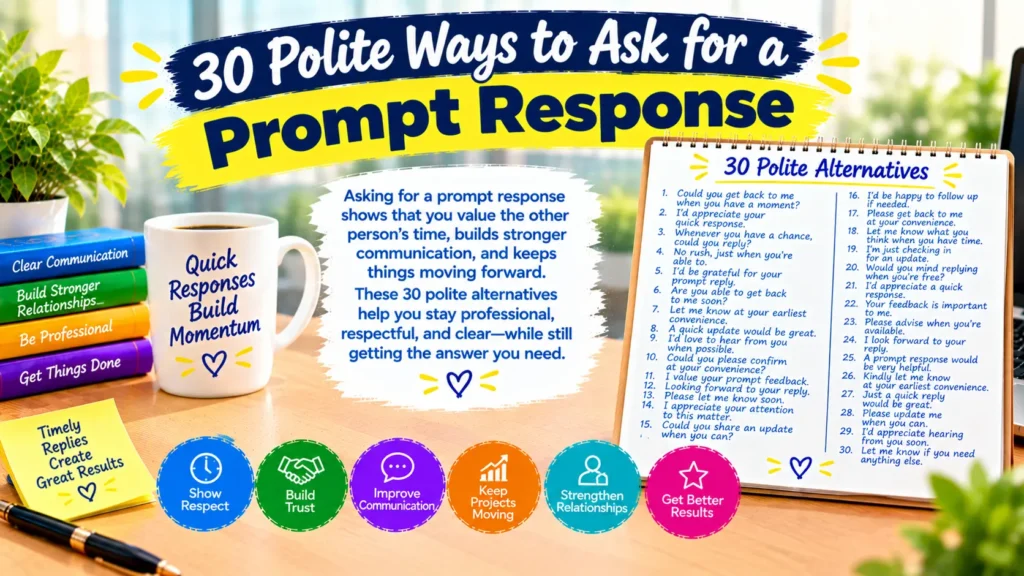
The phrase “please let me know at your earliest convenience” is a common way to ask someone for a response, update, decision, or piece of information without sounding too demanding. It works well in business emails, workplace conversations, client communication, and formal requests. However, using the same phrase too often can make your writing sound repetitive or overly formal.
Finding better ways to say please let me know at your earliest convenience can help you communicate more naturally while respecting the other person’s time. Depending on your relationship with the recipient, you might choose a formal expression, a friendly request, or a direct sentence that explains exactly what you need.
For example, instead of writing, “Please let me know at your earliest convenience,” you could say, “When you have a moment, could you share your feedback?” or “I would appreciate your response by Friday.”
In this guide, you will discover 30 professional and polite alternatives, complete with meanings, tones, practical examples, email templates, and tips for choosing the right expression in 2026.
What Does “Please Let Me Know at Your Earliest Convenience” Mean?
The phrase asks someone to provide information or respond as soon as reasonably possible, based on their schedule and availability.
It communicates urgency without directly demanding an immediate answer. However, the exact meaning depends on the situation, the relationship between the sender and recipient, and any deadline involved.
Literal meaning
The phrase has three main parts:
- Please: Adds politeness to the request.
- Let me know: Asks the recipient to share information, an opinion, a decision, or an update.
- At your earliest convenience: Asks the recipient to respond when they reasonably can, preferably soon.
Together, these words create a courteous request that suits many professional situations.
Example:
“Please let me know at your earliest convenience whether you can attend the meeting.”
This sentence asks the recipient to confirm their availability without demanding an immediate response.
Tone and purpose
The expression usually sounds polite, professional, and somewhat formal. People use it when they want to encourage a timely response without appearing impatient.
It serves several purposes:
- Requests information: Ask someone to provide missing details.
- Encourages a decision: Find out whether a proposal has been approved.
- Requests feedback: Ask a manager or colleague to review your work.
- Follows up: Check on a pending task or unanswered email.
- Maintains courtesy: Show respect for another person’s schedule.
Emotional context
The phrase can communicate patience and respect, but it can also sound distant or overly formal when you use it in a casual conversation.
For example, a client might appreciate the professional tone. A close colleague, however, may respond better to “Let me know when you get a chance.”
The key is to match your words to the situation and make any deadline clear.
When Should You Use This Phrase in Professional Communication?
Before choosing a synonym for “please let me know at your earliest convenience,” consider the context, the recipient, and how quickly you need an answer.
1. Business emails
This phrase works well when you request information, approval, feedback, or confirmation from someone outside your immediate team.
Example:
“Please let me know at your earliest convenience if you require any additional documents.”
For a more natural alternative, write:
“Could you let me know if you need any additional documents?”
2. Workplace communication
You can use the expression when following up with a manager, requesting a colleague’s input, or asking another department for an update.
Example:
“Please let me know at your earliest convenience when the revised report is ready.”
A shorter option is:
“Please share an update when you have a moment.”
3. Client communication
The phrase helps you remain courteous when you need a client’s decision, confirmation, or approval.
Example:
“Please let me know at your earliest convenience whether the proposed schedule works for your team.”
You can make the request more specific by adding a deadline if the project requires one.
4. Networking
In networking emails, a warmer expression can encourage a response without making the recipient feel pressured.
Example:
“I would appreciate your thoughts whenever you have time.”
This wording works especially well when contacting someone you met at a conference or someone who has offered professional advice.
5. Customer service
Customer service teams often use polite, clear language to request missing information or help resolve an issue.
Example:
“Please provide your order number when convenient so we can investigate the issue.”
This alternative explains exactly what the customer needs to do and why the information matters.
30 Professional and Polite Alternatives to “Please Let Me Know at Your Earliest Convenience”
The best alternative depends on how formal you want to sound and how quickly you need a response. The following expressions cover professional emails, formal requests, friendly messages, workplace conversations, and customer communication.
Professional alternatives
1. Please let me know as soon as you can.
Tone: Professional, polite, and direct.
Best use: When you need a reasonably quick response but do not want to sound demanding.
Example:
“Please let me know as soon as you can whether the revised proposal meets your requirements.”
This phrase feels more natural than the original and works well with colleagues, clients, and business partners. However, it communicates slightly more urgency than “at your earliest convenience.”
2. I would appreciate your response when possible.
Tone: Courteous and professional.
Best use: Formal business emails and requests for information.
Example:
“I would appreciate your response when possible so we can finalize the project schedule.”
This option emphasizes appreciation rather than pressure. Use it when you want to maintain a respectful tone while encouraging a response.
3. Could you please share an update when you have a moment?
Tone: Friendly and professional.
Best use: Project updates, internal emails, and routine follow-ups.
Example:
“Could you please share an update when you have a moment regarding the client presentation?”
The wording makes a clear request without sounding stiff. It is particularly useful when the recipient already understands the task.
4. Please share your feedback at your convenience.
Tone: Professional and respectful.
Best use: Reviews, reports, presentations, and proposals.
Example:
“Please share your feedback at your convenience so I can incorporate any necessary changes.”
This is a good choice when you want someone’s opinion but do not need an immediate answer.
5. I look forward to hearing from you soon.
Tone: Warm and professional.
Best use: Client emails, business inquiries, and networking messages.
Example:
“Thank you for reviewing our proposal. I look forward to hearing from you soon.”
This expression closes an email naturally. It works best when the recipient already knows what response you expect.
6. Please keep me informed when you can.
Tone: Professional and cooperative.
Best use: Ongoing projects, shared responsibilities, and status updates.
Example:
“Please keep me informed when you can about any changes to the delivery schedule.”
Choose this phrase when you want continued updates rather than one specific answer.
Formal alternatives
7. I would be grateful for your response at your earliest opportunity.
Tone: Highly formal and respectful.
Best use: Senior executives, official correspondence, and formal business requests.
Example:
“I would be grateful for your response at your earliest opportunity regarding the proposed contract terms.”
This expression is suitable for situations where a formal tone matters. It may sound unnecessarily stiff in everyday conversations with close colleagues.
8. Kindly provide an update when convenient.
Tone: Formal and concise.
Best use: Administrative requests, business correspondence, and professional follow-ups.
Example:
“Kindly provide an update when convenient regarding the status of the application.”
The sentence is short and clear. In some varieties of English, especially certain business settings, “kindly” is common. In other contexts, it can sound overly formal or abrupt, so consider your audience.
9. I would appreciate it if you could respond at your earliest opportunity.
Tone: Formal and courteous.
Best use: Requests that require a considered response.
Example:
“I would appreciate it if you could respond at your earliest opportunity regarding the revised agreement.”
This option works well when you want a complete, polished sentence for formal correspondence.
10. Please advise when you have an update.
Tone: Formal and businesslike.
Best use: Status requests, administrative matters, and project communication.
Example:
“Please advise when you have an update on the approval process.”
This phrase is common in some business environments. However, “please advise” can sound impersonal, so use a warmer alternative when building a close working relationship.
11. Your response at your earliest opportunity would be appreciated.
Tone: Very formal and impersonal.
Best use: Official letters, formal notices, and institutional correspondence.
Example:
“Your response at your earliest opportunity would be appreciated so that we may proceed with the next stage.”
This passive construction creates distance. Prefer a direct sentence when you want to sound approachable.
12. I would welcome your input when your schedule permits.
Tone: Respectful and collaborative.
Best use: Senior colleagues, consultants, clients, and subject-matter experts.
Example:
“I would welcome your input when your schedule permits, particularly on the proposed budget.”
This expression recognizes the recipient’s workload and invites their contribution without implying that they must respond immediately.
Friendly alternatives
13. Let me know when you get a chance.
Tone: Friendly, relaxed, and polite.
Best use: Messages to colleagues, familiar clients, and professional contacts you know well.
Example:
“Let me know when you get a chance if you can join us for the planning session.”
This is one of the most natural alternatives for everyday workplace communication.
14. Whenever you have a moment, please let me know.
Tone: Warm and considerate.
Best use: Informal business emails and internal messages.
Example:
“Whenever you have a moment, please let me know what you think of the new design.”
The wording acknowledges that the recipient may be busy while keeping your request clear.
15. When you have time, could you get back to me?
Tone: Conversational and polite.
Best use: Routine follow-ups with colleagues or familiar business contacts.
Example:
“When you have time, could you get back to me about the meeting arrangements?”
This sounds less formal than the original. Use it when a relaxed tone suits the relationship.
16. Please get back to me when you can.
Tone: Friendly and direct.
Best use: Team messages, short emails, and simple requests.
Example:
“Please get back to me when you can about which version you prefer.”
This expression is easy to understand and works well for routine communication. Add a deadline if you need a response by a specific time.
17. I’d love to hear your thoughts when you have time.
Tone: Warm, approachable, and encouraging.
Best use: Brainstorming, creative projects, networking, and requests for opinions.
Example:
“I’d love to hear your thoughts when you have time on the direction we’re considering for the campaign.”
This option encourages an open exchange rather than making the recipient feel that you are demanding a decision.
18. No rush, but please let me know when you can.
Tone: Casual and reassuring.
Best use: Low-priority requests and conversations with trusted colleagues.
Example:
“No rush, but please let me know when you can whether you’d like to review the draft.”
Use this phrase only when the matter genuinely has no urgent deadline. Saying “no rush” and then sending repeated reminders can confuse the recipient.
Email-ready alternatives
19. Could you please confirm at your earliest convenience?
Tone: Professional and courteous.
Best use: Meeting confirmations, bookings, schedules, and approvals.
Example:
“Could you please confirm at your earliest convenience whether Tuesday’s meeting still works for you?”
This version specifies the action you need, making it more useful than a general request to “let me know.”
20. Please let me know once you have had a chance to review this.
Tone: Polite and task-focused.
Best use: Document reviews, proposals, contracts, and reports.
Example:
“Please let me know once you have had a chance to review this proposal.”
The wording connects the requested response to a clear event: reviewing the material.
21. I would appreciate an update by [date/time].
Tone: Professional and deadline-focused.
Best use: Time-sensitive projects and decisions.
Example:
“I would appreciate an update by Thursday afternoon so we can prepare the final presentation.”
This is one of the best choices when you need an answer within a defined period. Replace the placeholder with a realistic deadline.
22. Could you share your decision when you are able?
Tone: Respectful and neutral.
Best use: Hiring decisions, project approvals, proposals, and planning.
Example:
“Could you share your decision when you are able? We would like to finalize the schedule.”
This phrase encourages a decision without applying unnecessary pressure.
23. Please let me know if you need any further information.
Tone: Helpful and professional.
Best use: Client emails, customer service, and business proposals.
Example:
“I have attached the requested documents. Please let me know if you need any further information.”
This expression is particularly effective when you have completed your part of the task and want to make further assistance available.
24. I would appreciate your confirmation when convenient.
Tone: Formal and courteous.
Best use: Confirming arrangements, orders, appointments, and project details.
Example:
“I would appreciate your confirmation when convenient so I can reserve the meeting room.”
This alternative is more specific than the original because it identifies the response you need.
Workplace alternatives
25. Please share your thoughts when you have a chance.
Tone: Collaborative and approachable.
Best use: Team discussions, draft reviews, and brainstorming.
Example:
“Please share your thoughts when you have a chance on the proposed changes to the onboarding process.”
This phrase encourages feedback and supports a collaborative workplace culture.
26. Let me know where things stand when you can.
Tone: Direct and conversational.
Best use: Project tracking and routine status checks.
Example:
“Let me know where things stand when you can with the vendor negotiations.”
Use this expression when you want to understand the current status rather than request a final decision.
27. Could you update me when you have more information?
Tone: Polite and practical.
Best use: Tasks that depend on new information or another person’s response.
Example:
“Could you update me when you have more information about the shipment?”
This alternative makes sense when the recipient cannot answer yet because they are waiting for details.
28. Please send me your thoughts by [date/time].
Tone: Professional and specific.
Best use: Reviews, team decisions, and work with deadlines.
Example:
“Please send me your thoughts by Wednesday at noon so I can prepare the final version.”
Unlike a vague request for an early response, this wording gives the recipient a clear target.
29. When you have a moment, could we discuss this?
Tone: Friendly and collaborative.
Best use: Workplace conversations, sensitive matters, and topics that need clarification.
Example:
“When you have a moment, could we discuss the revised responsibilities for the project?”
Use this expression when a conversation would work better than an email exchange.
30. Please let me know what works best for you.
Tone: Considerate and flexible.
Best use: Scheduling, coordinating meetings, and making arrangements.
Example:
“I am available on Tuesday or Thursday. Please let me know what works best for you.”
This option is particularly useful when the recipient needs to choose between several possibilities.
Quick Comparison Table
The table below helps you select an alternative based on tone, urgency, and purpose.
| Alternative | Tone | Best Use |
|---|---|---|
| Please let me know as soon as you can. | Professional | Prompt responses |
| I would appreciate your response when possible. | Courteous | Formal business emails |
| Could you share an update when you have a moment? | Friendly-professional | Project updates |
| I would be grateful for your response at your earliest opportunity. | Very formal | Official requests |
| Kindly provide an update when convenient. | Formal | Administrative matters |
| Let me know when you get a chance. | Casual-professional | Colleagues |
| No rush, but please let me know when you can. | Relaxed | Low-priority requests |
| Could you please confirm at your earliest convenience? | Professional | Confirmations |
| I would appreciate an update by Thursday. | Deadline-focused | Time-sensitive tasks |
| Please let me know once you have reviewed this. | Task-focused | Document reviews |
| Could you update me when you have more information? | Practical | Pending information |
| Please share your thoughts by Friday. | Direct-professional | Feedback deadlines |
| I would welcome your input when your schedule permits. | Respectful | Senior colleagues |
| I look forward to hearing from you soon. | Warm-professional | Email closings |
| Please let me know what works best for you. | Flexible | Scheduling |
Quick tip: Choose “when you have a moment” for a relaxed request, “at your earliest opportunity” for a formal request, and “by [date/time]” when you need a clear deadline.
Email Examples: How to Use These Alternatives Naturally
The following examples show how to use these business email phrases in real situations.
1. Email to a client
Subject: Follow-Up on the Project Proposal
Hello Sarah,
I hope you are doing well.
I have attached the revised proposal for your review. Could you please share your feedback when you have a moment? Your input will help us finalize the next steps.
Thank you for your time.
Best regards,
Alex
Why it works: The message sounds courteous, identifies the requested action, and explains why the feedback matters.
2. Email to your manager
Subject: Update on the Quarterly Report
Hi James,
I have completed the first draft of the quarterly report and would appreciate your feedback when your schedule permits.
Please let me know if you would like me to make any changes before submitting the final version.
Thank you,
Maria
Why it works: It respects the manager’s schedule while making the next step clear.
3. Email to a colleague
Subject: Meeting Schedule
Hi Daniel,
Could you let me know when you get a chance whether Thursday afternoon works for our meeting?
If that time does not suit you, I am happy to find another option.
Thanks,
Emma
Why it works: The friendly language encourages a response without making a routine scheduling request sound overly formal.
4. Email to a customer
Subject: Additional Information Required
Dear Customer,
Thank you for contacting our support team.
To help us resolve your issue, could you please provide your order number when convenient? Once we receive those details, we can investigate further.
Thank you for your cooperation.
Kind regards,
Customer Support Team
Why it works: The request explains exactly what the customer needs to provide and why it matters.
5. Networking email
Subject: Great Connecting With You
Hello Michael,
It was a pleasure meeting you at the industry event last week. I enjoyed hearing about your work in product development.
I would welcome the opportunity to continue our conversation. When you have a moment, please let me know if you would be available for a brief call.
Best regards,
Olivia
Why it works: The message is warm, personal, and respectful of the recipient’s time.
6. Meeting follow-up email
Subject: Follow-Up on Today’s Meeting
Hi Team,
Thank you for the productive discussion today.
Please share any additional thoughts by Wednesday afternoon so we can incorporate them into the final project plan.
If you have any questions, feel free to reach out.
Best,
David
Why it works: It summarizes the next action and provides a clear deadline, making it easier for everyone to respond.
Common Mistakes to Avoid
Even a polite phrase can cause confusion if you use it in the wrong situation. Follow these tips to improve your workplace communication and email etiquette.
1. Using the phrase in every email
Repeating “please let me know at your earliest convenience” in every message can make your writing sound mechanical.
Instead: Vary your language according to the task. Use “Could you share an update?” for status checks, “Please confirm” for arrangements, and “I would appreciate your feedback” for reviews.
2. Creating urgency without explaining why
The phrase can sound urgent, but it does not tell the recipient when you actually need the answer.
Instead: Explain the reason and provide a deadline.
Weak: “Please let me know at your earliest convenience.”
Better: “Could you confirm by Thursday afternoon? We need to finalize the schedule before the end of the week.”
3. Using overly formal language with colleagues
A formal expression can sound distant in a quick internal message.
Instead: Match your language to the relationship.
Formal: “I would be grateful for your response at your earliest opportunity.”
Natural: “Let me know when you get a chance.”
4. Using casual language with clients or senior leaders
Expressions such as “Get back to me ASAP” can sound abrupt, especially when you do not know the recipient well.
Instead: Use a courteous request.
Better: “Could you please send your confirmation by 3 p.m. tomorrow?”
5. Confusing politeness with vagueness
A polite request should still tell the recipient what you need.
Weak: “Please let me know when convenient.”
Better: “Please let me know whether you approve the revised budget when convenient.”
6. Saying “no rush” when the matter is urgent
This creates mixed signals and makes it difficult for the recipient to prioritize the task.
Instead: State the actual deadline clearly and explain the reason if needed.
7. Sending repeated follow-ups too quickly
A polite first request can become pressuring if you send several reminders within a short period.
Instead: Consider the urgency, the recipient’s workload, and any agreed response time. Follow up sooner only when the situation genuinely requires it.
Related Phrases for Professional Emails
These expressions can help you make business emails more specific and natural. Each phrase has a slightly different purpose.
- Please keep me updated. — Ask for ongoing information.
Example: “Please keep me updated on the delivery status.” - Please keep me posted. — Request informal progress updates.
Example: “Please keep me posted on the hiring process.” - I look forward to your response. — Close an email while expecting a reply.
Example: “I look forward to your response regarding the proposal.” - I would appreciate your feedback. — Request an opinion or review.
Example: “I would appreciate your feedback on the draft.” - Could you confirm? — Request verification.
Example: “Could you confirm the meeting time?” - Please advise. — Ask for guidance or information.
Example: “Please advise on the next steps.” - When you have a moment. — Acknowledge the recipient’s schedule.
Example: “When you have a moment, please review the attachment.” - At your earliest opportunity. — Request a response soon in a formal tone.
Example: “Please review the document at your earliest opportunity.” - As soon as possible. — Communicate greater urgency.
Example: “Please send the signed form as soon as possible.” - By the end of the day. — Set a clear time limit.
Example: “Could you share your comments by the end of the day?” - At your convenience. — Give the recipient flexibility.
Example: “Please review the optional materials at your convenience.” - When you are available. — Request action when the person has time.
Example: “Let me know when you are available for a quick call.” - Please follow up with me. — Ask the recipient to contact you again.
Example: “Please follow up with me once you receive approval.” - I would welcome your thoughts. — Invite opinions or suggestions.
Example: “I would welcome your thoughts on the proposed changes.” - Could you provide an update? — Ask about the current status.
Example: “Could you provide an update on the application?” - Please confirm at your earliest opportunity. — Request prompt confirmation.
Example: “Please confirm at your earliest opportunity whether you can attend.” - Let me know if anything changes. — Ask to be informed about developments.
Example: “Let me know if anything changes with the delivery schedule.” - Please respond by [date]. — Set a firm response deadline.
Example: “Please respond by October 15 so we can complete the arrangements.” - I would appreciate a quick reply. — Request a relatively prompt response.
Example: “I would appreciate a quick reply because the booking deadline is approaching.” - Feel free to reach out. — Invite questions or further communication.
Example: “Feel free to reach out if you need help with the application.”
Primary Phrase vs. Alternatives: Which One Should You Choose?
Although these expressions share a similar purpose, they do not all communicate the same level of urgency or formality.
| Phrase | Formality | Urgency | Best Situation |
|---|---|---|---|
| Please let me know at your earliest convenience. | Medium-high | Moderate, but vague | General professional requests |
| Please let me know as soon as you can. | Medium | Moderate-high | Responses needed soon |
| At your earliest opportunity. | High | Moderate-high | Formal correspondence |
| When you have a moment. | Low-medium | Low | Routine workplace requests |
| At your convenience. | Medium-high | Low | Non-urgent requests |
| As soon as possible. | Medium | High | Urgent tasks |
| By [date/time]. | Flexible | Clearly defined | Deadlines and deliverables |
| I look forward to hearing from you soon. | Medium | Mild | Email closings |
| Could you please confirm? | Medium | Depends on context | Scheduling and approvals |
| No rush, but let me know when you can. | Low | Very low | Casual internal communication |
The important difference between “at your earliest convenience” and “at your convenience”
These phrases sound similar, but they suggest different levels of urgency.
- At your earliest convenience: Please respond when you reasonably can, preferably soon.
- At your convenience: Please respond when it fits your schedule; the request may not be urgent.
For example, use “Please confirm at your earliest convenience” when a decision affects your next step. Use “Please review the optional reading at your convenience” when the recipient has plenty of time.
The difference between “as soon as possible” and “at your earliest convenience”
“As soon as possible” usually communicates stronger urgency. It can sound demanding without context, especially when the recipient has several competing priorities.
“At your earliest convenience” sounds more courteous but provides less clarity about the deadline.
When timing matters, the clearest option is often a specific request:
“Could you please send your feedback by 2 p.m. tomorrow? We need to submit the final document shortly afterward.”
This sentence remains polite while helping the recipient plan their work.
Cultural Usage and Professional Etiquette
The best phrase can vary across regions, industries, and workplace cultures. Consider the following guidelines when writing to people from different professional backgrounds.
US English
American business communication often favors concise, direct requests, especially in fast-moving workplaces.
Natural options include:
- “Could you let me know when you have a chance?”
- “Please send your feedback by Friday.”
- “Could you share an update when possible?”
These expressions balance friendliness with clarity. In time-sensitive situations, Americans often appreciate a specific deadline rather than a vague request for an early response.
UK English
British business communication often values courtesy and tact, although preferences vary by organization and individual.
Suitable options include:
- “I would be grateful if you could respond when convenient.”
- “Please let me know when you have a moment.”
- “I would appreciate your feedback at your earliest opportunity.”
Do not assume that every British workplace prefers highly formal wording. A short, friendly request may be the most natural choice among familiar colleagues.
Corporate communication
Large organizations often require clear requests, realistic deadlines, and accountability. Overly vague language can delay decisions.
For example, instead of writing:
“Please let me know at your earliest convenience.”
Try:
“Could you confirm your approval by Thursday at noon so we can proceed with implementation?”
This version identifies the action, deadline, and reason.
Customer service
Customer service communication should remain respectful, easy to understand, and action-oriented.
Instead of:
“Kindly advise at your earliest convenience.”
Write:
“Please reply with your order number when you can so we can look into this for you.”
The second sentence tells the customer exactly what information the team needs and how it will help.
Networking and professional relationships
Networking messages work best when they respect the recipient’s time and avoid unnecessary pressure.
For example:
“I enjoyed speaking with you at the conference. If your schedule allows, I would appreciate the opportunity to discuss your experience in the industry.”
This sounds more personal than a generic request for a response. It also makes the reason for contacting the person clear.
Frequently Asked Questions
1. What is the most professional way to say “please let me know at your earliest convenience”?
A strong professional alternative is “I would appreciate your response when possible.” It sounds courteous and works well in business emails. If you need an answer by a specific time, include a clear deadline.
2. What is a more polite way to ask someone to respond soon?
You can say, “Could you please let me know as soon as you can?” This expression is polite but signals that you need a reasonably quick response. For a more formal request, try “I would be grateful for your response at your earliest opportunity.”
3. Is “at your earliest convenience” formal?
Yes. The phrase generally sounds professional and somewhat formal. It suits business emails, client communication, and official requests, but it may sound stiff in casual messages between colleagues.
4. What is the difference between “at your convenience” and “at your earliest convenience”?
“At your convenience” gives the recipient flexibility to respond when their schedule allows. “At your earliest convenience” adds a suggestion that they should respond relatively soon. Neither phrase establishes a precise deadline.
5. Can I use “please let me know at your earliest convenience” in an email to my boss?
Yes. It is appropriate when requesting information, approval, or feedback from your manager. However, “Could you share your feedback when your schedule permits?” may sound more natural. If you need a decision by a particular date, state that deadline clearly.
6. What is a shorter alternative to “please let me know at your earliest convenience”?
Try “Please let me know when you can” or “Please advise when convenient.” The first sounds more conversational, while the second is more formal and businesslike.
7. Is “as soon as possible” more urgent than “at your earliest convenience”?
Usually, yes. “As soon as possible” communicates stronger urgency, while “at your earliest convenience” sounds more considerate of the recipient’s schedule. If you need an answer by a particular time, specify the deadline rather than relying on either phrase alone.
8. How do I ask a client for a response without sounding pushy?
Use a courteous, specific request, such as “Could you please share your feedback by Friday so we can finalize the proposal?” Explaining why you need the response helps the client understand the timing without feeling pressured.
9. What can I say instead when following up on an unanswered email?
You could write, “I wanted to follow up on my previous email. When you have a moment, could you let me know if you have any updates?” If the matter is time-sensitive, politely mention the deadline.
10. Should I use “kindly” in professional emails?
You can use “kindly” in formal business correspondence, especially where it is common in your workplace or region. However, it can sound stiff or abrupt in some contexts. “Could you please confirm?” is often a more natural and widely suitable alternative.
Final Summary: Choose the Right Phrase for the Situation
The best alternative to “please let me know at your earliest convenience” depends on your audience, purpose, and deadline. For everyday professional communication, “Could you share an update when you have a moment?” sounds natural and respectful. For formal emails, “I would be grateful for your response at your earliest opportunity” works well. For friendly workplace messages, “Let me know when you get a chance” feels approachable. When timing matters, use “Please send your response by [date/time]” to remove uncertainty. Good professional communication balances courtesy with clarity. Choose words that respect the recipient’s time, explain what you need, and make the next step easy to understand.




