
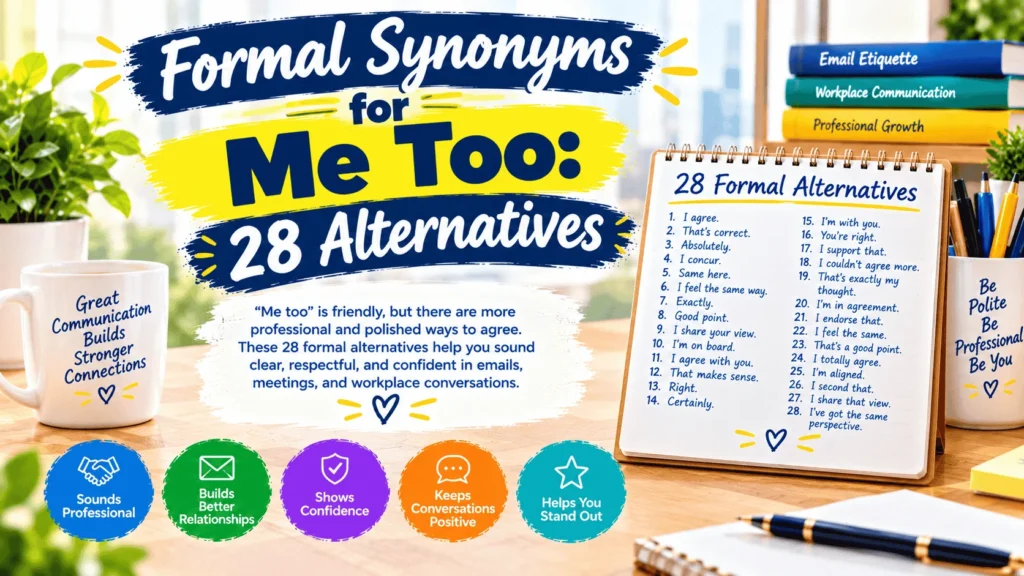
Finding formal synonyms for “me too” can help you sound more polished in emails, meetings, workplace conversations, and professional networking. While “me too” is perfectly natural in casual English, it can feel too informal in business communication when you want to show agreement, shared experience, or the same preference.
The best professional way to say “me too” depends on what you are agreeing with. You might say “I agree,” “I feel the same way,” “I share that view,” or “I would as well.” Each expression has a slightly different tone and purpose.
This guide explains the meaning of “me too” and provides practical alternatives for professional communication, workplace communication, business email phrases, client conversations, and formal correspondence.
What Does “Me Too” Mean?
“Me too” is a short expression used to show that you share the same feeling, opinion, experience, preference, or action as another person.
Literal meaning
The phrase essentially means:
“I am the same in this respect.”
For example:
- “I enjoyed the conference.”
“Me too.” - “I think we should review the proposal.”
“Me too.” - “I’m looking forward to the event.”
“Me too.”
Tone
“Me too” is:
- Casual
- Friendly
- Conversational
- Direct
- Common in spoken English
It is not grammatically wrong in professional communication. However, more precise wording often sounds better in formal emails and workplace discussions.
Purpose
People use “me too” to communicate:
- Agreement
- Shared feelings
- Shared opinions
- Similar experiences
- The same preference
- The same intention
- Support or understanding
Emotional context
Sometimes “me too” creates a sense of connection.
Example:
“I really enjoyed working with the team.”
“I feel the same way.”
The second sentence sounds warmer and more professional while still showing personal connection.
When Should You Use a Formal Alternative to “Me Too”?
Choosing a formal alternative to “me too” depends on your audience and situation.
1. In emails
Use a more polished expression when replying to:
- Managers
- Executives
- Clients
- Customers
- Business partners
- New professional contacts
Instead of:
“Me too. I hope we can work together again.”
Try:
“I feel the same way. I hope we have the opportunity to work together again.”
2. In the workplace
In meetings, “me too” may sound overly casual.
Instead of:
“Me too, I think the deadline is too tight.”
Use:
“I agree. I think the deadline is quite tight.”
3. With clients
Professional communication benefits from clarity and respect.
Instead of:
“Me too. I appreciate your support.”
Try:
“I appreciate your support as well.”
4. In networking
A friendly but professional response works best.
“It was great meeting you.”
You could respond:
“It was a pleasure meeting you as well.”
5. In customer service
Customer-facing communication should sound courteous rather than conversational.
“I’m glad we were able to resolve this.”
A suitable response is:
“I’m glad we were able to resolve it as well.”
28 Formal Synonyms and Professional Alternatives for “Me Too”
Below are practical alternatives grouped by tone and context.
Professional Alternatives
1. I agree.
Tone: Professional, direct
Best use: Meetings, emails, workplace discussions
This is one of the clearest alternatives when “me too” means that you share someone’s opinion.
Example:
“I believe we should prioritize customer feedback.”
“I agree. Customer feedback should guide the next phase.”
2. I feel the same way.
Tone: Warm, professional
Best use: Feelings, opinions, personal reactions
This works especially well when someone expresses an emotion.
Example:
“I’m very pleased with how the project turned out.”
“I feel the same way.”
3. I think so as well.
Tone: Polite, professional
Best use: Business discussions and emails
Example:
“This approach will probably save us time.”
“I think so as well.”
4. I agree with you.
Tone: Direct, respectful
Best use: Meetings and workplace communication
Example:
“We need better communication between departments.”
“I agree with you.”
5. I share your view.
Tone: Formal, polished
Best use: Business emails, management discussions
Example:
“The current process needs to be simplified.”
“I share your view on this matter.”
6. I share your perspective.
Tone: Professional, thoughtful
Best use: Business discussions and strategic communication
Example:
“We should focus more on long-term customer relationships.”
“I share your perspective.”
Formal Alternatives
7. I concur.
Tone: Very formal
Best use: Formal correspondence, professional discussions
“Concur” means to agree.
Example:
“I believe the proposal deserves further consideration.”
“I concur.”
It is correct but can sound stiff in everyday workplace communication.
8. I am of the same opinion.
Tone: Formal
Best use: Formal written communication
Example:
“The current timeline presents several challenges.”
“I am of the same opinion.”
9. I hold the same view.
Tone: Formal, professional
Best use: Reports, business correspondence, discussions
Example:
“The policy should be reviewed annually.”
“I hold the same view.”
10. I share that opinion.
Tone: Formal and neutral
Best use: Emails and professional discussions
Example:
“The proposal needs more supporting data.”
“I share that opinion.”
11. I would agree with that.
Tone: Polite, measured
Best use: Meetings and professional conversations
Example:
“The first option seems more practical.”
“I would agree with that.”
12. I would say the same.
Tone: Polished, natural
Best use: Workplace and business conversations
Example:
“The presentation was very effective.”
“I would say the same.”
Friendly Professional Alternatives
13. I feel the same.
Tone: Friendly, warm
Best use: Colleagues and professional relationships
Example:
“It was great working with everyone.”
“I feel the same.”
14. Likewise.
Tone: Concise, polished
Best use: Networking and professional conversations
Example:
“It was a pleasure speaking with you.”
“Likewise.”
15. Same here.
Tone: Casual-professional
Best use: Friendly colleagues and informal workplace conversations
Example:
“I’m looking forward to the workshop.”
“Same here.”
This is less formal than “I feel the same way.”
16. I feel similarly.
Tone: Friendly and professional
Best use: Discussions involving feelings or opinions
Example:
“I found the experience very rewarding.”
“I feel similarly.”
17. I share that sentiment.
Tone: Warm, polished
Best use: Emails, networking, professional relationships
Example:
“We are grateful for the team’s continued support.”
“I share that sentiment.”
Email-Friendly Alternatives
18. I do as well.
Tone: Polite and concise
Best use: Emails and written communication
Example:
“I appreciate your assistance.”
“I do as well.”
However, depending on the sentence, a clearer option such as “I appreciate it as well” may sound more natural.
19. I would as well.
Tone: Formal
Best use: Expressing the same intended action
Example:
“I would be interested in discussing this further.”
“I would as well.”
20. I feel the same way about this.
Tone: Warm and professional
Best use: Emails involving opinions or reactions
Example:
“I believe the partnership has been very valuable.”
“I feel the same way about this.”
21. I appreciate that as well.
Tone: Courteous
Best use: Client and business emails
Example:
“Thank you for your patience.”
“I appreciate that as well.”
22. I share your enthusiasm.
Tone: Positive and professional
Best use: Projects, events, partnerships
Example:
“I’m excited about the next stage of the project.”
“I share your enthusiasm.”
Workplace Alternatives
23. I agree with that assessment.
Tone: Professional and analytical
Best use: Meetings and decision-making
Example:
“The current process creates unnecessary delays.”
“I agree with that assessment.”
24. I have the same concern.
Tone: Professional
Best use: Workplace problems and risks
Example:
“I’m concerned about the revised deadline.”
“I have the same concern.”
25. I have the same perspective.
Tone: Professional
Best use: Strategy and team discussions
Example:
“We should consider the long-term impact.”
“I have the same perspective.”
26. I am in agreement.
Tone: Formal
Best use: Formal workplace writing
Example:
“The revised process should improve efficiency.”
“I am in agreement.”
27. I share your enthusiasm.
Tone: Positive and professional
Best use: Team communication, projects, networking
Example:
“I’m excited about launching the new service.”
“I share your enthusiasm.”
28. That is my view as well.
Tone: Formal and precise
Best use: Business discussions and emails
Example:
“The proposal needs a stronger financial analysis.”
“That is my view as well.”
Quick Comparison Table
| Alternative | Tone | Best Use |
|---|---|---|
| I agree. | Professional | Meetings |
| I feel the same way. | Warm | Personal opinions |
| I concur. | Very formal | Formal writing |
| Likewise. | Polished | Networking |
| I share your view. | Formal | Business emails |
| I share your perspective. | Professional | Strategy |
| I would say the same. | Natural | Workplace |
| I am of the same opinion. | Formal | Formal correspondence |
| I hold the same view. | Formal | Business writing |
| Same here. | Casual | Friendly colleagues |
| I share that sentiment. | Warm/formal | Emails |
| I have the same concern. | Professional | Problems/risks |
| I agree with that assessment. | Analytical | Meetings |
| That is my view as well. | Formal | Business discussions |
| I would agree with that. | Polite | Meetings |
| I think so as well. | Professional | Discussions |
| I agree with you. | Direct | Workplace |
| I feel similarly. | Friendly | Opinions |
| I am in agreement. | Formal | Professional writing |
| I share your enthusiasm. | Positive | Projects/networking |
Email Examples Using Alternatives to “Me Too”
1. Client Email
Client:
“We are very pleased with the progress so far.”
Professional response:
“I’m pleased with the progress as well. We appreciate your continued partnership.”
2. Manager Email
Manager:
“I believe we should review the timeline before proceeding.”
Response:
“I agree. Reviewing the timeline now should help us avoid unnecessary delays.”
3. Colleague Email
Colleague:
“I enjoyed working on this project.”
Response:
“I feel the same way. It was a valuable experience for me as well.”
4. Customer Service
Customer:
“I’m glad we were able to resolve the issue.”
Response:
“I’m glad we were able to resolve it as well. Thank you for your patience.”
5. Networking
Contact:
“It was great connecting with you.”
Response:
“Likewise. I enjoyed our conversation and hope we can stay in touch.”
6. Meeting Follow-Up
Colleague:
“I think the proposal needs a little more detail.”
Response:
“I agree. I’ll add the relevant details before we send the proposal.”
Common Mistakes When Replacing “Me Too”
1. Choosing an expression that is too formal
“I concur” is grammatically correct, but it may sound unnatural in a casual team conversation.
Instead, use:
“I agree.”
Save highly formal expressions for situations that genuinely require them.
2. Using “likewise” incorrectly
“Likewise” works well when you are returning a similar sentiment.
Natural:
“It was nice meeting you.”
“Likewise.”
But it does not replace every use of “me too.”
3. Using “I agree” for emotions
If someone says:
“I’m really excited about this opportunity.”
“I agree” can sound strange.
Better:
“I feel the same way.”
4. Giving a vague response
Sometimes “me too” is short because the speaker wants to acknowledge a specific point.
Instead of:
“Me too.”
Use:
“I have the same concern about the deadline.”
This tells the reader exactly what you mean.
5. Overusing formal language
Professional does not always mean extremely formal.
For most workplace communication:
“I agree.”
is usually better than:
“I am of the same opinion.”
Good email etiquette depends on matching your language to the relationship.
Related Phrases and Expressions
Here are related expressions that can replace or expand on “me too.”
- I agree — I have the same opinion.
“I agree with your recommendation.” - I feel the same way — I share the same feelings.
“I feel the same way about the project.” - Likewise — I feel or think similarly.
“It was great speaking with you.” “Likewise.” - I concur — I formally agree.
“I concur with your assessment.” - I share your view — I have the same opinion.
“I share your view on this issue.” - I share your perspective — I see the issue similarly.
“I share your perspective on the strategy.” - I would say the same — I would express the same opinion.
“I would say the same about the results.” - I have the same concern — I share the same worry.
“I have the same concern regarding the timeline.” - I share that sentiment — I have the same feeling.
“I share that sentiment.” - I am in agreement — I formally agree.
“I am in agreement with the proposed approach.” - That is my view as well — I hold the same opinion.
“That is my view as well.” - I think so as well — I have the same thought.
“I think so as well.” - I agree with you — I directly support the person’s opinion.
“I agree with you on this matter.” - I feel similarly — I have a similar emotional reaction.
“I feel similarly about the outcome.” - I share your enthusiasm — I am equally excited.
“I share your enthusiasm for the new project.” - I would as well — I would do the same.
“I would as well, given the circumstances.”
“Me Too” vs. Professional Alternatives
| Phrase | Formality | Tone | Best Context |
|---|---|---|---|
| Me too | Low | Casual | Friends, casual chats |
| Same here | Low | Friendly | Colleagues |
| I agree | Medium | Professional | Meetings |
| I feel the same way | Medium | Warm | Opinions/emotions |
| Likewise | Medium | Polished | Networking |
| I share your view | High | Professional | Business |
| I share your perspective | High | Analytical | Strategy |
| I concur | Very high | Formal | Formal writing |
| I am of the same opinion | Very high | Formal | Official communication |
| I share that sentiment | High | Warm/formal | Emails |
| I have the same concern | Medium-high | Professional | Workplace issues |
| That is my view as well | High | Formal | Business discussions |
The key difference is what you are agreeing with. “Me too” is broad, while professional alternatives can communicate the exact relationship between your response and the other person’s statement.
Cultural Usage of “Me Too” in Professional Communication
US English
American workplace communication often values direct, friendly language.
Expressions such as:
- “I agree.”
- “I feel the same way.”
- “Likewise.”
- “I think so too.”
are widely natural.
“Me too” is also common, but it tends to fit casual conversation better than formal business writing.
UK English
British professional communication can favor slightly more restrained expressions in formal settings.
For example:
“I agree with you.”
or:
“I share your view.”
may sound more suitable than an overly casual response.
“Likewise” is also common in professional social interactions.
Corporate Communication
Large organizations often favor clarity over unnecessary formality.
For example:
“I agree with this approach.”
is usually more effective than:
“I am in complete concurrence with your aforementioned perspective.”
Professional writing should be clear, concise, and natural.
Customer Service
Customer service representatives should acknowledge the customer’s feelings without sounding overly familiar.
Instead of:
“Me too!”
try:
“I’m pleased to hear that as well.”
or:
“I’m glad we were able to help.”
Networking
Networking communication should balance warmth and professionalism.
If someone says:
“It was a pleasure meeting you.”
A natural response is:
“Likewise. I enjoyed speaking with you.”
This is warmer and more polished than simply saying “me too.”
FAQs About Formal Synonyms for “Me Too”
1. What is a professional way to say “me too”?
The best general professional alternative is “I agree” when you share someone’s opinion. For feelings or experiences, “I feel the same way” is often better.
2. What is a formal alternative to “me too”?
Formal options include “I concur,” “I share your view,” “I am of the same opinion,” and “That is my view as well.”
3. Is “me too” professional?
“Me too” is not unprofessional, but it is relatively casual. In formal emails, client communication, and official correspondence, a more specific response often sounds more polished.
4. Can I use “likewise” instead of “me too”?
Yes, when you are returning a similar feeling, statement, or sentiment.
Example:
“It was a pleasure meeting you.”
“Likewise.”
5. What is a professional way to say “me too” in an email?
Depending on the meaning, use:
- “I agree.”
- “I feel the same way.”
- “I share your view.”
- “I appreciate that as well.”
- “I share that sentiment.”
- “Likewise.”
6. What is a formal way to say “I feel the same”?
You can say:
“I share that sentiment.”
or:
“I hold the same view.”
The first works particularly well for feelings, while the second is better for opinions.
7. Is “I concur” too formal for an email?
It can be. “I concur” is correct but has a formal tone. In most workplace emails, “I agree” sounds more natural.
8. What is the best synonym for “me too” at work?
“I agree” is usually the safest option when discussing opinions. For shared experiences or feelings, “I feel the same way” is more appropriate.
9. How do I say “me too” professionally to a client?
Choose a response that identifies what you share.
For example:
“I appreciate that as well.”
or:
“I’m pleased to hear that, and I feel the same way.”
10. What is a polite way to say “me too” in a business conversation?
Good choices include:
- “I agree.”
- “I feel the same way.”
- “Likewise.”
- “I share your perspective.”
- “I would say the same.”
- “That is my view as well.”
Final Summary
The best formal synonyms for “me too” depend on what you want to communicate. For general agreement, “I agree” is the safest professional choice. For emotions, use “I feel the same way.” For networking, “Likewise” sounds natural and polished. For formal business writing, “I share your view,” “I concur,” or “That is my view as well” can work well. The most effective professional communication does not simply replace casual words with formal ones; it chooses language that clearly expresses the exact meaning, matches the relationship, and fits the situation.




