
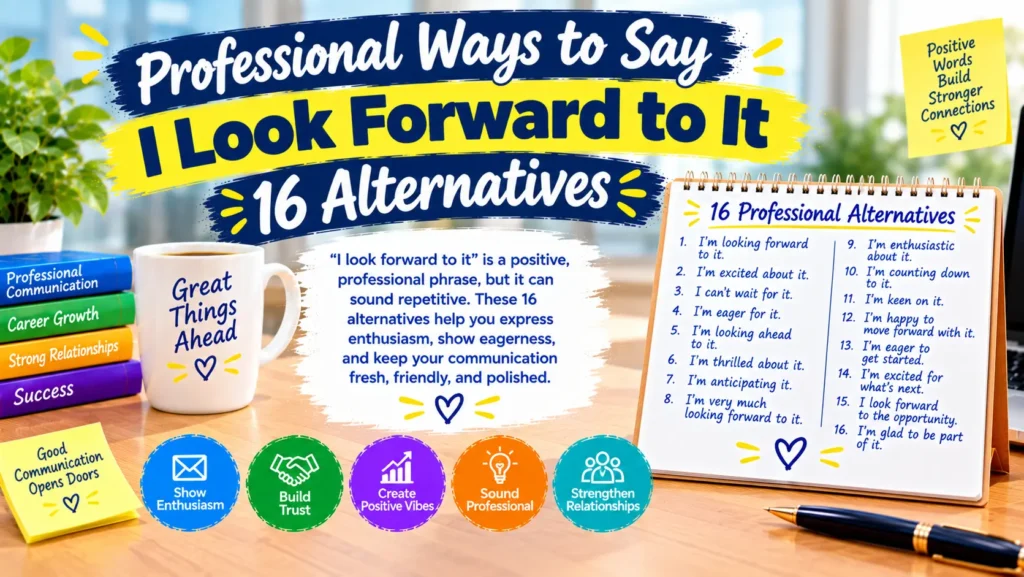
“I look forward to it” is a polite and positive way to show that you are excited about something that will happen in the future. It works well in emails, meetings, workplace conversations, client communication, and networking. However, repeating the same phrase can make your business communication feel predictable.
That is why many people search for a professional way to say “I look forward to it”. Depending on the situation, you may want to sound more formal, friendly, confident, enthusiastic, or concise.
The best alternative depends on what you are anticipating. You might look forward to a meeting, project, conversation, opportunity, collaboration, event, or response.
This guide provides practical business email phrases, workplace examples, and professional alternatives you can use naturally in 2026.
What Does “I Look Forward to It” Mean?
Literal Meaning
“I look forward to it” means you are pleased about something expected to happen in the future.
For example:
I look forward to our meeting next week.
This tells the recipient that you are anticipating the meeting positively.
Tone
The phrase usually sounds:
- Professional
- Polite
- Positive
- Friendly
- Respectful
- Moderately formal
It does not normally sound overly enthusiastic, which makes it useful for professional communication.
Purpose
You can use “I look forward to it” to:
- Show enthusiasm
- End an email positively
- Confirm interest
- Build rapport
- Express anticipation
- Show appreciation for an upcoming opportunity
Emotional Context
The phrase communicates a mild sense of excitement without sounding too emotional.
For example:
Thank you for arranging the meeting. I look forward to it.
This sounds positive and professional.
However, if you are writing to a close colleague, you may want something warmer:
I’m really looking forward to it!
For a highly formal situation, you could write:
I look forward to the opportunity.
28 Professional Alternatives to “I Look Forward to It”
Below are practical alternatives grouped by tone and situation.
Professional Alternatives
1. I Look Forward to the Opportunity
Tone: Professional and positive
Best use: Interviews, projects, partnerships, business opportunities
This is a strong formal alternative to “I look forward to it” when you want to emphasize the opportunity itself.
Example:
Thank you for considering my proposal. I look forward to the opportunity to work with your team.
2. I’m Looking Forward to It
Tone: Friendly and professional
Best use: Everyday workplace emails and conversations
This is a slightly more conversational version of the original phrase.
Example:
Thanks for arranging everything. I’m looking forward to it.
3. I Look Forward to Our Conversation
Tone: Professional
Best use: Networking, interviews, client calls
This works especially well when you are anticipating a phone call or discussion.
Example:
Thank you for your time. I look forward to our conversation tomorrow.
4. I Look Forward to Our Meeting
Tone: Professional and polished
Best use: Business meetings and appointments
Example:
Thank you for confirming the details. I look forward to our meeting on Thursday.
5. I Look Forward to Working With You
Tone: Warm and professional
Best use: New clients, colleagues, vendors, and business partners
Example:
Thank you for choosing our services. I look forward to working with you.
6. I Look Forward to Collaborating With You
Tone: Professional and confident
Best use: Projects, partnerships, team initiatives
Example:
We appreciate the opportunity and look forward to collaborating with you.
Formal Alternatives
7. I Anticipate It With Great Interest
Tone: Formal
Best use: Highly polished business or professional correspondence
Example:
I anticipate the upcoming discussion with great interest.
This is more formal than most everyday business email phrases, so use it selectively.
8. I Welcome the Opportunity
Tone: Formal and confident
Best use: Applications, proposals, partnerships
Example:
I welcome the opportunity to discuss how we can support your organization.
9. I Am Eager to Proceed
Tone: Formal and decisive
Best use: Projects, agreements, business processes
Example:
We have reviewed the proposal and are eager to proceed.
10. I Am Very Much Looking Forward to It
Tone: Formal-friendly
Best use: Important meetings, events, or professional occasions
Example:
Thank you for the invitation. I am very much looking forward to it.
11. I Anticipate Our Discussion
Tone: Formal
Best use: Meetings, negotiations, professional discussions
Example:
I appreciate your time and anticipate our discussion next week.
12. I Look Forward to the Next Steps
Tone: Professional and business-focused
Best use: Projects, interviews, proposals, negotiations
Example:
Thank you for reviewing the proposal. I look forward to the next steps.
Friendly Alternatives
13. I’m Excited About It
Tone: Friendly and enthusiastic
Best use: Colleagues, familiar clients, informal professional settings
Example:
Thanks for organizing the event. I’m excited about it!
14. I’m Really Looking Forward to It
Tone: Warm and enthusiastic
Best use: Colleagues, networking, events
Example:
It will be great to catch up. I’m really looking forward to it.
15. I Can’t Wait
Tone: Very casual and enthusiastic
Best use: Close colleagues or informal communication
Example:
I can’t wait to see the new office!
Avoid this phrase in highly formal emails because it can sound too casual.
16. I’m Excited to Get Started
Tone: Friendly and professional
Best use: New projects and jobs
Example:
Thank you for the warm welcome. I’m excited to get started.
17. I’m Looking Forward to What’s Ahead
Tone: Positive and warm
Best use: New roles, projects, partnerships
Example:
I appreciate the opportunity and am looking forward to what’s ahead.
Email-Friendly Alternatives
18. I Look Forward to Hearing From You
Tone: Professional
Best use: Follow-up emails and requests for responses
Example:
Thank you for reviewing my application. I look forward to hearing from you.
This is more specific than “I look forward to it” because it clearly identifies what you expect next.
19. I Look Forward to Connecting
Tone: Professional and friendly
Best use: Networking and introductions
Example:
Thank you for reaching out. I look forward to connecting with you.
20. I Look Forward to Speaking With You
Tone: Polite and professional
Best use: Calls, interviews, consultations
Example:
I appreciate your time and look forward to speaking with you tomorrow.
21. I Look Forward to Discussing This Further
Tone: Professional
Best use: Proposals, client communication, business discussions
Example:
Please review the attached proposal. I look forward to discussing this further.
22. I Look Forward to Continuing Our Discussion
Tone: Polished and professional
Best use: Follow-up emails
Example:
Thank you for the productive conversation. I look forward to continuing our discussion.
Workplace Alternatives
23. I’m Looking Forward to Working on This Together
Tone: Collaborative and friendly
Best use: Teams and projects
Example:
Thanks for sharing the project details. I’m looking forward to working on this together.
24. I’m Looking Forward to Getting Started
Tone: Positive and professional
Best use: New assignments or projects
Example:
Everything looks good from my side. I’m looking forward to getting started.
25. I’m Looking Forward to the Project
Tone: Professional and approachable
Best use: Workplace communication
Example:
The project looks promising, and I’m looking forward to it.
26. I Look Forward to Moving Forward
Tone: Professional and confident
Best use: Agreements, decisions, projects
Example:
Thank you for confirming the details. I look forward to moving forward.
27. I’m Pleased About the Opportunity
Tone: Polite and positive
Best use: New roles, projects, partnerships
Example:
I’m pleased about the opportunity to contribute to this initiative.
28. I’m Excited to Continue
Tone: Friendly and positive
Best use: Ongoing projects and collaborations
Example:
We have made great progress so far, and I’m excited to continue working together.
Quick Comparison Table
| Alternative | Tone | Best Use |
|---|---|---|
| I look forward to the opportunity | Formal | Business opportunities |
| I’m looking forward to it | Professional-friendly | General emails |
| I look forward to our conversation | Professional | Calls and discussions |
| I look forward to our meeting | Professional | Meetings |
| I look forward to working with you | Warm professional | Clients and colleagues |
| I look forward to collaborating with you | Professional | Partnerships |
| I welcome the opportunity | Formal | Proposals and applications |
| I anticipate our discussion | Formal | Business discussions |
| I look forward to the next steps | Professional | Projects |
| I look forward to hearing from you | Professional | Follow-ups |
| I look forward to connecting | Friendly professional | Networking |
| I look forward to speaking with you | Professional | Calls |
| I’m excited about it | Friendly | Familiar contacts |
| I’m really looking forward to it | Warm | Colleagues |
| I’m excited to get started | Positive | New projects |
| I look forward to discussing this further | Professional | Client emails |
| I look forward to continuing our discussion | Polished | Follow-ups |
| I’m looking forward to working on this together | Collaborative | Teams |
| I’m looking forward to getting started | Positive | Assignments |
| I look forward to moving forward | Confident | Business decisions |
Email Examples
1. Client Email
Thank you for taking the time to discuss your requirements. I look forward to working with you and supporting your team.
This sounds warm without becoming overly casual.
2. Email to Your Manager
Thank you for sharing the project details. I look forward to getting started and contributing to the team.
This communicates enthusiasm while maintaining respect.
3. Email to a Colleague
Thanks for sending this over. I’m looking forward to working on it together.
This is more conversational and works well for internal workplace communication.
4. Customer Email
Thank you for choosing our services. We look forward to assisting you and ensuring a smooth experience.
For customer service, “we look forward to assisting you” often sounds more natural than “we look forward to it.”
5. Networking Email
It was great connecting with you. I look forward to continuing our conversation and exploring potential opportunities to collaborate.
This is a strong professional networking expression.
6. Meeting Follow-Up
Thank you for the productive meeting today. I look forward to discussing the next steps with you.
This gives the email a clear and professional ending.
When Should You Use “I Look Forward to It”?
The original phrase is perfectly acceptable when the recipient already knows what “it” refers to.
For example:
Thank you for confirming the event details. I look forward to it.
The phrase becomes less effective when the reference is unclear.
Instead of:
I look forward to it.
You might write:
I look forward to our discussion.
This gives the reader more information and makes the message sound more polished.
Common Mistakes to Avoid
1. Using It Without a Clear Reference
If the recipient does not know what “it” means, avoid the vague pronoun.
Less clear:
I look forward to it.
Better:
I look forward to our meeting next Tuesday.
2. Using “I Can’t Wait” in Formal Emails
“I can’t wait” expresses strong enthusiasm but can sound casual.
For a client, use:
I look forward to working with you.
Instead of:
I can’t wait to work with you!
3. Overusing “I Look Forward to…”
Using the same phrase in every email can make your writing repetitive.
Instead, vary your wording:
- I look forward to our discussion.
- I welcome the opportunity.
- I’m excited to get started.
- I look forward to the next steps.
- I look forward to connecting.
4. Using Excessively Formal Language
A phrase can be grammatically correct but still feel unnatural.
For example:
I anticipate the forthcoming interaction with considerable enthusiasm.
This sounds unnecessarily complicated.
A simpler option is:
I look forward to our conversation.
Good professional communication should be clear rather than overly sophisticated.
5. Mixing Formal and Casual Tones
Avoid ending a highly formal business email with a very casual expression.
For example:
I appreciate your consideration and look forward to our meeting. Can’t wait!
A consistent alternative would be:
I appreciate your consideration and look forward to our meeting.
Related Phrases and Expressions
Here are related expressions that can replace or complement “I look forward to it.”
| Expression | Meaning | Example |
|---|---|---|
| I look forward to hearing from you | Expecting a response | I look forward to hearing from you soon. |
| I look forward to meeting you | Anticipating a meeting | I look forward to meeting you next week. |
| I look forward to speaking with you | Anticipating a conversation | I look forward to speaking with you tomorrow. |
| I look forward to working with you | Anticipating collaboration | I look forward to working with your team. |
| I look forward to connecting | Anticipating contact | I look forward to connecting soon. |
| I welcome the opportunity | Positive response to an opportunity | I welcome the opportunity to assist. |
| I’m excited to begin | Enthusiasm about starting | I’m excited to begin the project. |
| I’m pleased to move forward | Positive agreement | I’m pleased to move forward with the proposal. |
| I anticipate our discussion | Expecting a discussion | I anticipate our discussion next week. |
| I look forward to the next steps | Anticipating progress | I look forward to the next steps. |
| I’m eager to begin | Strong professional interest | I’m eager to begin working with the team. |
| I’m excited to collaborate | Enthusiasm about teamwork | I’m excited to collaborate with you. |
| I look forward to continuing | Expecting continuation | I look forward to continuing our work. |
| I look forward to discussing this | Anticipating discussion | I look forward to discussing this further. |
| I’m looking forward to what’s ahead | Positive anticipation | I’m looking forward to what’s ahead. |
| I’m pleased about the opportunity | Positive attitude | I’m pleased about the opportunity to contribute. |
“I Look Forward to It” vs. Other Alternatives
“I Look Forward to It” vs. “I’m Looking Forward to It”
Both are correct, but they have slightly different tones.
I look forward to it sounds more polished and professional.
I’m looking forward to it sounds more conversational and friendly.
For a formal client email:
I look forward to our meeting.
For a colleague:
I’m looking forward to it!
“I Look Forward to It” vs. “I Can’t Wait”
“I can’t wait” expresses stronger excitement.
| Phrase | Formality | Enthusiasm |
|---|---|---|
| I look forward to it | High | Moderate |
| I’m looking forward to it | Medium-high | Moderate |
| I’m excited about it | Medium | High |
| I’m really looking forward to it | Medium | High |
| I can’t wait | Low | Very high |
For most business situations, “I look forward to it” is safer than “I can’t wait.”
“I Look Forward to It” vs. “I Welcome the Opportunity”
These phrases have different purposes.
I look forward to it focuses on anticipation.
I look forward to our meeting.
I welcome the opportunity focuses on willingness and appreciation.
I welcome the opportunity to discuss the project.
“I Look Forward to It” vs. “I Look Forward to Hearing From You”
These should not always be treated as interchangeable.
Use “I look forward to it” when you anticipate an event or activity.
Use “I look forward to hearing from you” when you expect a response.
Event:
I look forward to our meeting.
Response:
I look forward to hearing from you.
This distinction is important for effective email etiquette.
Cultural and Professional Usage
US English
“I look forward to it” is common in American workplace communication. It sounds natural in emails, meetings, customer communication, and networking.
Americans often use:
I’m looking forward to it.
for a warmer, more conversational tone.
UK English
The phrase is also standard in British English and works well in professional correspondence.
More formal British business writing may favor:
I look forward to the opportunity.
or:
I look forward to hearing from you.
Corporate Communication
Corporate communication usually favors clarity and professionalism.
Strong choices include:
- I look forward to our discussion.
- I look forward to the next steps.
- I welcome the opportunity.
- I look forward to working with you.
- I look forward to continuing our collaboration.
Avoid unnecessarily elaborate language.
Customer Service
Customer service communication should sound helpful and positive.
Instead of:
We look forward to it.
be specific:
We look forward to assisting you.
or:
We look forward to helping you resolve this matter.
Specific language feels more attentive.
Networking
Networking communication benefits from a warm but professional tone.
Good options include:
I look forward to connecting with you.
I look forward to continuing our conversation.
I look forward to exploring opportunities to work together.
These phrases communicate interest without sounding overly familiar.
FAQs
1. What is a professional way to say “I look forward to it”?
A strong professional alternative is “I look forward to the opportunity.” Other choices include “I look forward to our discussion,” “I look forward to the next steps,” and “I look forward to working with you.”
2. What is a formal alternative to “I look forward to it”?
Use “I welcome the opportunity,” “I anticipate our discussion,” or “I look forward to the opportunity.” Choose the phrase based on what you are anticipating.
3. Is “I look forward to it” professional?
Yes. “I look forward to it” is professional, polite, and widely accepted in business communication. It works particularly well when the context clearly explains what “it” refers to.
4. Is “I’m looking forward to it” professional?
Yes. It is professional but slightly more conversational. It works well with colleagues, clients you know well, and other familiar business contacts.
5. What can I say instead of “I look forward to it” in an email?
You can write:
I look forward to our conversation.
I look forward to working with you.
I look forward to the next steps.
I look forward to hearing from you.
I welcome the opportunity.
6. How do you say “I look forward to it” to a client?
Try:
I look forward to working with you.
or:
I look forward to our upcoming discussion.
These options sound professional and client-focused.
7. How do you say “I look forward to it” to your manager?
A good option is:
I look forward to getting started.
or:
I look forward to contributing to the project.
Both show enthusiasm while maintaining a professional tone.
8. What is a friendly synonym for “I look forward to it”?
Try “I’m really looking forward to it” or “I’m excited about it.” These sound warmer while remaining appropriate for many workplace situations.
9. Is “I can’t wait” appropriate in a professional email?
It depends on the relationship. “I can’t wait” is informal and enthusiastic, so it works better with close colleagues or familiar contacts. For formal business emails, “I look forward to it” is safer.
10. What is the best email ending when looking forward to a meeting?
Use:
I look forward to our meeting.
For a more specific ending:
I look forward to discussing the next steps with you.
Both are concise and professional.
Final Summary
Choosing the right alternative to “I look forward to it” depends on your audience, relationship, and purpose. For professional communication, “I look forward to the opportunity,” “I look forward to our discussion,” and “I look forward to working with you” are strong choices. For formal messages, “I welcome the opportunity” works well. For friendly workplace communication, “I’m looking forward to it” or “I’m excited to get started” sounds natural. In emails, specificity usually makes your message stronger, so name the meeting, conversation, opportunity, or next step whenever possible. The best business email phrases are clear, warm, and appropriate to the relationship




