
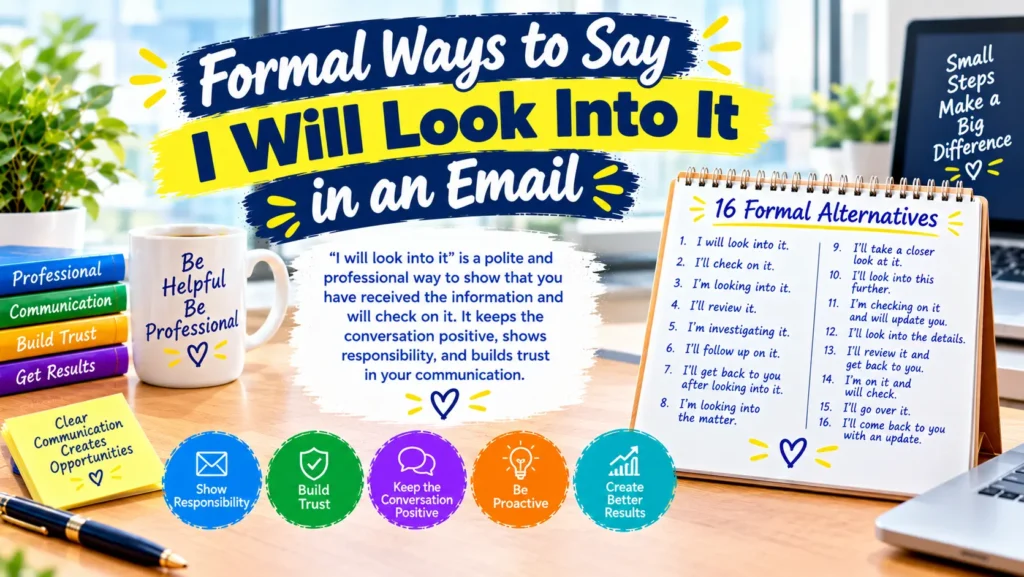
Knowing formal ways to say “I will look into it” in an email can help you sound more professional, helpful, and confident at work. While “I will look into it” is perfectly acceptable in many situations, you may want a stronger alternative when replying to a client, manager, customer, business partner, or professional contact.
The phrase usually means that you will investigate a question, review information, check a problem, or gather more details before providing an answer. Depending on the situation, you can choose a phrase that sounds formal, reassuring, friendly, or direct.
For example, instead of writing:
“I will look into it and get back to you.”
You could write:
“I will review the matter and follow up with you shortly.”
Both sentences communicate the same basic idea, but the second sounds more polished for formal business communication.
This guide explains professional alternatives, their tone, best use cases, and practical email examples.
What Does “I Will Look Into It” Mean?
“I will look into it” means I will investigate, review, check, or examine the matter and try to find an answer or solution.
Literal meaning
The phrase tells the reader that you intend to spend time examining an issue.
For example:
“I will look into the billing issue.”
This means you will investigate why the billing issue occurred.
Tone
“I will look into it” usually has a:
- Professional tone
- Neutral tone
- Helpful tone
- Cooperative tone
- Moderately informal feel
It works well in everyday workplace communication, but some situations call for more precise business email phrases.
Purpose
You might use the phrase when you need to:
- Investigate a problem
- Check information
- Review a document
- Confirm details
- Research a question
- Speak with another department
- Find a solution
- Verify whether something is possible
Emotional context
The phrase can reassure someone that you are taking their concern seriously.
For example:
“Thank you for bringing this to my attention. I will look into it and update you as soon as possible.”
This sounds responsive without promising an immediate solution.
When Is “I Will Look Into It” Appropriate?
In Emails
The phrase works well when you need time to investigate something before responding.
“Thank you for your email. I will look into the issue and get back to you shortly.”
For a more formal message, consider:
“Thank you for bringing this matter to my attention. I will review it and follow up with you.”
In the Workplace
You can use it with colleagues when someone asks you to check something.
“I will look into the scheduling issue and let you know what I find.”
For a manager or senior executive, a more polished alternative may be better:
“I will review the matter and provide an update.”
With Clients
Client communication often benefits from language that sounds reassuring and accountable.
Instead of:
“I’ll look into it.”
Try:
“I will investigate this matter and follow up with you as soon as I have more information.”
In Networking
Networking messages can remain professional while sounding warm.
“Thank you for sharing this. I will look into the opportunity and get back to you.”
In Customer Service
Customer service requires clarity and reassurance.
“I understand your concern. I will investigate the issue and provide an update as soon as possible.”
25 Professional and Formal Alternatives to “I Will Look Into It”
Below are practical alternatives grouped by tone and situation.
1. I Will Review the Matter
Tone: Professional and formal
Best use: Business emails, managers, clients
This is one of the safest formal alternatives.
Example:
“Thank you for bringing this to my attention. I will review the matter and follow up with you shortly.”
2. I Will Investigate the Matter
Tone: Formal and serious
Best use: Complaints, problems, disputes, technical issues
Use this when you need to conduct a proper investigation.
Example:
“I will investigate the matter and provide you with an update once I have more information.”
3. I Will Look Into This Further
Tone: Professional and natural
Best use: General workplace emails
This keeps the original meaning while sounding slightly more deliberate.
Example:
“I will look into this further and let you know what I find.”
4. I Will Review This and Get Back to You
Tone: Professional and friendly
Best use: Email, workplace communication
This is useful when you need time before giving an answer.
Example:
“I will review this and get back to you by tomorrow.”
5. I Will Check on This
Tone: Friendly and professional
Best use: Colleagues, routine workplace requests
It sounds less formal but remains appropriate for business communication.
Example:
“I will check on this with the accounting team and let you know.”
6. I Will Check the Details
Tone: Professional and direct
Best use: Information requests
Use this when you need to verify specific facts.
Example:
“I will check the details and confirm the information with you.”
7. I Will Investigate Further
Tone: Formal and confident
Best use: Complaints, technical concerns, complex issues
Example:
“I will investigate further and provide an update once the review is complete.”
8. I Will Review the Information
Tone: Formal and neutral
Best use: Documents, reports, proposals, data
Example:
“I will review the information and respond with my findings.”
9. I Will Verify the Details
Tone: Formal and precise
Best use: Business, finance, contracts, scheduling
Example:
“I will verify the details and confirm everything with you shortly.”
10. I Will Confirm This
Tone: Professional and concise
Best use: When another person or department must provide confirmation
Example:
“I will confirm this with the relevant team and get back to you.”
11. I Will Follow Up on This
Tone: Professional and action-oriented
Best use: Pending issues and requests
Example:
“I will follow up on this with our operations team and keep you updated.”
12. I Will Check Into This
Tone: Professional and conversational
Best use: Internal workplace communication
Example:
“I will check into this and let you know if there are any updates.”
13. I Will Assess the Situation
Tone: Formal and analytical
Best use: Business decisions, problems, or risks
Example:
“I will assess the situation and recommend the appropriate next steps.”
14. I Will Examine the Issue
Tone: Formal
Best use: Problems requiring careful review
Example:
“I will examine the issue and determine what may have caused it.”
15. I Will Review the Issue
Tone: Professional and neutral
Best use: Workplace and client communication
Example:
“I will review the issue and provide an update as soon as possible.”
16. I Will Determine What Happened
Tone: Direct and investigative
Best use: Errors, incidents, unexpected problems
Example:
“I will determine what happened and share my findings with you.”
17. I Will Gather More Information
Tone: Professional and transparent
Best use: When you do not yet have enough information
Example:
“I will gather more information and follow up with you once I have a clearer picture.”
18. I Will Consult With the Relevant Team
Tone: Formal and collaborative
Best use: Business and corporate communication
Example:
“I will consult with the relevant team and confirm the next steps.”
19. I Will Check With the Appropriate Department
Tone: Formal and professional
Best use: Customer service and corporate emails
Example:
“I will check with the appropriate department and provide an update.”
20. I Will Explore the Matter Further
Tone: Formal and polished
Best use: Business proposals, opportunities, complex questions
Example:
“I will explore the matter further and share my recommendations.”
21. I Will Assess the Situation and Follow Up
Tone: Professional and reassuring
Best use: Client and management communication
Example:
“I will assess the situation and follow up with you once I have more information.”
22. I Will Review This and Provide an Update
Tone: Professional and accountable
Best use: Client emails and workplace communication
Example:
“I will review this and provide an update by the end of the day.”
23. I Will Research This Further
Tone: Professional and precise
Best use: Questions requiring research
Example:
“I will research this further and share the relevant information with you.”
24. I Will Take a Closer Look at This
Tone: Friendly and professional
Best use: Colleagues and less formal emails
Example:
“I will take a closer look at this and let you know what I find.”
25. I Will Address This and Follow Up With You
Tone: Professional, confident, and reassuring
Best use: Client concerns, complaints, workplace problems
Example:
“I will address this with the appropriate team and follow up with you shortly.”
Quick Comparison Table
| Alternative | Tone | Best Use |
|---|---|---|
| I will review the matter | Formal | Clients and managers |
| I will investigate the matter | Very formal | Complaints and problems |
| I will review this and get back to you | Professional | General emails |
| I will check on this | Friendly | Colleagues |
| I will verify the details | Formal | Business information |
| I will follow up on this | Professional | Pending issues |
| I will assess the situation | Formal | Business decisions |
| I will examine the issue | Formal | Problems |
| I will gather more information | Professional | Unclear situations |
| I will consult with the relevant team | Formal | Corporate emails |
| I will research this further | Professional | Questions |
| I will take a closer look at this | Friendly | Colleagues |
| I will provide an update | Professional | Clients and managers |
| I will confirm this | Direct | Verification |
| I will address this and follow up | Confident | Complaints and concerns |
Email Examples
1. Client Email
Subject: Follow-Up on Your Request
Thank you for bringing this matter to our attention. I will review the issue with our team and provide you with an update as soon as possible.
This sounds professional without making an unrealistic promise.
2. Email to a Manager
Thank you for sharing the information. I will review the matter and follow up with you once I have confirmed the details.
This is a strong professional alternative to “I will look into it.”
3. Email to a Colleague
Thanks for letting me know. I will check into this and get back to you shortly.
This is less formal but natural for workplace communication.
4. Customer Service Email
Thank you for contacting us. I understand your concern, and I will investigate the matter and provide an update once I have more information.
This combines empathy with accountability.
5. Networking Email
Thank you for sharing this opportunity. I will review the details and get back to you once I have had a chance to consider it.
This sounds thoughtful and professional.
6. Meeting Follow-Up
Thank you for the productive discussion today. I will review the points we discussed and follow up with the relevant next steps.
This is more polished than simply saying “I will look into it.”
Common Mistakes to Avoid
1. Using the Phrase Too Often
Repeating “I will look into it” in every email can make your communication sound generic.
Instead, choose a phrase that explains the action you will take.
For example:
“I will verify the figures with our finance team.”
is more specific than:
“I will look into it.”
2. Choosing an Overly Formal Expression
Not every situation requires language such as “I will investigate the matter.”
For a colleague, this may sound unnecessarily serious.
Better:
“I will check on this and let you know.”
3. Being Too Casual With Clients
Avoid phrases such as:
“I’ll check it out.”
when responding to a formal client request.
Use:
“I will review the matter and follow up with you.”
4. Making Promises You Cannot Keep
Avoid:
“I will resolve this immediately.”
unless you know that you can do so.
A safer option is:
“I will review the issue and provide an update as soon as possible.”
5. Not Giving a Follow-Up Time
When appropriate, include a timeframe.
Instead of:
“I will review this.”
write:
“I will review this and provide an update by tomorrow afternoon.”
This makes the message clearer and more accountable.
Related Business Email Phrases
Here are related expressions that can help you vary your professional communication.
| Phrase | Meaning | Example |
|---|---|---|
| I will review this | Examine something | “I will review this today.” |
| I will investigate | Find out what happened | “I will investigate the issue.” |
| I will verify | Check accuracy | “I will verify the details.” |
| I will confirm | Establish that something is correct | “I will confirm the schedule.” |
| I will follow up | Continue checking | “I will follow up with the team.” |
| I will check with the team | Ask another group | “I will check with the team.” |
| I will research this | Find information | “I will research this further.” |
| I will assess this | Evaluate something | “I will assess the situation.” |
| I will examine the issue | Look carefully at a problem | “I will examine the issue.” |
| I will gather information | Collect facts | “I will gather more information.” |
| I will consult with the team | Discuss with others | “I will consult with the team.” |
| I will provide an update | Share new information | “I will provide an update tomorrow.” |
| I will get back to you | Respond later | “I will get back to you shortly.” |
| I will keep you informed | Continue providing updates | “I will keep you informed.” |
| I will keep you posted | Give ongoing updates | “I will keep you posted.” |
| I will address the issue | Deal with a problem | “I will address the issue promptly.” |
| I will clarify this | Remove uncertainty | “I will clarify this with the team.” |
| I will determine the next steps | Decide what happens next | “I will determine the next steps.” |
“I Will Look Into It” vs. Professional Alternatives
The best formal alternative to “I will look into it” depends on what you actually plan to do.
“I will review the matter”
Use this when you need to examine information.
Formality: High
Best for: Clients, managers, formal emails
“I will investigate the matter”
Use this when there is a problem, complaint, or unusual situation.
Formality: Very high
Best for: Complaints, incidents, disputes
“I will check on this”
Use this for simple requests.
Formality: Moderate
Best for: Colleagues and routine workplace messages
“I will verify the details”
Use this when accuracy matters.
Formality: High
Best for: Finance, contracts, schedules, data
“I will follow up on this”
Use this when someone else may need to provide information.
Formality: High
Best for: Business emails and pending requests
“I will take a closer look at this”
Use this when you want to sound helpful without being overly formal.
Formality: Moderate
Best for: Colleagues and friendly professional communication
Cultural Usage and Business Communication
US English
In American workplace communication, “I will look into it” is common and natural. Professionals often use shorter alternatives such as:
“I’ll check on that.”
or:
“I’ll look into this and get back to you.”
Directness is generally valued, so concise language works well.
UK English
British business communication may also use “I’ll look into this,” although phrases such as:
“I’ll look into the matter.”
or:
“I’ll look into this and come back to you.”
can sound natural depending on the context.
Corporate Communication
Large organizations often prefer precise language.
Instead of:
“I’ll look into it.”
you might write:
“I will review the matter and provide an update.”
This tells the reader what action you intend to take.
Customer Service
Customer-facing communication should combine professionalism with reassurance.
A strong example is:
“I will investigate this matter and keep you informed of any developments.”
Networking
Networking messages should sound professional but not stiff.
For example:
“I will review the opportunity and get back to you soon.”
is usually better than an overly formal phrase such as:
“I shall investigate the aforementioned matter.”
The second sounds unnatural in modern business communication.
How to Choose the Right Alternative
When choosing a professional way to say “I will look into it,” ask yourself what action you will actually take.
If you need to read something:
Use:
“I will review the matter.”
If you need to investigate a problem:
Use:
“I will investigate the matter.”
If you need to verify facts:
Use:
“I will verify the details.”
If you need to ask another team:
Use:
“I will check with the relevant team.”
If you need additional research:
Use:
“I will research this further.”
If you plan to respond later:
Use:
“I will review this and get back to you.”
If you want to sound friendly:
Use:
“I will take a closer look at this.”
This approach makes your workplace communication more precise and useful.
FAQs
1. What is a formal way to say “I will look into it”?
A strong formal alternative is “I will review the matter.” Other options include “I will investigate the matter,” “I will examine the issue,” and “I will assess the situation.”
2. What is a professional way to say “I will look into this”?
You can say:
“I will review this and provide an update.”
This sounds professional, clear, and appropriate for business emails.
3. Is “I will look into it” professional?
Yes. “I will look into it” is professional and widely understood. However, more specific wording can sound more polished in formal communication.
4. What is another way to say “I will look into this and get back to you”?
Try:
“I will review this and follow up with you.”
You can also say:
“I will investigate this and provide an update.”
5. How do I say “I will look into it” to a client?
A professional option is:
“I will review the matter and follow up with you as soon as possible.”
For a serious issue, use:
“I will investigate the matter and keep you informed.”
6. What is a polite way to say “I will check”?
You can say:
“I will check the details and get back to you.”
For a more formal email:
“I will verify the details and provide an update.”
7. What is a formal alternative to “I’ll check on that”?
Try:
“I will review the matter.”
or:
“I will verify the relevant information.”
8. How can I sound more professional in an email?
Use specific action words such as review, investigate, verify, assess, confirm, research, examine, and follow up instead of relying on vague phrases.
For example:
“I will verify the details with our finance team and update you tomorrow.”
9. Should I say “I will look into it” or “I will investigate”?
Use “I will look into it” for general requests. Use “I will investigate” when the matter involves a problem, complaint, incident, or concern that requires a more thorough review.
10. What is the best business email phrase instead of “I will look into it”?
For most professional emails, “I will review the matter and follow up with you” is an excellent choice because it sounds clear, polite, and accountable.
Final Summary
The best formal ways to say “I will look into it” in an email depend on your audience and purpose. For most business situations, “I will review the matter,” “I will investigate the matter,” “I will verify the details,” and “I will review this and provide an update” are strong choices. For colleagues, friendlier phrases such as “I will check on this” or “I will take a closer look at this” work well. With clients and customers, combine a clear action with a follow-up promise. The goal is not simply to sound formal. Good professional communication should tell the reader what you will do and, when possible, when they can expect an update.




