
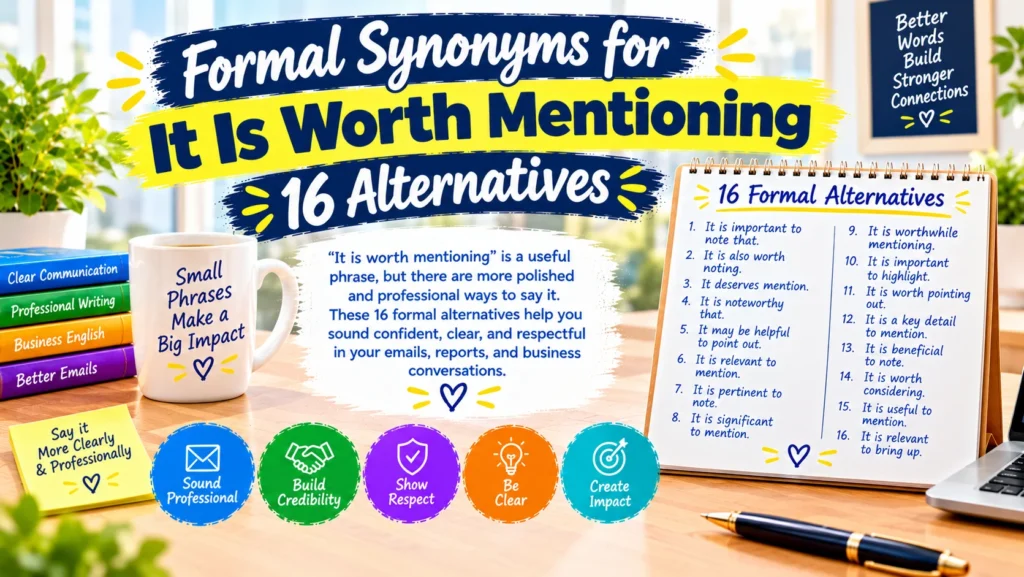
Finding the right formal synonyms for “it is worth mentioning” can make business writing sound clearer, more polished, and more professional. The phrase is useful when you want to draw attention to an important fact, detail, result, or consideration without sounding too forceful.
However, repeating the same expression in every email, report, presentation, or workplace message can make your writing feel predictable. Choosing a suitable alternative also helps you match your tone to the situation.
For example, you might write “It is important to note that…” in a formal report, “Please note that…” in an email, or “I would like to highlight…” when speaking with a client.
This guide covers professional communication, workplace communication, business email phrases, client correspondence, networking, reports, and everyday office situations.
What Does “It Is Worth Mentioning” Mean?
The phrase “it is worth mentioning” means that a particular fact, point, detail, or circumstance deserves attention because it may be useful or relevant to the reader.
Literal meaning
The phrase suggests:
“This information is important enough to bring to your attention.”
For example:
It is worth mentioning that the project was completed ahead of schedule.
This tells the reader that completing the project early is a notable fact.
Tone
“It is worth mentioning” generally sounds:
- Professional
- Neutral
- Polite
- Moderately formal
- Informative
- Non-confrontational
It does not usually sound aggressive or overly authoritative.
Purpose
You can use the expression to:
- Introduce an important detail
- Highlight a positive result
- Add context
- Draw attention to a concern
- Clarify a situation
- Support an argument
- Introduce additional information
Emotional context
The phrase can also create a gentle transition. Instead of saying:
This is important.
you can soften the statement:
It is worth mentioning that this option may reduce overall costs.
That makes the message feel more measured and professional.
When Should You Use “It Is Worth Mentioning”?
The phrase works well in many professional situations, but the best alternative depends on your audience and purpose.
1. In Professional Emails
You can use it when introducing an important detail without making the statement sound too strong.
Example:
It is worth mentioning that the revised proposal includes additional support at no extra cost.
For a more direct email, use:
Please note that the revised proposal includes additional support.
2. In Workplace Communication
The phrase works well in meetings, reports, internal messages, and team discussions.
Example:
It is worth mentioning that the team completed all testing before the deadline.
A more concise workplace alternative is:
It is important to note that the team completed all testing before the deadline.
3. With Clients
When communicating with clients, choose a phrase that sounds informative rather than demanding.
Example:
I would like to highlight that the new package includes priority customer support.
This sounds more personal and client-friendly than repeatedly using “it is worth mentioning.”
4. In Networking
Networking communication usually benefits from a warm but professional tone.
Example:
I should also mention that our team has experience working with international clients.
Or:
I would also like to highlight our experience in this area.
5. In Customer Service
Customer service messages should remain clear, polite, and easy to understand.
Example:
Please note that your request may require up to three business days to process.
Here, “please note” is usually more natural than “it is worth mentioning.”
28 Formal Synonyms for “It Is Worth Mentioning”
Below are practical alternatives grouped by tone and purpose.
Professional Alternatives
1. It Is Important to Note That
Tone: Professional and direct
Best use: Reports, emails, business communication
This is one of the strongest formal alternatives to “it is worth mentioning.”
Example:
It is important to note that the deadline has been moved to Friday.
2. It Is Important to Highlight That
Tone: Professional and purposeful
Best use: Reports, presentations, client communication
Use this when you want the reader to pay special attention to a particular point.
Example:
It is important to highlight that all customer data remains confidential.
3. I Would Like to Highlight
Tone: Professional and personal
Best use: Emails, presentations, client communication
This option clearly shows that you are intentionally bringing something to the reader’s attention.
Example:
I would like to highlight the excellent progress made by the project team.
4. I Would Like to Point Out
Tone: Professional and moderately direct
Best use: Workplace discussions and emails
Example:
I would like to point out that the revised figures reflect the latest data.
This works particularly well when clarification is needed.
5. It Should Be Noted That
Tone: Formal and objective
Best use: Reports, policies, formal documents
Example:
It should be noted that the agreement remains subject to final approval.
This is an excellent formal synonym for “it is worth mentioning.”
6. It Is Relevant to Note That
Tone: Formal and analytical
Best use: Reports, research, professional analysis
Example:
It is relevant to note that customer demand increased during the final quarter.
Formal Alternatives
7. It Is Noteworthy That
Tone: Formal and polished
Best use: Reports, academic writing, presentations
Use this when the information is particularly notable.
Example:
It is noteworthy that customer satisfaction increased by 18%.
8. It Deserves Mention That
Tone: Formal
Best use: Reports and professional writing
Example:
It deserves mention that the team completed the project without additional funding.
This is grammatically acceptable but less common than “it is important to note that.”
9. It Is Significant to Note That
Tone: Formal and analytical
Best use: Business reports and professional analysis
Example:
It is significant to note that operating costs have declined steadily.
10. It Is Relevant to Highlight That
Tone: Formal
Best use: Reports, proposals, business presentations
Example:
It is relevant to highlight that the new process reduces administrative work.
11. Of Particular Note Is
Tone: Highly formal
Best use: Reports, formal presentations, written analysis
Example:
Of particular note is the substantial improvement in customer retention.
This structure works well when you want to emphasize one specific item.
12. It May Be Useful to Note That
Tone: Polite, formal, and cautious
Best use: Emails, reports, advice
Example:
It may be useful to note that the system will be unavailable on Sunday.
This is especially useful when you want to sound helpful rather than authoritative.
Friendly Professional Alternatives
13. I’d Also Like to Mention
Tone: Friendly and professional
Best use: Emails and conversations
Example:
I’d also like to mention that we can provide additional training if needed.
14. I’d Like to Add That
Tone: Friendly and natural
Best use: Emails, meetings, networking
Example:
I’d like to add that we appreciate your continued support.
15. It’s Also Helpful to Know That
Tone: Friendly and informative
Best use: Customer service and internal communication
Example:
It’s also helpful to know that the subscription can be canceled at any time.
16. It’s Also Good to Note That
Tone: Friendly and professional
Best use: Informal workplace emails
Example:
It’s also good to note that the updated software is compatible with older devices.
17. I Should Also Mention
Tone: Natural and conversational
Best use: Emails, networking, workplace communication
Example:
I should also mention that Sarah will be joining the meeting.
Email-Friendly Alternatives
18. Please Note That
Tone: Polite and direct
Best use: Business emails and customer communication
Example:
Please note that the office will be closed on Monday.
This is one of the most useful business email phrases.
19. Please Be Advised That
Tone: Formal and official
Best use: Notices, customer service, formal emails
Example:
Please be advised that your application is currently under review.
Use it selectively because it can sound more official than necessary.
20. I Would Like to Bring to Your Attention
Tone: Formal and respectful
Best use: Client emails, complaints, important issues
Example:
I would like to bring to your attention a discrepancy in the invoice.
This is appropriate when something genuinely requires attention.
21. I Would Like to Draw Your Attention to
Tone: Formal and authoritative
Best use: Reports, policies, professional notices
Example:
I would like to draw your attention to the updated payment terms.
22. For Your Consideration
Tone: Formal and respectful
Best use: Proposals, recommendations, business emails
Example:
I am sharing the following option for your consideration.
This is not an exact synonym, but it serves a similar purpose when presenting information for review.
Workplace Alternatives
23. It Is Worth Noting That
Tone: Professional and neutral
Best use: Meetings, reports, workplace communication
Example:
It is worth noting that the team achieved its target two weeks early.
24. I Would Like to Emphasize
Tone: Professional and stronger
Best use: Meetings, presentations, management communication
Example:
I would like to emphasize the importance of meeting the revised deadline.
25. It Is Relevant to Mention
Tone: Formal and analytical
Best use: Reports and workplace discussions
Example:
It is relevant to mention that the policy applies to all departments.
26. Another Point to Consider Is
Tone: Professional and collaborative
Best use: Meetings, proposals, discussions
Example:
Another point to consider is the potential impact on the support team.
27. It May Be Helpful to Consider
Tone: Polite and collaborative
Best use: Workplace communication and recommendations
Example:
It may be helpful to consider the long-term maintenance costs.
28. I Would Also Like to Mention
Tone: Professional and polite
Best use: Emails, reports, client communication
Example:
I would also like to mention that the final report is now available.
Quick Comparison Table
| Alternative | Tone | Best Use |
|---|---|---|
| It is important to note that | Professional | Business emails |
| It should be noted that | Formal | Reports |
| It is noteworthy that | Formal | Analysis |
| I would like to highlight | Professional | Presentations |
| Please note that | Direct | Emails |
| Please be advised that | Official | Notices |
| I would like to mention | Friendly professional | Emails |
| I should also mention | Conversational | Workplace |
| It is worth noting that | Neutral | General business writing |
| I would like to point out | Direct | Clarification |
| Of particular note is | Highly formal | Reports |
| It may be useful to note that | Polite | Emails |
| I would like to emphasize | Strong | Management |
| Another point to consider is | Collaborative | Meetings |
| I would like to draw your attention to | Formal | Important issues |
Email Examples
Client Email
Dear Mr. Smith,
I would like to highlight that the revised proposal includes additional support at no extra cost. Please let me know if you would like to discuss the changes.
Best regards,
[Name]
Email to a Manager
Hi Sarah,
It is important to note that the team has completed the initial testing ahead of schedule. We are now preparing for the final review.
Best,
[Name]
Email to a Colleague
Hi James,
I should also mention that the client has approved the revised timeline. We can begin the next phase tomorrow.
Thanks,
[Name]
Customer Service Email
Dear Customer,
Please note that your request is currently being processed. You should receive an update within three business days.
Kind regards,
Customer Support
Networking Email
Hi Daniel,
It was great speaking with you at the conference. I’d also like to mention that our team regularly works with companies in your industry.
I hope we can stay in touch.
Meeting Follow-Up
Thank you for attending today’s meeting.
It is worth noting that we agreed to complete the first phase by November 15. I have included the action items below for reference.
Common Mistakes to Avoid
1. Overusing the Same Phrase
Repeating “it is worth mentioning” several times can make a report or email sound mechanical.
Instead, vary your language:
- It is important to note that…
- I would like to highlight…
- Please note that…
- It is noteworthy that…
- Another point to consider is…
2. Using an Overly Formal Expression
Not every email needs:
I would like to draw your attention to the fact that…
For a simple internal message, this may sound unnecessarily formal.
Better:
Please note that the meeting starts at 10 a.m.
3. Choosing the Wrong Tone
A customer service email usually benefits from clarity.
Instead of:
It is of particular note that your payment remains outstanding.
Use:
Please note that your payment is still outstanding.
The second version is easier to understand.
4. Making a Small Detail Sound Too Important
“It is noteworthy that” suggests that the information deserves special attention.
Do not use it for trivial details.
Instead:
I’d also like to mention that the meeting room has changed.
5. Using “Please Be Advised” Everywhere
“Please be advised” can sound formal or official. It may be appropriate for notices but unnecessarily stiff in friendly workplace emails.
Consider:
Please note that the schedule has changed.
Related Phrases
Here are useful expressions related to “it is worth mentioning”:
- It is important to note — introduces an important fact.
It is important to note that the deadline is firm. - It is worth noting — draws attention to a relevant point.
It is worth noting that sales increased. - Please note — politely directs attention.
Please note that the office closes at 5 p.m. - It should be noted — formal and objective.
It should be noted that approval is required. - It is noteworthy — emphasizes something notable.
It is noteworthy that retention improved. - I would like to highlight — personally emphasizes information.
I would like to highlight the team’s contribution. - I would like to point out — introduces clarification.
I would like to point out a discrepancy. - I would like to emphasize — gives stronger emphasis.
I would like to emphasize the importance of accuracy. - I should mention — conversational and professional.
I should mention that the deadline has changed. - I would also like to mention — adds another relevant point.
I would also like to mention the updated pricing. - Another point to consider — introduces another factor.
Another point to consider is the cost. - It may be useful to note — offers information gently.
It may be useful to note that support is available. - For your consideration — presents something for review.
I am sending the proposal for your consideration. - Of particular note — highlights a specific item.
Of particular note is the improvement in response time. - I would like to draw your attention to — directs attention to an issue.
I would like to draw your attention to the revised policy. - It is relevant to note — emphasizes relevance.
It is relevant to note that the policy applies company-wide.
“It Is Worth Mentioning” vs. Other Alternatives
| Phrase | Formality | Tone | Best Use |
|---|---|---|---|
| It is worth mentioning | Medium | Neutral | General communication |
| It is worth noting | Medium | Neutral | Reports and emails |
| It is important to note | High | Direct | Professional writing |
| It should be noted | High | Objective | Formal reports |
| It is noteworthy | High | Analytical | Research and reports |
| Please note | Medium | Direct | Business emails |
| I would like to highlight | Medium-high | Professional | Presentations |
| I would like to emphasize | High | Strong | Important matters |
| I should mention | Medium | Friendly | Internal communication |
| Please be advised | High | Official | Notices |
| Another point to consider | Medium | Collaborative | Meetings |
| Of particular note is | Very high | Formal | Reports |
Which one should you choose?
If you need a professional way to say “it is worth mentioning,” use:
It is important to note that…
If you need a formal alternative to “it is worth mentioning,” use:
It should be noted that…
For a friendly email, use:
I’d also like to mention that…
For customer communication:
Please note that…
For presentations:
I would like to highlight…
For formal reports:
It is noteworthy that…
Cultural and Professional Usage
US English
In American business communication, “it is important to note,” “please note,” and “I would like to highlight” are widely understood and natural.
Professional emails often favor direct wording.
Example:
Please note that the submission deadline is Friday.
UK English
British professional writing often uses similar expressions, including:
- It is worth noting that…
- It should be noted that…
- It is important to note that…
- I would like to point out…
The choice depends more on context and formality than on a major difference between US and UK English.
Corporate Communication
Corporate writing generally favors concise expressions.
Instead of:
It is worth mentioning that we have made several improvements to the system.
You could write:
We have made several improvements to the system.
If the detail needs emphasis:
It is important to note that we have made several improvements to the system.
The second version is useful when the information supports a larger point.
Customer Service
Customer-facing communication should prioritize clarity.
Prefer:
Please note that refunds may take five business days to process.
over:
It is noteworthy that refunds may take five business days to process.
The first sounds more natural and easier for customers to understand.
Networking
Networking communication should usually feel warm and natural.
Good choices include:
- I’d also like to mention…
- I should mention…
- I’d like to highlight…
- Another point worth mentioning is…
Avoid overly bureaucratic language unless the situation is highly formal.
FAQs
1. What is a formal synonym for “it is worth mentioning”?
A strong formal synonym is “it is important to note that.” Other options include “it should be noted that,” “it is noteworthy that,” and “it is relevant to note that.”
2. What is the professional way to say “it is worth mentioning”?
The best professional option is usually “it is important to note that.” For emails, “please note that” is often more concise.
3. What is a polite alternative to “it is worth mentioning”?
You can say “I would also like to mention that” or “it may be useful to note that.” Both sound polite and professional.
4. Can I use “it is worth mentioning” in an email?
Yes. The phrase is appropriate for professional emails when you want to introduce an important or relevant detail.
5. What is the best business email phrase?
“Please note that” is one of the most useful choices because it is concise, professional, and easy to understand.
6. Is “it is worth noting” better than “it is worth mentioning”?
They are very similar. “It is worth noting” often sounds slightly more polished and analytical, while “it is worth mentioning” can sound more conversational.
7. Is “it should be noted” formal?
Yes. “It should be noted that” is a formal, objective expression often used in reports, policies, and professional documents.
8. What is a friendly alternative?
Try “I’d also like to mention that” or “I should also mention that.” These options work well in friendly workplace communication.
9. What should I use in a client email?
Use “I would like to highlight,” “please note,” or “I would also like to mention.” The best choice depends on how important the information is.
10. What is the strongest alternative?
For strong professional emphasis, use “I would like to emphasize that.” For objective emphasis, use “it is important to note that.”
Final Summary
The best formal synonyms for “it is worth mentioning” depend on your audience, purpose, and desired level of formality. For most professional communication, “it is important to note that” is the safest choice. For formal reports, choose “it should be noted that” or “it is noteworthy that.” For business emails, “please note that” offers a concise and professional option. When you want a warmer tone, use “I’d also like to mention that.” In presentations and client communication, “I would like to highlight” works particularly well. The key is to choose language that emphasizes the right information without making your message sound unnecessarily formal.




