
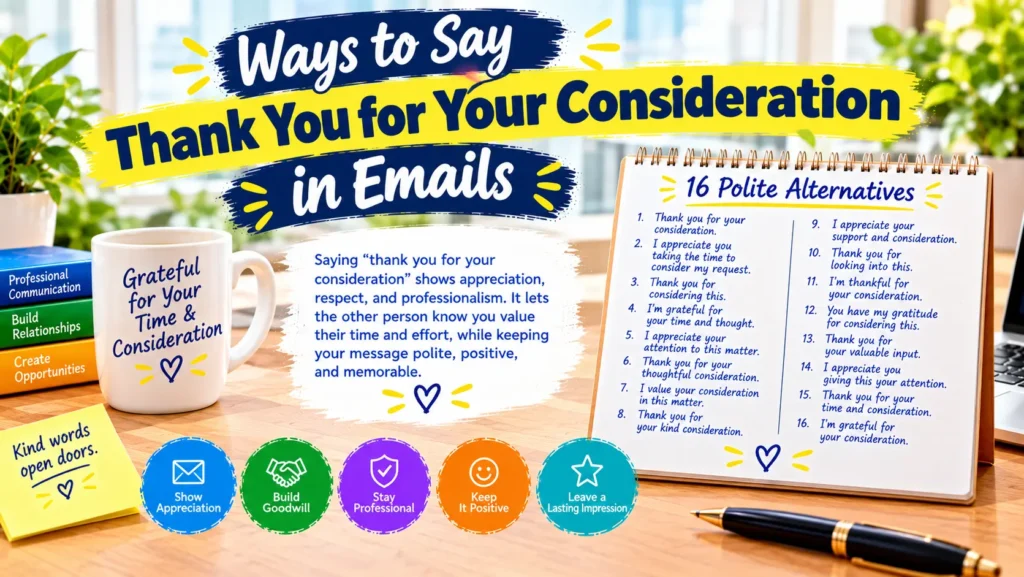
When writing a professional email, “thank you for your consideration” is a polite way to show appreciation for someone’s time, attention, review, or decision. However, using the same phrase repeatedly can make your emails sound predictable. That is why many professionals look for ways to say thank you for your consideration in emails that sound natural, respectful, and appropriate for different situations.
The best alternative depends on your relationship with the recipient and the purpose of your message. A job application may require a formal expression, while a message to a colleague can sound warmer and more conversational. Client emails, networking messages, requests, proposals, and follow-ups may also call for slightly different wording.
This guide provides professional, formal, friendly, and email-ready alternatives, along with examples you can use immediately.
What Does “Thank You for Your Consideration” Mean?
Literal Meaning
“Thank you for your consideration” means that you appreciate someone taking the time to think about, review, evaluate, or consider something you have presented.
For example:
Thank you for your consideration of my application.
Here, the writer appreciates the recipient for reviewing the application.
The phrase can also refer to a request, proposal, business opportunity, recommendation, invitation, or other matter.
Tone
The phrase generally has a:
- Professional tone
- Polite tone
- Respectful tone
- Formal or semi-formal feel
- Appreciative quality
It works particularly well when you want to show respect without sounding overly emotional.
Purpose
You might use this phrase when you want to:
- Thank someone for reviewing your request
- Appreciate someone’s time
- Close a job application email
- Follow up on a proposal
- Thank a client for reviewing an offer
- Acknowledge someone’s decision-making process
- Show appreciation for a business opportunity
Emotional Context
The phrase communicates respect and appreciation. It tells the reader that you understand their time and attention have value.
For example:
Thank you for considering my proposal. I appreciate the time you have taken to review it.
This sounds appreciative without putting pressure on the recipient.
When Should You Use This Phrase Professionally?
1. In Emails
“Thank you for your consideration” is useful at the end of emails involving requests, applications, proposals, or decisions.
Example:
I have attached the proposal for your review. Thank you for your consideration, and I look forward to hearing from you.
2. In Workplace Communication
You can use it when asking a manager or colleague to consider an idea, schedule change, request, or recommendation.
Example:
I would appreciate your consideration of this proposed schedule change.
3. With Clients
The phrase works well when a client is reviewing a quote, proposal, contract, or service.
Example:
Thank you for taking the time to review our proposal. We appreciate your consideration.
4. In Networking
A professional networking email may use a warmer variation.
Example:
Thank you for considering my request to connect. I appreciate your time.
5. In Customer Service
Customer service emails can use a simple and respectful variation.
Example:
Thank you for considering our recommendation. Please let us know if we can provide any additional information.
28 Professional Ways to Say “Thank You for Your Consideration”
Below are practical alternatives grouped by tone and situation.
Professional Alternatives
1. Thank You for Considering My Request
Tone: Professional and direct
Best use: Requests to managers, clients, or business contacts
This is one of the closest alternatives to the original phrase.
Example:
Thank you for considering my request. I appreciate your time and attention.
2. I Appreciate Your Consideration
Tone: Professional and concise
Best use: Business emails and formal requests
This is a natural professional way to say thank you for your consideration.
Example:
I appreciate your consideration of this proposal and look forward to your feedback.
3. Thank You for Taking the Time to Consider This
Tone: Appreciative and professional
Best use: Proposals, requests, and workplace emails
This version emphasizes the recipient’s time.
Example:
Thank you for taking the time to consider this opportunity. I look forward to discussing it further.
4. I’m Grateful for Your Consideration
Tone: Warm and professional
Best use: Applications, recommendations, and important requests
Example:
I’m grateful for your consideration and appreciate the opportunity to present my qualifications.
5. Thank You for Reviewing My Request
Tone: Clear and professional
Best use: Workplace and client communication
Use this when the recipient has been asked to examine something specific.
Example:
Thank you for reviewing my request. Please let me know if you need any additional information.
6. I Appreciate Your Time and Consideration
Tone: Respectful and polished
Best use: Formal business emails
Example:
I appreciate your time and consideration. I look forward to hearing your thoughts.
Formal Alternatives
7. Thank You for Your Careful Consideration
Tone: Formal and respectful
Best use: Applications, proposals, official correspondence
Adding “careful” shows appreciation for thoughtful review.
Example:
Thank you for your careful consideration of my application.
8. I Sincerely Appreciate Your Consideration
Tone: Formal and sincere
Best use: Important professional requests
Example:
I sincerely appreciate your consideration and the opportunity to discuss this position.
9. Thank You for Giving This Matter Your Consideration
Tone: Formal
Best use: Corporate and official correspondence
Example:
Thank you for giving this matter your consideration. I would be pleased to provide further details.
10. I Appreciate Your Thoughtful Consideration
Tone: Formal, warm, and appreciative
Best use: Proposals, recommendations, and applications
Example:
I appreciate your thoughtful consideration of my proposal.
11. Thank You for Reviewing This Opportunity
Tone: Formal and business-focused
Best use: Sales, partnerships, proposals
Example:
Thank you for reviewing this opportunity. I would welcome the chance to discuss the next steps.
12. Your Consideration Is Greatly Appreciated
Tone: Highly formal
Best use: Formal correspondence and institutional communication
Example:
Your consideration is greatly appreciated. Please contact me if you require additional information.
Friendly Alternatives
13. Thanks for Taking the Time to Look This Over
Tone: Friendly and professional
Best use: Colleagues and familiar business contacts
Example:
Thanks for taking the time to look this over. I’d love to hear your thoughts.
14. I Really Appreciate You Taking the Time to Consider This
Tone: Warm and conversational
Best use: Colleagues, partners, and familiar contacts
Example:
I really appreciate you taking the time to consider this idea.
15. Thanks for Giving This Some Thought
Tone: Friendly and casual
Best use: Colleagues or people you know well
Example:
Thanks for giving this some thought. Let me know what you decide.
16. I Appreciate You Taking a Look
Tone: Friendly and natural
Best use: Internal workplace emails
Example:
I appreciate you taking a look at the proposal. Let me know if you have any questions.
17. Thanks for Considering My Request
Tone: Friendly but professional
Best use: Everyday workplace emails
Example:
Thanks for considering my request. I appreciate your help.
Email-Ready Alternatives
18. Thank You for Taking the Time to Review This
Tone: Professional and appreciative
Best use: Documents, proposals, reports, and attachments
Example:
Thank you for taking the time to review this document. I look forward to your feedback.
19. I Appreciate Your Time and Attention
Tone: Polished and professional
Best use: Business emails and formal requests
Example:
I appreciate your time and attention to this matter.
20. Thank You for Reviewing My Proposal
Tone: Specific and professional
Best use: Sales, business proposals, and partnerships
Example:
Thank you for reviewing my proposal. I would be happy to answer any questions you may have.
21. Thank You for Considering This Opportunity
Tone: Professional and positive
Best use: Business opportunities and partnerships
Example:
Thank you for considering this opportunity. I look forward to discussing how we might work together.
22. I Appreciate the Opportunity to Be Considered
Tone: Formal and appreciative
Best use: Job applications and professional opportunities
Example:
I appreciate the opportunity to be considered for the position.
Workplace Alternatives
23. I Appreciate Your Review
Tone: Concise and professional
Best use: Documents, reports, and internal requests
Example:
I appreciate your review of the attached report.
24. Thank You for Considering My Suggestion
Tone: Professional and collaborative
Best use: Workplace discussions
Example:
Thank you for considering my suggestion. I believe it could improve the current process.
25. Thank You for Giving My Request Your Attention
Tone: Respectful and formal
Best use: Requests to supervisors or senior colleagues
Example:
Thank you for giving my request your attention. I appreciate your feedback.
26. I Appreciate Your Feedback and Consideration
Tone: Collaborative
Best use: Managers, colleagues, and project teams
Example:
I appreciate your feedback and consideration as we work through the proposed changes.
27. Thank You for Considering My Perspective
Tone: Respectful and thoughtful
Best use: Workplace discussions and disagreements
Example:
Thank you for considering my perspective. I appreciate the opportunity to explain my concerns.
28. Thank You for Giving This Request Careful Thought
Tone: Respectful and sincere
Best use: Sensitive or important workplace requests
Example:
Thank you for giving this request careful thought. I appreciate your understanding.
Quick Comparison Table
| Alternative | Tone | Best Use |
|---|---|---|
| I appreciate your consideration | Professional | General business emails |
| Thank you for considering my request | Professional | Requests |
| I appreciate your time and consideration | Formal | Applications and proposals |
| Thank you for taking the time to consider this | Professional | Business communication |
| I’m grateful for your consideration | Warm | Important requests |
| Thank you for your careful consideration | Formal | Applications |
| I sincerely appreciate your consideration | Formal | Formal correspondence |
| Thanks for considering my request | Friendly | Colleagues |
| Thanks for taking the time to look this over | Friendly | Internal emails |
| I appreciate you taking a look | Casual professional | Workplace |
| Thank you for reviewing my request | Professional | Managers and clients |
| Thank you for reviewing my proposal | Business | Sales and partnerships |
| I appreciate your time and attention | Polished | Business emails |
| Thank you for considering this opportunity | Professional | Networking and business |
| I appreciate the opportunity to be considered | Formal | Job applications |
| I appreciate your review | Concise | Documents |
| Thank you for considering my suggestion | Collaborative | Workplace |
| Thank you for giving my request your attention | Formal | Managers |
| I appreciate your feedback and consideration | Collaborative | Teams |
| Thank you for considering my perspective | Respectful | Workplace discussions |
Email Examples
Client Email
Dear Ms. Taylor,
Thank you for taking the time to review our proposal. We appreciate your consideration and would be happy to answer any questions.
Best regards,
Daniel
A more concise version:
Thank you for considering our proposal. Please let me know if you need any additional information.
Email to a Manager
Hi Sarah,
I wanted to ask whether we could adjust the project timeline by two days. Thank you for considering my request. I appreciate your time.
Best,
James
This is a good example of professional workplace communication because it makes the request clear without sounding demanding.
Email to a Colleague
Hi Mark,
Thanks for taking the time to look over the report. I appreciate your feedback and consideration.
Best,
Alex
The friendly tone works because the relationship is already established.
Customer Email
Dear Customer,
Thank you for considering our service. We appreciate your interest and would be happy to answer any questions you may have.
Kind regards,
Customer Support Team
Networking Email
Hi Jessica,
Thank you for considering my request to connect. I appreciate your time and would be glad to learn more about your work in the industry.
Best regards,
Michael
Meeting Follow-Up
Hi Team,
Thank you for taking the time to review the proposed agenda. I appreciate your consideration and welcome any feedback before our meeting.
Best,
Emma
Common Mistakes to Avoid
1. Using the Same Phrase in Every Email
“Thank you for your consideration” is useful, but repeating it in every message can make your writing feel formulaic.
Instead, match your wording to the situation.
Better:
Thank you for reviewing my proposal.
rather than using the same generic closing every time.
2. Choosing a Tone That Is Too Formal
A phrase such as:
Your consideration is greatly appreciated.
may sound too formal when emailing a close colleague.
A better option would be:
Thanks for considering my request.
3. Sounding Too Casual
Avoid phrases such as:
Thanks for checking this out!
when communicating with a senior executive or formal client unless your relationship supports that tone.
4. Creating Pressure
Avoid wording that implies the recipient owes you a positive response.
Instead of:
I hope you will seriously consider my request.
use:
Thank you for considering my request.
The second version respects the recipient’s decision.
5. Adding Unnecessary Words
Professional emails benefit from clarity.
Instead of:
I just wanted to take a moment to say that I sincerely and genuinely appreciate your careful consideration of my request.
write:
I sincerely appreciate your consideration.
Simple wording often sounds more confident.
Related Phrases
Here are useful expressions related to “thank you for your consideration.”
1. Thank you for your time
Shows appreciation for someone’s time.
Example:
Thank you for your time and attention.
2. I appreciate your time
A concise professional expression.
Example:
I appreciate your time and feedback.
3. Thank you for reviewing this
Best when someone needs to examine a document.
Example:
Thank you for reviewing this proposal.
4. Thank you for your attention
Useful for important matters.
Example:
Thank you for your attention to this matter.
5. I appreciate your feedback
Best when you expect comments or suggestions.
Example:
I appreciate your feedback on the draft.
6. Thank you for considering my application
Ideal for job applications.
Example:
Thank you for considering my application.
7. I appreciate the opportunity
Shows gratitude for an opportunity.
Example:
I appreciate the opportunity to discuss this position.
8. Thank you for reviewing my request
Specific and professional.
Example:
Thank you for reviewing my request.
9. I appreciate your thoughtful response
Useful after receiving a detailed reply.
Example:
I appreciate your thoughtful response.
10. Thank you for your understanding
Best for sensitive situations.
Example:
Thank you for your understanding and patience.
11. Thank you for your patience
Useful when someone has waited.
Example:
Thank you for your patience while we reviewed the matter.
12. I’m grateful for your time
Warmer than a standard business phrase.
Example:
I’m grateful for your time and guidance.
13. Thank you for giving this your attention
Useful for important workplace matters.
Example:
Thank you for giving this matter your attention.
14. I appreciate your consideration of this matter
Formal and business-focused.
Example:
I appreciate your consideration of this matter.
15. Thank you for taking this into account
Useful when someone is making a decision.
Example:
Thank you for taking these circumstances into account.
16. Thank you for considering my perspective
Useful for workplace discussions.
Example:
Thank you for considering my perspective during our discussion.
“Thank You for Your Consideration” vs. Other Alternatives
“Thank You for Your Consideration” vs. “I Appreciate Your Consideration”
Both phrases are professional and polite.
Thank you for your consideration sounds slightly more traditional.
I appreciate your consideration sounds slightly more natural and conversational.
For modern business emails, either option works well.
“Thank You for Your Consideration” vs. “Thank You for Your Time”
These phrases are not identical.
Use thank you for your consideration when someone is evaluating a request, application, proposal, or opportunity.
Use thank you for your time when you mainly want to acknowledge their time.
Example:
Thank you for your consideration of my application.
versus:
Thank you for your time during our meeting.
“Thank You for Your Consideration” vs. “Thank You for Reviewing This”
The second option is more specific.
If someone has actually reviewed a document, proposal, or request, saying:
Thank you for reviewing this.
may sound more direct and natural.
“Thank You for Your Consideration” vs. “I Appreciate Your Time and Attention”
This alternative emphasizes the recipient’s effort rather than the decision itself.
It works particularly well in corporate communication.
“Thank You for Your Consideration” vs. “Thanks for Considering My Request”
The first is more formal. The second sounds more conversational.
For a manager:
Thank you for considering my request.
For a close colleague:
Thanks for considering my request.
Cultural Usage
US English
In American business communication, “thank you for your consideration” is common in formal requests, job applications, proposals, and business correspondence.
Modern US workplace writing often favors slightly more direct alternatives such as:
I appreciate your consideration.
or:
Thank you for taking the time to review this.
UK English
British professional communication also uses the phrase, particularly in formal letters and applications. British business writing may favor restrained, polite language.
For example:
Thank you for considering my application.
is natural and professional.
Corporate Communication
Corporate emails generally benefit from clear and neutral language. Avoid overly emotional wording unless the situation calls for it.
Good choices include:
I appreciate your consideration.
Thank you for reviewing this proposal.
Thank you for your time and attention.
Customer Service
Customer-facing communication should sound respectful without becoming overly formal.
A good option is:
Thank you for considering our services.
or:
We appreciate your time and interest.
Networking
Networking emails usually work best with a warm professional tone.
For example:
Thank you for considering my request to connect.
This feels more personal than a very formal expression while remaining appropriate for professional communication.
FAQs
1. What is a professional way to say “thank you for your consideration”?
A strong professional alternative is:
I appreciate your consideration.
Other options include “Thank you for considering my request” and “Thank you for taking the time to consider this.”
2. What is a formal alternative to “thank you for your consideration”?
Try:
I sincerely appreciate your consideration.
Another formal option is:
Thank you for your careful consideration.
These work well in applications, proposals, and formal correspondence.
3. Is “thank you for your consideration” professional?
Yes. It is a professional and polite expression commonly used in business emails, job applications, proposals, and formal requests.
4. Is “I appreciate your consideration” better than “thank you for your consideration”?
Neither is always better. “I appreciate your consideration” often sounds slightly more natural and modern, while “thank you for your consideration” has a more traditional formal tone.
5. How do you thank someone for considering your request?
You can write:
Thank you for considering my request. I appreciate your time and attention.
For a more concise email:
I appreciate your consideration of my request.
6. How do you use “thank you for your consideration” in an email?
Use it near the end of an email after explaining your request.
Example:
I have attached the proposal for your review. Thank you for your consideration. I look forward to hearing your thoughts.
7. What can I say instead of “thank you for considering my application”?
You can say:
I appreciate the opportunity to be considered.
or:
Thank you for taking the time to review my application.
Both work well in job applications.
8. What is a friendly alternative to “thank you for your consideration”?
Try:
Thanks for considering my request.
or:
Thanks for taking the time to look this over.
These options work well with colleagues and familiar professional contacts.
9. Is “your consideration is greatly appreciated” too formal?
It can sound quite formal and somewhat traditional. It is appropriate for official correspondence but may feel stiff in everyday workplace emails.
A more natural alternative is:
I appreciate your consideration.
10. What is the best email closing when asking someone to consider something?
A strong closing is:
Thank you for considering my request. I appreciate your time and look forward to hearing from you.
It is polite, professional, and does not pressure the recipient.
Final Summary
The best ways to say thank you for your consideration in emails depend on your audience, purpose, and desired tone. For everyday professional communication, “I appreciate your consideration” is one of the strongest choices. For formal situations, use “Thank you for your careful consideration” or “I sincerely appreciate your consideration.” For colleagues, “Thanks for considering my request” sounds warmer and more natural. When discussing proposals, applications, requests, or client matters, choose a specific phrase that tells the reader exactly what you appreciate. The strongest business email phrases are clear, respectful, concise, and matched to the relationship.




