
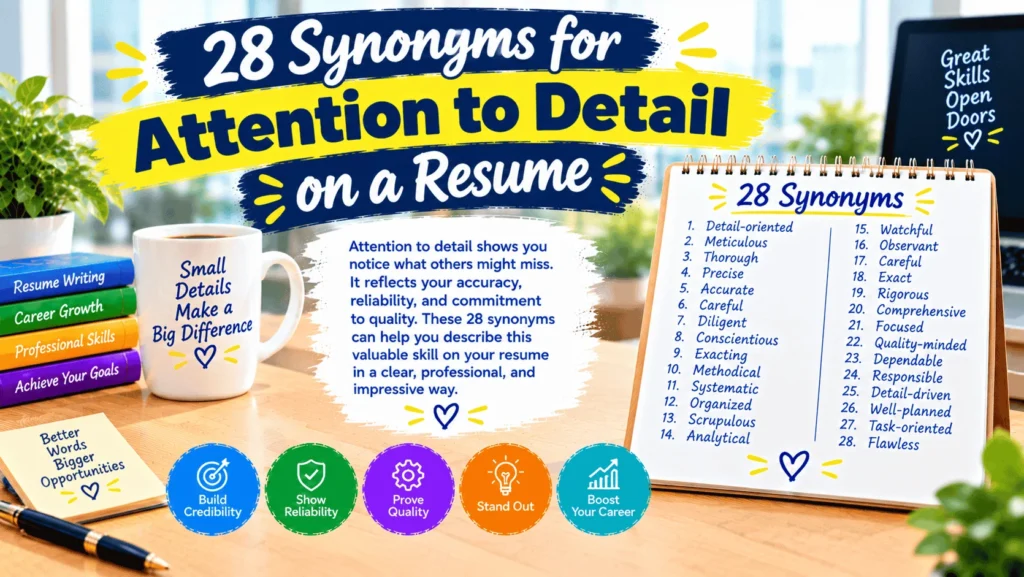
If you are looking for good synonyms for attention to detail on a resume, you probably want a stronger way to describe your accuracy, organization, and ability to notice small but important issues. While “attention to detail” is useful, it appears on many resumes and can sound generic when used without evidence.
The right alternative can make your resume more specific and professional. For example, instead of simply writing “I have excellent attention to detail,” you could say “highly detail-oriented,” “meticulous,” “quality-focused,” or “strong eye for accuracy.”
Your choice should match the job and the skill you want to emphasize. Some phrases work well for resumes, while others fit better in cover letters, interviews, emails, workplace communication, or professional networking.
This guide explains the best professional way to say attention to detail, with practical examples, tone differences, and resume-ready sentences.
What Does “Attention to Detail” Mean?
Attention to detail means carefully noticing, checking, and managing small pieces of information to ensure work is accurate, complete, and high quality.
On a resume, the phrase usually suggests that you can:
- Spot errors and inconsistencies
- Follow instructions carefully
- Check work before submitting it
- Maintain accurate records
- Notice important details others may miss
- Produce consistent, high-quality work
- Follow processes and standards
- Manage complex information accurately
Literal meaning
The phrase describes the ability to focus closely on individual details rather than looking only at the bigger picture.
Example:
“Her attention to detail helps her identify errors before reports are submitted.”
Tone
“Attention to detail” has a professional, neutral, and positive tone. It is suitable for most industries and levels of employment.
Purpose
Employers often look for this quality because small mistakes can create larger problems in areas such as:
- Finance
- Healthcare
- Administration
- Legal work
- Data entry
- Engineering
- Project management
- Customer service
- Quality control
- Research
- Marketing
- Software development
Emotional context
The phrase can communicate reliability, care, responsibility, precision, and professionalism.
However, simply claiming that you are detail-oriented is less convincing than showing how you use the skill.
Instead of:
“I have great attention to detail.”
Try:
“Reviewed financial reports for accuracy and corrected discrepancies before submission.”
The second example demonstrates the skill rather than merely naming it.
28 Good Synonyms for Attention to Detail on a Resume
Here are strong alternatives, organized by the context in which they work best.
1. Detail-Oriented
Tone: Professional
Best use: Most resumes and job applications
“Detail-oriented” is probably the most direct synonym for attention to detail.
Resume example:
Detail-oriented administrative professional with experience managing complex records and schedules.
It works well because it is concise and widely understood.
2. Meticulous
Tone: Formal and professional
Best use: Positions requiring accuracy and careful review
“Meticulous” suggests that you work carefully and pay close attention to small details.
Resume example:
Meticulous financial analyst with a strong record of identifying reporting discrepancies.
This is especially effective for finance, accounting, research, administration, and quality assurance.
3. Highly Detail-Oriented
Tone: Professional
Best use: Summary statements and professional profiles
Adding “highly” emphasizes the strength of the skill.
Example:
Highly detail-oriented project coordinator skilled in managing multiple deadlines and documentation requirements.
Avoid using this phrase repeatedly throughout the same resume.
4. Detail-Focused
Tone: Professional and modern
Best use: Corporate resumes
“Detail-focused” emphasizes concentration on accuracy and completeness.
Example:
Detail-focused operations specialist with experience maintaining accurate client records.
5. Precision-Focused
Tone: Formal and technical
Best use: Engineering, manufacturing, finance, data, and technical roles
This phrase emphasizes precision rather than simply noticing details.
Example:
Precision-focused engineer experienced in reviewing technical specifications and quality standards.
6. Meticulous in My Work
Tone: Professional and personal
Best use: Cover letters, profiles, and interviews
This is a more natural alternative when you want to describe yourself directly.
Example:
I am meticulous in my work and consistently review documents for accuracy before submission.
7. Strong Eye for Detail
Tone: Professional and conversational
Best use: Resumes, cover letters, creative roles
This phrase sounds slightly more natural and less repetitive than “attention to detail.”
Example:
Strong eye for detail when reviewing marketing materials, product information, and client communications.
8. Strong Eye for Accuracy
Tone: Professional
Best use: Finance, administration, data, and customer service
This option focuses specifically on correctness.
Example:
Demonstrated a strong eye for accuracy when processing high-volume customer records.
9. Accuracy-Focused
Tone: Professional and concise
Best use: Resume skills sections
Example:
Accuracy-focused professional with experience managing large volumes of financial data.
This is particularly useful when accuracy is central to the role.
10. Quality-Focused
Tone: Professional
Best use: Operations, manufacturing, management, and customer service
“Quality-focused” suggests that you care about producing work that meets high standards.
Example:
Quality-focused professional committed to maintaining accurate and consistent customer records.
11. Precision-Oriented
Tone: Formal
Best use: Technical and analytical positions
Example:
Precision-oriented data analyst with experience validating complex datasets.
12. Thorough
Tone: Professional and straightforward
Best use: General resumes and workplace communication
“Thorough” suggests that you complete tasks carefully and do not overlook important information.
Example:
Thorough administrative professional with experience reviewing contracts and maintaining compliance records.
13. Careful and Thorough
Tone: Professional and approachable
Best use: Administrative, customer-facing, and support positions
Example:
Known for being careful and thorough when handling sensitive customer information.
14. Highly Accurate
Tone: Professional
Best use: Finance, data, administration, and technical work
Example:
Highly accurate professional with experience processing financial transactions and maintaining detailed records.
15. Accuracy-Driven
Tone: Modern and results-focused
Best use: Corporate and technical resumes
Example:
Accuracy-driven operations specialist with a track record of reducing documentation errors.
16. Detail-Conscious
Tone: Professional
Best use: Workplace and business contexts
Example:
Detail-conscious coordinator skilled in organizing schedules, reports, and project documentation.
17. Diligent
Tone: Formal and professional
Best use: Traditional resumes and professional applications
“Diligent” emphasizes care, persistence, and responsible work habits.
Example:
Diligent accounting professional with a strong record of maintaining accurate financial records.
18. Careful With Details
Tone: Friendly and straightforward
Best use: Interviews, cover letters, and less formal professional writing
Example:
I am careful with details and always verify important information before sending reports to clients.
This is less powerful than “meticulous” on a resume but sounds natural in conversation.
19. Detail-Driven
Tone: Modern and business-focused
Best use: Corporate and project-based roles
Example:
Detail-driven project manager experienced in coordinating complex deliverables across multiple teams.
20. Quality-Conscious
Tone: Formal and professional
Best use: Manufacturing, operations, healthcare, and quality assurance
Example:
Quality-conscious professional committed to meeting internal standards and regulatory requirements.
21. Methodical
Tone: Formal and analytical
Best use: Research, engineering, finance, and operations
“Methodical” suggests a structured, careful approach.
Example:
Methodical researcher skilled in reviewing data, documenting findings, and identifying inconsistencies.
22. Systematic
Tone: Professional and analytical
Best use: Operations, project management, research, and technical roles
Example:
Systematic approach to reviewing documentation and identifying process improvements.
23. Detail-Driven Professional
Tone: Strong and professional
Best use: Resume summaries
Example:
Detail-driven professional with five years of experience managing complex administrative processes.
24. Committed to Accuracy
Tone: Professional and trustworthy
Best use: Resume summaries and cover letters
Example:
Committed to accuracy, consistency, and timely completion of financial reports.
25. Strong Focus on Accuracy
Tone: Professional
Best use: General business resumes
Example:
Strong focus on accuracy when handling customer accounts and transaction records.
26. Precise and Thorough
Tone: Formal
Best use: Technical, analytical, and professional roles
Example:
Precise and thorough approach to reviewing contracts, reports, and operational procedures.
27. Consistently Accurate
Tone: Results-focused
Best use: Achievement-based resumes
Example:
Maintained consistently accurate records across more than 2,000 customer accounts.
This is stronger than simply saying you “pay attention to detail” because it points toward performance.
28. Strong Quality-Control Mindset
Tone: Professional and specialized
Best use: Quality assurance, manufacturing, software testing, and operations
Example:
Strong quality-control mindset with experience identifying defects and improving review procedures.
Quick Comparison Table
| Alternative | Tone | Best Use |
|---|---|---|
| Detail-oriented | Professional | General resumes |
| Meticulous | Formal | Accuracy-heavy roles |
| Highly detail-oriented | Professional | Resume summaries |
| Detail-focused | Modern | Corporate resumes |
| Precision-focused | Technical | Engineering/data |
| Strong eye for detail | Friendly professional | Resumes/cover letters |
| Accuracy-focused | Professional | Data/finance |
| Quality-focused | Business | Operations |
| Thorough | Neutral | General employment |
| Highly accurate | Professional | Finance/data |
| Diligent | Formal | Traditional professions |
| Methodical | Analytical | Research/technical |
| Systematic | Professional | Operations |
| Detail-driven | Modern | Corporate roles |
| Quality-conscious | Formal | QA/operations |
| Committed to accuracy | Professional | Summaries/cover letters |
| Precise and thorough | Formal | Technical roles |
| Consistently accurate | Results-focused | Achievement statements |
How to Use These Synonyms on a Resume
A strong resume does more than list a synonym. It connects the skill to an action or result.
Weak
Attention to detail.
Better
Detail-oriented professional with experience reviewing reports and maintaining accurate records.
Stronger
Reviewed 150+ client records weekly and maintained 99% data accuracy.
The final example gives an employer evidence of the skill.
Use the right synonym for the job
For an accounting position, consider:
Meticulous and accuracy-focused accounting professional.
For an administrative position:
Detail-oriented administrative professional experienced in managing complex documentation.
For a software testing position:
Strong quality-control mindset with experience identifying and resolving software defects.
For project management:
Detail-driven project coordinator skilled in managing timelines, documentation, and deliverables.
For customer service:
Thorough and accuracy-focused professional committed to maintaining reliable customer records.
Professional Usage in Different Contexts
In Emails
When writing a business email, “attention to detail” often describes someone’s work quality.
Example:
Thank you for your careful review and attention to detail.
A slightly more polished alternative is:
Thank you for your meticulous review of the document.
For everyday business email phrases, “careful review,” “thorough review,” and “close attention” often sound more natural.
In the Workplace
In workplace communication, use these phrases to describe performance:
Your thorough approach helped us catch the reporting error before submission.
Or:
I appreciate your meticulous work on the project.
These alternatives sound more specific than repeatedly saying “great attention to detail.”
With Clients
Client communication should sound positive without becoming overly formal.
Example:
Thank you for your careful review of the proposal. Your feedback helped us finalize the details.
“Careful review” often works better than “meticulousness” because it feels natural and client-friendly.
In Networking
Networking language usually benefits from a warm and conversational tone.
Example:
I really appreciated your thoughtful approach to the discussion.
Or:
Your thorough perspective on the project was very helpful.
In Customer Service
Customer service communication should emphasize accuracy and care.
Example:
We carefully reviewed your account to make sure all information was accurate.
Instead of:
We used our attention to detail to review your account.
The first sentence sounds much more natural.
Email Examples
Client Email
Thank you for your careful review of the proposal. We have incorporated your comments and updated the final version accordingly.
Manager Email
I appreciate your meticulous review of the report. Your feedback helped us identify several inconsistencies before submission.
Colleague Email
Thanks for taking such a thorough look at the document. I appreciate you catching those small errors.
Customer Email
We carefully reviewed your account and confirmed that all of the information is now correct.
Networking Email
I appreciated your thoughtful and thorough perspective during our conversation. It gave me several useful ideas to consider.
Meeting Follow-Up
Thank you for the detailed discussion today. I appreciate everyone’s careful review of the proposed next steps.
Common Mistakes to Avoid
1. Repeating “Attention to Detail” Too Often
Using the phrase several times can make a resume feel repetitive.
Instead, rotate naturally between:
- Detail-oriented
- Meticulous
- Thorough
- Accuracy-focused
- Precise
- Quality-focused
- Methodical
2. Making an Unsupported Claim
Simply writing:
Excellent attention to detail
does not prove anything.
Support the claim with evidence.
Better:
Identified and corrected 50+ data inconsistencies during monthly reporting.
3. Choosing an Overly Formal Word
“Meticulous” is useful, but you do not need it everywhere.
For a friendly workplace message, this may sound too stiff:
Thank you for your meticulous attention to the matter.
A more natural version is:
Thank you for taking the time to review this carefully.
4. Using Generic Resume Buzzwords
Words such as “detail-oriented” are common. They become stronger when connected to measurable achievements.
Instead of:
Detail-oriented employee.
Try:
Maintained accurate records for 500+ customer accounts with consistent compliance across monthly audits.
5. Confusing “Detail-Oriented” With “Organized”
These qualities overlap but are not identical.
Detail-oriented means you notice and manage small pieces of information carefully.
Organized means you arrange tasks, information, resources, or schedules effectively.
A person can be highly organized without being particularly detail-oriented.
Related Phrases and Their Meanings
| Related phrase | Meaning | Example |
|---|---|---|
| Careful review | Checking something closely | “I completed a careful review.” |
| Thorough review | Checking all relevant areas | “The team conducted a thorough review.” |
| Strong eye for detail | Ability to notice small issues | “She has a strong eye for detail.” |
| High level of accuracy | Consistently correct work | “The role requires a high level of accuracy.” |
| Quality-focused | Focused on producing good work | “He takes a quality-focused approach.” |
| Precision-oriented | Focused on exactness | “She is precision-oriented.” |
| Detail-conscious | Aware of important details | “He is detail-conscious when reviewing contracts.” |
| Diligent approach | Careful and responsible approach | “She takes a diligent approach to documentation.” |
| Methodical approach | Structured and careful process | “He uses a methodical approach to research.” |
| Thorough approach | Complete and careful process | “Her thorough approach improves accuracy.” |
| Careful attention | Focus on important information | “Thank you for your careful attention.” |
| Quality control | Process for maintaining standards | “I managed quality-control checks.” |
| Accuracy-driven | Strong focus on correctness | “Accuracy-driven analyst.” |
| Error-conscious | Alert to potential errors | “Error-conscious reviewer.” |
| Detail management | Managing small pieces of information | “Strong detail-management skills.” |
| Precision | Exactness and accuracy | “Requires precision and consistency.” |
| Consistency | Maintaining the same standard | “Ensured consistency across reports.” |
| Verification | Checking that information is correct | “Completed verification before submission.” |
Primary Phrase vs. Alternatives
The best alternative depends on the exact quality you want to communicate.
| Phrase | Formality | Main emphasis | Best use |
|---|---|---|---|
| Attention to detail | Neutral | General care | General resumes |
| Detail-oriented | Professional | Overall detail awareness | Most resumes |
| Meticulous | Formal | Extremely careful work | Finance/research |
| Thorough | Neutral | Completeness | General workplace |
| Precise | Formal | Exactness | Technical roles |
| Accuracy-focused | Professional | Correctness | Data/finance |
| Quality-focused | Professional | Work standards | Operations |
| Methodical | Formal | Structured process | Research |
| Systematic | Professional | Organized process | Operations |
| Strong eye for detail | Friendly | Noticing small issues | Creative/client roles |
| Detail-driven | Modern | Detail-centered approach | Corporate resumes |
| Diligent | Formal | Care and responsibility | Traditional roles |
Which is the strongest?
There is no single best synonym for every resume.
Best all-purpose option: Detail-oriented
Best formal option: Meticulous
Best technical option: Precision-focused
Best results-focused option: Accuracy-driven
Best friendly option: Strong eye for detail
Best analytical option: Methodical
Best quality-focused option: Quality-focused
Cultural Usage
US English
“Detail-oriented” is extremely common in American resumes and job descriptions. It is familiar to recruiters and hiring managers across many industries.
Example:
Detail-oriented professional with five years of experience in operations.
UK English
British professional communication commonly uses “attention to detail,” “meticulous,” “thorough,” and “accurate.”
Example:
A meticulous administrator with excellent record-keeping skills.
Both American and British English generally understand these expressions.
Corporate Communication
Corporate writing tends to favor concise expressions such as:
- Detail-oriented
- Accuracy-focused
- Quality-focused
- Thorough
- Precision-driven
Avoid unnecessarily complicated vocabulary when a simple phrase communicates the same idea.
Customer Service
Customer service communication benefits from warmer language:
We carefully reviewed your request.
This is usually better than:
We conducted a meticulous examination of your request.
The second sentence sounds unnecessarily formal.
Networking
Networking requires a balance between professionalism and warmth.
Instead of:
I was impressed by your meticulous attention to detail.
Consider:
I really appreciated your thoughtful and thorough approach.
The second version sounds more conversational.
FAQs
1. What is a good synonym for attention to detail on a resume?
Detail-oriented is the most versatile synonym. Other strong choices include meticulous, thorough, precision-focused, accuracy-focused, quality-focused, and detail-driven.
2. What is a formal alternative to attention to detail?
“Meticulous,” “precision-oriented,” “methodical,” and “highly accurate” are strong formal alternatives. Choose the word that best matches the job.
3. How do I say “attention to detail” professionally?
You can say:
Detail-oriented professional with a strong focus on accuracy and quality.
Even better, demonstrate the skill with a measurable accomplishment.
4. Is “detail-oriented” a good resume skill?
Yes. It is widely understood and appropriate for many positions. However, because it is common, you should support it with specific examples or achievements.
5. What is a stronger word than detail-oriented?
“Meticulous” can be stronger because it suggests an especially careful approach. “Precision-focused” may be stronger for technical positions.
6. How can I show attention to detail without saying it?
Use evidence:
Reviewed 200+ monthly records and corrected discrepancies before final submission.
This demonstrates attention to detail without using the exact phrase.
7. What is another way to say “strong attention to detail”?
Try:
- Highly detail-oriented
- Meticulous
- Strong eye for detail
- Accuracy-focused
- Precision-focused
- Thorough
- Detail-driven
8. What is the best synonym for attention to detail in a resume summary?
“Detail-oriented” works well for most industries. For specialized positions, “meticulous,” “accuracy-focused,” or “precision-focused” may communicate the skill more effectively.
9. Can I use “meticulous” on a resume?
Yes. “Meticulous” is professional and effective when the position requires careful review, accuracy, compliance, or quality control.
10. Should I put “attention to detail” in my resume skills section?
You can, but showing the skill through accomplishments is usually stronger. Combine the skill with evidence rather than relying only on a keyword.
Final Summary
The best good synonyms for attention to detail on a resume depend on the job and the specific quality you want to highlight. Detail-oriented is the safest all-purpose option, while meticulous works well for formal and accuracy-heavy positions. Precision-focused suits technical roles, accuracy-driven emphasizes results, and strong eye for detail offers a warmer alternative.
For resumes, do not simply replace one buzzword with another. The strongest professional communication pairs the synonym with evidence. Show how your careful work improved accuracy, prevented errors, supported clients, or strengthened results. That approach makes your resume more credible, specific, and persuasive.




