
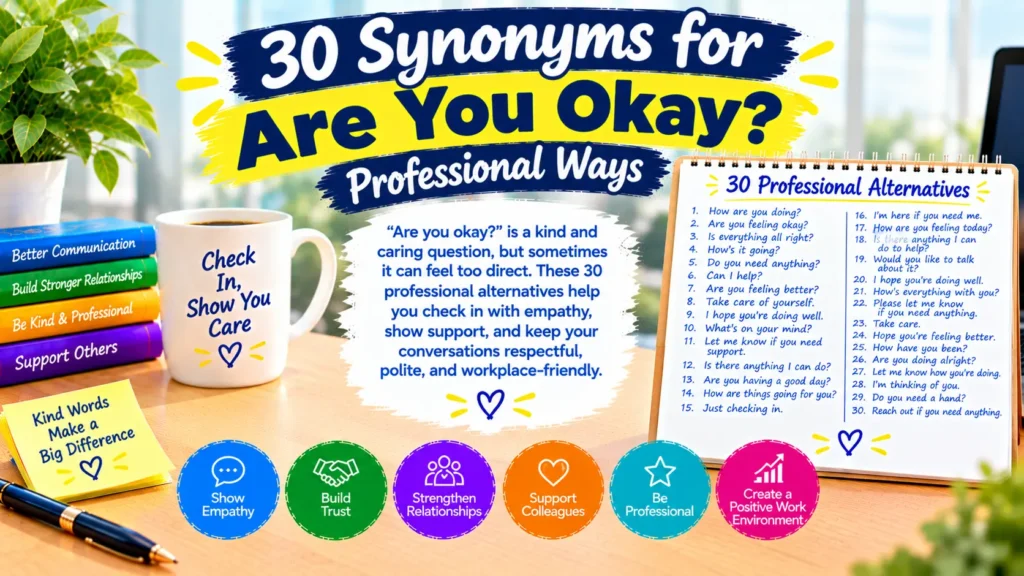
The phrase “Are you okay?” is a simple way to show concern, check on someone’s well-being, or find out if something is wrong. However, it may not always fit the situation, especially in professional emails, workplace conversations, client communication, or formal meetings.
Finding the right synonyms for are you okay can help you sound more professional, polite, supportive, and respectful. For example, you might ask a colleague, “Is everything all right?” or write to a client, “I wanted to check whether everything is going smoothly.”
The best alternative depends on your relationship with the person, the situation, and the level of concern you want to express. Some phrases work well in formal business emails, while others sound warmer and more natural in everyday conversations.
In this guide, you will discover 30 professional, formal, friendly, and email-ready alternatives to “Are you okay?” You will also find practical examples, a comparison table, email templates, common mistakes, and answers to frequently asked questions.
What Does “Are You Okay?” Mean?
“Are you okay?” is a question that asks whether someone feels well, feels safe, or is dealing with a problem.
People use this phrase to check on someone’s physical health, emotional state, comfort, or general well-being.
Literal meaning
The literal meaning of “Are you okay?” is “Are you feeling well?” or “Is everything all right with you?”
For example:
- Physical well-being: “You fell during the game. Are you okay?”
- Emotional well-being: “You seem upset. Are you okay?”
- Workplace concerns: “You have been unusually quiet today. Are you okay?”
- General comfort: “Is this meeting time okay for you?”
Tone and purpose
The phrase usually sounds caring, direct, and conversational. It shows that you have noticed something and want to make sure the other person feels comfortable or safe.
However, the tone can change depending on how you say it. A gentle question may show genuine concern, while a repeated or forceful question may sound intrusive.
When should you use an alternative?
Consider choosing a different expression when:
- You need a more professional tone in an email.
- You want to check on a colleague without asking about private matters.
- You are contacting a client about a possible issue.
- You want to express concern without making assumptions.
- You need to confirm that someone is comfortable with a decision or arrangement.
For example, “I hope everything is going well” sounds less personal than “Are you okay?” and works well in a professional email.
When Is “Are You Okay?” Appropriate at Work?
The phrase is not automatically unprofessional. In fact, it can be the right choice when someone appears distressed, experiences an accident, or needs immediate support.
Still, professional communication often benefits from language that matches the situation.
In emails
When you write an email, choose a phrase that explains why you are reaching out.
Instead of:
“Are you okay? You haven’t replied to my last email.”
Try:
“I wanted to check in and see whether you have everything you need from me.”
The second version sounds supportive rather than demanding.
In workplace conversations
When a colleague seems stressed, a gentle question can show care without putting them under pressure.
Example:
“You seem to have a lot on your plate today. Is there anything I can help with?”
This focuses on support rather than asking the person to explain their emotions.
With clients
Clients may appreciate a professional check-in that focuses on their experience, progress, or needs.
Example:
“I wanted to make sure everything is going smoothly with the new system.”
This approach is especially useful when you want to identify concerns without making the client uncomfortable.
In networking
When reconnecting with a professional contact, a friendly expression works better than a personal question without context.
Example:
“I hope all is well with you. How have things been since we last spoke?”
This sounds warm and encourages a natural conversation.
In customer service
Customer service teams should focus on the customer’s experience and any help they may need.
Example:
“Is there anything else I can help you with today?”
This is more useful than asking whether the customer is okay when the actual goal is to resolve a problem.
30 Professional and Polite Synonyms for “Are You Okay?”
The following alternatives cover different levels of formality, concern, and friendliness. Choose the phrase that best matches your situation.
Professional Alternatives to “Are You Okay?”
These expressions work well with colleagues, managers, clients, and business contacts.
1. Is Everything All Right?
Tone: Professional, caring, and direct.
Best use: Workplace conversations, emails, and situations where you notice a possible problem.
This is one of the closest synonyms for “Are you okay?” It expresses concern without sounding overly personal.
Example: “You seemed concerned during the meeting. Is everything all right?”
2. Is Everything Going Well?
Tone: Polite, neutral, and professional.
Best use: Client communication, project updates, and general check-ins.
This phrase focuses on how things are progressing rather than on someone’s personal feelings.
Example: “I wanted to check in and ask whether everything is going well with the project.”
3. How Are Things Going?
Tone: Friendly and professional.
Best use: Conversations with colleagues, managers, and business contacts.
This open-ended question allows the other person to share an update or mention a concern if they wish.
Example: “How are things going with the new responsibilities?”
4. Is There Anything You Need Help With?
Tone: Supportive and practical.
Best use: Team communication, workload concerns, and project difficulties.
This phrase offers direct support without asking personal questions.
Example: “I noticed the deadline is approaching. Is there anything you need help with?”
5. Are You Comfortable With This Arrangement?
Tone: Respectful and businesslike.
Best use: Scheduling, negotiations, workplace decisions, and client agreements.
Use this expression when you want to know whether someone agrees with a plan or feels comfortable with the arrangement.
Example: “We can move the meeting to Thursday. Are you comfortable with this arrangement?”
6. Is Everything on Track?
Tone: Professional and task-focused.
Best use: Project management, deadlines, and team updates.
This is a useful alternative when you are concerned about progress rather than someone’s health or emotional state.
Example: “I wanted to check whether everything is on track for Friday’s launch.”
Formal Alternatives to “Are You Okay?”
These options suit formal emails, senior colleagues, important clients, and situations that call for respectful language.
7. I Hope Everything Is Well With You.
Tone: Formal, courteous, and warm.
Best use: Business emails, professional introductions, and follow-up messages.
This expression shows concern without requiring the recipient to discuss personal matters.
Example: “I hope everything is well with you. I am writing to follow up on our recent discussion.”
8. May I Ask If Everything Is All Right?
Tone: Respectful and formal.
Best use: Sensitive workplace conversations and communication with senior professionals.
This phrase softens the question and gives the other person room to respond.
Example: “You seemed concerned after the presentation. May I ask if everything is all right?”
9. I Wanted to Check Whether You Are Doing Well.
Tone: Thoughtful and professional.
Best use: Formal emails, personal check-ins, and follow-ups after a difficult event.
It communicates genuine concern without sounding overly familiar.
Example: “I wanted to check whether you are doing well following last week’s unexpected changes.”
10. Please Let Me Know If You Need Any Assistance.
Tone: Formal, supportive, and courteous.
Best use: Client emails, management communication, and professional support.
This phrase is especially effective when you want to offer help while respecting the recipient’s privacy.
Example: “Please let me know if you need any assistance with the onboarding process.”
11. I Would Like to Ensure That Everything Is in Order.
Tone: Formal and businesslike.
Best use: Administrative matters, business arrangements, and project coordination.
This alternative focuses on whether things are proceeding correctly.
Example: “I would like to ensure that everything is in order before we finalize the agreement.”
12. I Trust That All Is Well.
Tone: Formal, polished, and somewhat traditional.
Best use: Formal correspondence with established business contacts.
This phrase expresses goodwill but does not directly ask the recipient to share personal information.
Example: “I trust that all is well. I am writing to discuss the next stage of our partnership.”
Friendly Alternatives to “Are You Okay?”
These expressions work well with teammates, familiar clients, friends at work, and professional contacts you know well.
13. How Are You Holding Up?
Tone: Warm, empathetic, and concerned.
Best use: Difficult deadlines, stressful events, personal challenges, or demanding periods.
This phrase is especially appropriate when you know someone has been dealing with a challenging situation.
Example: “I know this week has been demanding. How are you holding up?”
14. How Have You Been?
Tone: Friendly and conversational.
Best use: Reconnecting with colleagues, former coworkers, and professional contacts.
This expression works well when you have not spoken to someone for a while.
Example: “It’s been a while since we last spoke. How have you been?”
15. Everything Good?
Tone: Casual, friendly, and direct.
Best use: Informal workplace conversations with familiar colleagues.
This short phrase sounds natural in conversation but may feel too casual in a formal business email.
Example: “You seem a little distracted today. Everything good?”
16. Are You Doing All Right?
Tone: Gentle, friendly, and caring.
Best use: Checking on a colleague who seems tired, upset, or unusually quiet.
It feels slightly softer than the direct question “Are you okay?”
Example: “You had a difficult call earlier. Are you doing all right?”
17. How’s Everything on Your End?
Tone: Friendly and professional.
Best use: Remote work, virtual meetings, project discussions, and client check-ins.
This expression invites an update about work or general circumstances.
Example: “How’s everything on your end with the upcoming presentation?”
18. Is There Anything on Your Mind?
Tone: Empathetic and open.
Best use: Supportive conversations with colleagues or team members.
This phrase encourages someone to share a concern if they feel comfortable doing so. Use it only when your relationship allows for a more personal conversation.
Example: “You seemed hesitant during the discussion. Is there anything on your mind?”
Email Alternatives to “Are You Okay?”
Written communication requires special care because readers cannot hear your tone of voice. These phrases help you sound clear, polite, and considerate.
19. I Just Wanted to Check In.
Tone: Friendly, gentle, and professional.
Best use: Follow-up emails, remote teams, and general check-ins.
This is a flexible phrase that does not pressure the recipient to explain anything.
Example: “I just wanted to check in and see how things are going with the proposal.”
20. I Hope Everything Is Going Smoothly.
Tone: Courteous and reassuring.
Best use: Client communication, project updates, and business relationships.
This phrase expresses goodwill and works particularly well when you want to know whether a process is running without problems.
Example: “I hope everything is going smoothly with the transition to our new platform.”
21. I Wanted to See How You Were Doing.
Tone: Warm and considerate.
Best use: Follow-up emails after a challenging event or an extended absence.
This wording shows that you care about the person, not just the work.
Example: “I wanted to see how you were doing after the changes announced last week.”
22. Please Let Me Know If There Is Anything I Can Do to Help.
Tone: Helpful, polite, and professional.
Best use: Supporting colleagues, clients, and team members who face difficulties.
This phrase offers assistance without demanding an explanation.
Example: “I understand that the schedule has changed. Please let me know if there is anything I can do to help.”
23. I Wanted to Make Sure You Have Everything You Need.
Tone: Supportive and practical.
Best use: Onboarding, client service, project handovers, and new assignments.
It focuses on resources and support rather than personal well-being.
Example: “I wanted to make sure you have everything you need before the training session.”
24. Is There Anything I Can Clarify for You?
Tone: Professional and reassuring.
Best use: Client emails, instructions, presentations, and project handovers.
Use this phrase when you suspect someone may have questions or need additional information.
Example: “Please review the attached proposal and let me know if there is anything I can clarify for you.”
Workplace Alternatives to “Are You Okay?”
These phrases are useful when you notice a problem at work or want to support a colleague without crossing personal boundaries.
25. Do You Need a Hand With Anything?
Tone: Friendly, helpful, and approachable.
Best use: Teamwork, busy periods, and everyday office conversations.
This natural expression offers practical support.
Example: “You have several tasks due today. Do you need a hand with anything?”
26. Is There Anything We Should Address?
Tone: Collaborative and professional.
Best use: Team meetings, project reviews, and discussions about workplace problems.
This phrase shifts attention toward solutions rather than personal feelings.
Example: “Before we move forward, is there anything we should address regarding the new timeline?”
27. Would You Like to Talk About It?
Tone: Empathetic and respectful.
Best use: Conversations with colleagues you know well who may be experiencing difficulty.
This phrase gives the other person a choice. It does not assume they want to discuss the issue.
Example: “You seemed upset after the meeting. Would you like to talk about it?”
28. Is Something Bothering You?
Tone: Direct, concerned, and personal.
Best use: Close working relationships where you have noticed a clear change in someone’s behavior.
This expression can show genuine concern, but it may feel intrusive if you use it with someone you barely know.
Example: “You seem distracted today. Is something bothering you?”
29. Are You Feeling Better?
Tone: Caring and considerate.
Best use: Following up after illness, an injury, or a known period of discomfort.
Use this phrase when you already know the person was unwell.
Example: “I heard you were feeling unwell yesterday. Are you feeling better today?”
30. Is There Anything You’d Like to Discuss?
Tone: Respectful, professional, and open-ended.
Best use: One-on-one meetings, manager conversations, and project reviews.
This phrase allows the other person to raise a personal or work-related concern without feeling pressured.
Example: “Before we wrap up, is there anything you’d like to discuss or any support you need?”
Quick Comparison Table
| Alternative | Tone | Best Use |
|---|---|---|
| Is everything all right? | Caring, direct | General check-ins |
| Is everything going well? | Professional | Client updates |
| How are things going? | Friendly | Workplace conversations |
| Do you need help with anything? | Supportive | Teamwork |
| Are you comfortable with this arrangement? | Respectful | Decisions and agreements |
| Is everything on track? | Task-focused | Project updates |
| I hope everything is well with you. | Formal, warm | Business emails |
| May I ask if everything is all right? | Formal | Sensitive conversations |
| I wanted to check whether you are doing well. | Considerate | Personal follow-ups |
| Please let me know if you need assistance. | Formal, helpful | Client support |
| I would like to ensure everything is in order. | Businesslike | Administrative matters |
| I trust that all is well. | Traditional, formal | Professional correspondence |
| How are you holding up? | Empathetic | Difficult situations |
| How have you been? | Friendly | Reconnecting |
| Everything good? | Casual | Familiar colleagues |
| Are you doing all right? | Gentle | Personal check-ins |
| How’s everything on your end? | Friendly, professional | Remote work |
| Is there anything on your mind? | Empathetic | Supportive conversations |
| I just wanted to check in. | Gentle, professional | Follow-up emails |
| I hope everything is going smoothly. | Courteous | Client communication |
| I wanted to see how you were doing. | Warm | Follow-ups |
| Please let me know if I can help. | Supportive | Offering assistance |
| Do you have everything you need? | Practical | Onboarding |
| Is there anything I can clarify? | Professional | Instructions and proposals |
| Do you need a hand with anything? | Friendly | Team support |
| Is there anything we should address? | Collaborative | Meetings |
| Would you like to talk about it? | Empathetic | Sensitive situations |
| Is something bothering you? | Direct, personal | Close colleagues |
| Are you feeling better? | Caring | Recovery follow-ups |
| Is there anything you’d like to discuss? | Respectful | One-on-one meetings |
Email Examples: How to Ask “Are You Okay?” Professionally
The right wording depends on the recipient and the reason for your message. Use these examples as starting points.
1. Email to a Client
Subject: Checking In on the Project
Hi Jordan,
I wanted to check in and see whether everything is going smoothly with the project. Please let me know if you have any questions or need additional support from our team.
Best regards,
Alex
Why it works: It shows concern while keeping the focus on the client’s experience.
2. Email to Your Manager
Subject: Quick Check-In
Hi Morgan,
I wanted to check in following our meeting earlier today. Please let me know if there is anything you would like me to clarify or any additional support I can provide.
Best regards,
Taylor
Why it works: It stays professional and offers practical help without making personal assumptions.
3. Email to a Colleague
Subject: Checking In
Hi Sam,
You seemed a little overwhelmed during today’s meeting, so I wanted to check in. How are things going? If you need a hand with anything, I’d be happy to help.
Thanks,
Jamie
Why it works: It combines genuine concern with an offer of support.
4. Email to a Customer
Subject: Following Up on Your Experience
Hello Casey,
I wanted to make sure everything is going well with your recent purchase. If you have encountered any issues or need assistance, please reply to this email, and I’ll be happy to help.
Kind regards,
Customer Support Team
Why it works: It focuses on the customer’s experience and gives them a clear next step.
5. Email to a Networking Contact
Subject: Reconnecting
Hi Riley,
I hope everything is going well with you. It’s been a while since we last connected, and I wanted to see how things have been on your end.
I’d love to hear what you’ve been working on recently.
Best,
Chris
Why it works: It sounds warm and natural without asking a personal question too soon.
6. Meeting Follow-Up Email
Subject: Follow-Up on Today’s Meeting
Hi everyone,
Thank you for your time today. I wanted to check whether there are any outstanding concerns or questions we should address before moving forward.
Please share any feedback or support you may need.
Best regards,
Morgan
Why it works: It invites people to raise concerns while keeping the discussion focused on the team’s work.
Common Mistakes to Avoid
Even a well-intended question can create discomfort when you use it in the wrong way. Follow these guidelines to maintain professional communication.
1. Asking Too Many Times
Repeatedly asking “Are you okay?” may make someone feel pressured to explain their feelings.
Instead: Ask once in a considerate way and give them room to respond.
Example: “I wanted to check in. I’m here if you need anything.”
2. Assuming Someone Has a Problem
A quiet colleague may simply be concentrating. Avoid treating your impression as a fact.
Instead: Use neutral language.
Example: “How are things going today?” rather than “What’s wrong with you?”
3. Using Overly Personal Language With Clients
Questions about someone’s emotions or private life can cross professional boundaries.
Instead: Focus on their experience or needs.
Example: “Is there anything we can do to improve your experience?”
4. Choosing a Phrase That Sounds Too Formal
A phrase such as “May I inquire as to your well-being?” may sound unnatural in an everyday conversation.
Instead: Use simple language that fits your relationship.
Example: “I hope you’re doing well.”
5. Using Casual Language in Formal Emails
Expressions such as “Everything good?” work well with familiar colleagues but may sound too casual when you contact a new client.
Instead: Choose “I wanted to check whether everything is going well.”
6. Asking Without Offering Support
A question can feel empty if you show concern but provide no practical help when help is appropriate.
Instead: Pair your question with an offer.
Example: “Is everything all right? Please let me know if I can help with anything.”
7. Using “Are You Okay?” to Request a Work Update
If you want to know whether a task is complete, asking about someone’s well-being may confuse the purpose of your message.
Instead: Ask a direct work-related question.
Example: “Is everything on track for the deadline?”
Related Phrases: 18 Expressions With Meanings and Examples
These related expressions help you communicate concern, support, and interest in different situations.
- Checking in: Contacting someone to see how things are going.
Example: “I’m checking in to see how the transition is going.” - Touching base: Briefly reconnecting or exchanging updates.
Example: “I wanted to touch base before Friday’s meeting.” - How are you feeling? Asking about someone’s physical or emotional state.
Example: “How are you feeling after taking some time off?” - Hope you’re doing well: Expressing goodwill.
Example: “I hope you’re doing well and enjoying the new role.” - Are you feeling all right? Checking whether someone feels physically or emotionally well.
Example: “You look tired. Are you feeling all right?” - Can I help? Offering direct assistance.
Example: “You seem busy. Can I help with the report?” - Need anything? Offering help in a casual way.
Example: “I’m heading to the supply room. Need anything?” - What’s going on? Asking about a situation or concern.
Example: “I noticed a few changes in the schedule. What’s going on?” - How can I support you? Asking what help someone needs.
Example: “I know the workload has increased. How can I support you?” - Are things manageable? Checking whether someone can handle their responsibilities.
Example: “With the new deadlines, are things manageable?” - Is everything okay on your end? Checking for problems or delays.
Example: “I wanted to confirm that everything is okay on your end before we proceed.” - Do you have any concerns? Inviting someone to share potential issues.
Example: “Do you have any concerns about the proposed timeline?” - Would you like some help? Offering assistance politely.
Example: “Would you like some help preparing the presentation?” - Are we all set? Confirming readiness or completion.
Example: “Are we all set for tomorrow’s client meeting?” - Is everything clear? Checking whether someone understands instructions.
Example: “Is everything clear, or would you like me to explain any part again?” - How are you managing? Asking how someone is coping with a challenge.
Example: “How are you managing with the new responsibilities?” - Let me know if you need anything. Offering ongoing support.
Example: “I’ll be available this afternoon, so let me know if you need anything.” - I hope things improve soon. Expressing sympathy and hope.
Example: “I’m sorry this has been a difficult week. I hope things improve soon.”
“Are You Okay?” vs. Other Alternatives
Not every synonym carries the same meaning. Some ask about well-being, while others focus on work, comfort, or support.
| Phrase | Formality | Main Purpose | Best Situation |
|---|---|---|---|
| Are you okay? | Neutral | Check on well-being | Everyday conversation |
| Is everything all right? | Neutral to professional | Express concern | General check-in |
| I hope you’re doing well. | Professional | Express goodwill | Email opening |
| How are you holding up? | Friendly | Show empathy | Difficult period |
| Is everything on track? | Professional | Check progress | Project management |
| Do you need any assistance? | Formal | Offer help | Client or workplace email |
| Are you comfortable with this? | Professional | Check comfort or agreement | Decisions and arrangements |
| Is something bothering you? | Personal | Explore a concern | Close relationships |
| Is there anything we should address? | Professional | Identify issues | Meetings |
| Are you feeling better? | Caring | Check recovery | After illness |
Which phrase is closest in meaning?
“Is everything all right?” is one of the closest alternatives because it expresses nearly the same concern as “Are you okay?”
Which phrase sounds most professional?
“I wanted to check in and see whether everything is going well” works well for many business emails because it sounds polite and gives the recipient room to respond.
Which phrase is best for offering help?
“Please let me know if there is anything I can do to help” is a strong choice when you want to provide support without pressuring someone to share personal details.
Cultural Usage: How to Ask “Are You Okay?” Professionally
The best way to express concern can vary across workplaces, cultures, and professional relationships.
US English
In American workplaces, direct and friendly expressions are common. “Is everything okay?” and “How are things going?” work well in many everyday situations.
In formal emails, professionals often prefer “I wanted to check in” or “Please let me know if you need any assistance.”
UK English
British workplace communication often uses understated, polite expressions such as “Are you all right?” and “I hope you’re well.”
However, “Are you all right?” can also suggest concern when someone looks upset or has experienced a problem. Context and tone matter.
Corporate communication
In corporate environments, employees often choose expressions that focus on support, progress, and solutions.
For example:
- “Is everything on track?”
- “Are there any concerns we should address?”
- “Do you have the support you need?”
These phrases work well when the purpose is to identify an issue or keep a project moving.
Customer service
Customer service teams should focus on the customer’s needs rather than making assumptions about their emotional state.
Good examples include:
- “Is there anything else I can help you with?”
- “Are you satisfied with the solution?”
- “Have we addressed your concern?”
These questions encourage clear feedback and help customers explain what they need.
Professional networking
Networking requires warmth without unnecessary familiarity. When reconnecting with someone, use expressions such as:
- “I hope you’re doing well.”
- “How have things been?”
- “I wanted to see how things are going on your end.”
These phrases help build rapport without making the conversation feel intrusive.
FAQs About Synonyms for “Are You Okay?”
1. What is a professional way to say “Are you okay?”
A professional way to say “Are you okay?” is “Is everything all right?” You can also say, “I wanted to check in and see how things are going.” Both expressions communicate concern without sounding overly personal.
2. What is a formal alternative to “Are you okay?”
“I wanted to check whether everything is all right” is a polite formal alternative. “Please let me know if you need any assistance” is also suitable when you want to offer professional support.
3. How do you ask “Are you okay?” in a business email?
Use a phrase that matches your purpose. For a general check-in, write, “I hope everything is going well.” If you want to offer help, write, “Please let me know if there is anything I can do to support you.”
4. How do you ask a coworker if they are okay without sounding intrusive?
Use gentle, open-ended language such as “How are things going?” or “I wanted to check in and see how you’re doing.” Avoid assuming that something is wrong, and give your coworker the choice to share as much or as little as they wish.
5. What is a friendly way to ask if someone is okay?
“Are you doing all right?” and “How are you holding up?” are friendly options. The second phrase works especially well when you know someone is facing a difficult situation.
6. How do you ask a client if everything is okay?
Ask about the client’s experience or the progress of their project. For example, “I wanted to make sure everything is going smoothly. Please let me know if you have any questions or concerns.”
7. Is “Are you okay?” unprofessional?
No. “Are you okay?” is appropriate in many workplace situations, especially when someone appears distressed or needs immediate help. However, a more specific or neutral phrase may work better in formal emails or conversations with clients.
8. What is a polite way to check on someone’s well-being?
“I hope you’re doing well” is a polite way to express goodwill. If you want a direct response, ask, “I wanted to check in and see how you’ve been feeling.”
9. What can I say instead of “Are you okay?” when someone is upset?
You can say, “Would you like to talk about it?” or “Is there anything I can do to help?” Both expressions show concern and give the other person control over the conversation.
10. What is the best synonym for “Are you okay?” in a professional setting?
“Is everything all right?” is a strong general alternative. For business emails, “I wanted to check in and see whether everything is going well” often sounds more natural. The best choice depends on whether you are checking on someone’s well-being, offering help, or asking about work progress.
Conclusion: Choose the Right Alternative for Every Situation
Choosing the right synonym for “Are you okay?” helps you show concern while maintaining a professional tone. For business emails, phrases such as “I wanted to check in” and “I hope everything is going well” sound polite and natural. In the workplace, “Do you need a hand with anything?” offers practical support, while “Is everything all right?” works well for a direct, caring question. When speaking with clients, focus on their experience and needs. Above all, keep your language simple, respect personal boundaries, and let the situation guide your choice. Thoughtful wording builds trust and strengthens professional relationships.