The phrase “work closely” is common in professional communication, but it may not be the strongest choice for your resume. If you want to highlight teamwork, collaboration, or your ability to build strong working relationships, choosing more specific words can help you stand out to employers.
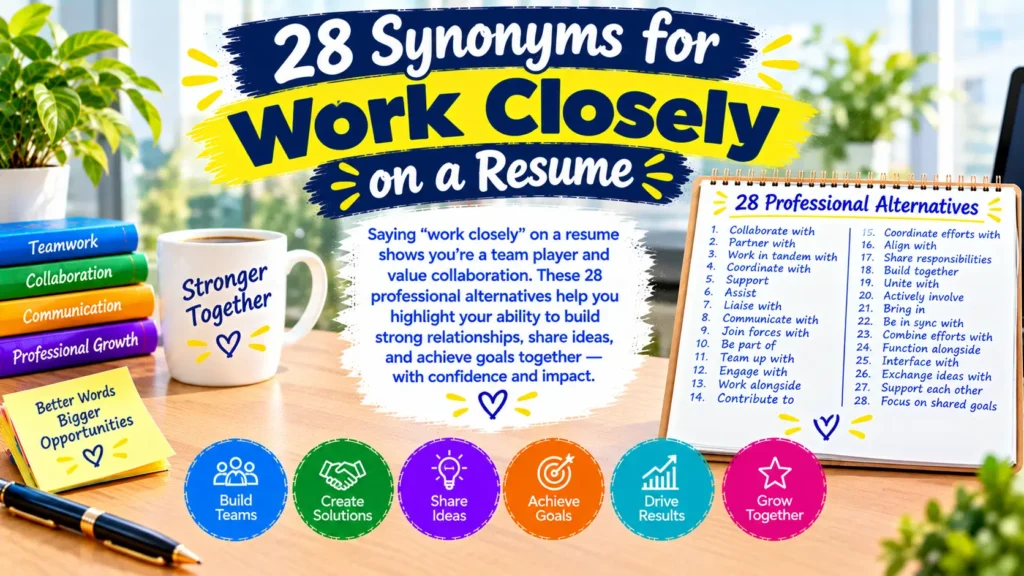
There are many useful synonyms for work closely on a resume, including collaborated with, partnered with, coordinated with, liaised with, and worked cross-functionally with. Each phrase highlights a slightly different skill, so the best choice depends on your responsibilities and achievements.
For example, instead of writing, “Worked closely with the sales team,” you could write, “Collaborated with the sales team to improve customer retention.” The second version explains how you worked with others and connects your teamwork to a business goal.
In this guide, you will discover 28 professional alternatives, learn when to use each one, and see practical examples for resumes, cover letters, LinkedIn profiles, and professional communication.
What Does “Work Closely” Mean on a Resume?
The phrase “work closely” means working with another person, team, department, or organization in a cooperative and connected way. It often suggests regular communication, shared responsibilities, and a common goal.
On a resume, this phrase helps employers understand that you can cooperate with others, share information, solve problems, and contribute to team success.
Literal Meaning
To work closely with someone means to maintain an active working relationship with them. You may share information, coordinate tasks, solve challenges, or make decisions together.
Example:
- Basic: Worked closely with the marketing team.
- Stronger: Collaborated with the marketing team to launch three successful campaigns.
The second example uses a stronger verb and gives the reader a clearer picture of your contribution.
Tone and Purpose
“Work closely” has a professional, neutral, and cooperative tone. It works in most industries, but it can sound vague when you use it repeatedly.
Replacing it with a more precise expression can help you show specific strengths, such as:
- Teamwork: Your ability to contribute to shared goals.
- Communication: Your ability to exchange information clearly.
- Leadership: Your ability to coordinate people and guide projects.
- Problem-solving: Your ability to work with others to resolve challenges.
- Relationship management: Your ability to build productive professional connections.
Emotional and Professional Context
This phrase also communicates trust and mutual support. Employers often look for candidates who can work well with colleagues, clients, managers, and external partners.
However, your resume should do more than say you are a team player. It should demonstrate how you used collaboration to achieve results.
For example:
“Partnered with engineering and product teams to reduce project delays by 20%.”
This statement shows teamwork, cross-functional communication, and a measurable outcome.
28 Professional Synonyms for Work Closely on a Resume
The following alternatives can help you describe collaboration more clearly. Choose the phrase that best reflects what you actually did.
Professional Alternatives
1. Collaborated With
Tone: Professional and versatile.
Best use: Team projects, shared responsibilities, and joint problem-solving.
“Collaborated with the marketing team to develop campaigns that increased customer engagement.”
Why it works: “Collaborated with” is one of the strongest general replacements for “worked closely with.” It emphasizes cooperation and shared effort without sounding overly formal.
2. Partnered With
Tone: Professional and relationship-focused.
Best use: Cross-department projects, strategic initiatives, and business partnerships.
“Partnered with the sales team to improve lead conversion and customer retention.”
Why it works: This phrase suggests a productive relationship built around shared objectives. It is especially useful when both parties contributed to the outcome.
3. Coordinated With
Tone: Organized and professional.
Best use: Scheduling, project management, communication, and task alignment.
“Coordinated with operations and logistics teams to ensure timely product delivery.”
Why it works: Use this phrase when your responsibilities involved keeping people, schedules, or tasks aligned.
4. Worked in Partnership With
Tone: Professional and collaborative.
Best use: Long-term initiatives, business relationships, and projects involving multiple stakeholders.
“Worked in partnership with department leaders to implement new operational procedures.”
Why it works: This alternative emphasizes a sustained working relationship rather than a single interaction.
5. Teamed Up With
Tone: Friendly and energetic.
Best use: Creative projects, informal workplaces, and collaborative achievements.
“Teamed up with designers to create user-friendly digital resources.”
Why it works: It sounds approachable and active. For a traditional corporate resume, “collaborated with” may be a better fit.
6. Joined Forces With
Tone: Positive and action-oriented.
Best use: Joint initiatives, problem-solving, and projects that require combined effort.
“Joined forces with customer support and product teams to resolve recurring service issues.”
Why it works: This expression emphasizes bringing different strengths together to achieve a shared result. Use it selectively on formal resumes.
Formal Alternatives
7. Liaised With
Tone: Formal and communication-focused.
Best use: Roles that involve communication between departments, clients, suppliers, or external organizations.
“Liaised with external vendors to maintain service standards and meet delivery deadlines.”
Why it works: “Liaised with” is a useful formal alternative when your main responsibility involved exchanging information or connecting different parties.
8. Cooperated With
Tone: Formal and neutral.
Best use: Shared responsibilities, compliance projects, and coordinated business activities.
“Cooperated with internal teams to maintain compliance with company policies.”
Why it works: This phrase highlights willingness to support shared work. However, “collaborated with” often sounds more proactive when describing professional achievements.
9. Engaged With
Tone: Professional and relationship-oriented.
Best use: Stakeholder communication, client relationships, and cross-team discussions.
“Engaged with key stakeholders to gather feedback and refine project requirements.”
Why it works: Use it when you actively communicated with people to understand their needs or gain their input.
10. Consulted With
Tone: Formal and knowledge-focused.
Best use: Decision-making, expert input, planning, and problem-solving.
“Consulted with senior engineers to evaluate technical solutions and improve system reliability.”
Why it works: This phrase shows that you sought guidance or expertise. It is most accurate when the other person provided advice or specialist knowledge.
11. Coordinated Efforts With
Tone: Formal and organized.
Best use: Multi-team initiatives, complex projects, and operational planning.
“Coordinated efforts with regional managers to implement updated service procedures.”
Why it works: This alternative emphasizes alignment and organized action among different people or groups.
12. Worked in Conjunction With
Tone: Highly formal.
Best use: Technical projects, institutional work, and formal organizational settings.
“Worked in conjunction with compliance officers to review internal procedures.”
Why it works: It clearly communicates joint activity, although it may sound unnecessarily formal in a modern resume. Use “collaborated with” when you want a more direct style.
Friendly and Relationship-Focused Alternatives
13. Built Strong Working Relationships With
Tone: Friendly and professional.
Best use: Team leadership, account management, customer service, and relationship-driven roles.
“Built strong working relationships with clients and internal teams to improve service delivery.”
Why it works: This phrase highlights trust, communication, and your ability to maintain productive professional relationships.
14. Supported
Tone: Helpful and cooperative.
Best use: Team assistance, administrative work, project delivery, and shared responsibilities.
“Supported the product team during testing, documentation, and launch preparation.”
Why it works: It emphasizes your contribution to a team’s success. However, use it only when your role involved providing assistance rather than leading the entire initiative.
15. Contributed to
Tone: Neutral and achievement-focused.
Best use: Team projects, shared goals, and collaborative outcomes.
“Contributed to a cross-functional initiative that reduced processing time by 15%.”
Why it works: This phrase is useful when several people shared responsibility for a result and you want to describe your part accurately.
16. Worked Hand in Hand With
Tone: Warm and cooperative.
Best use: Close team relationships, hands-on projects, and collaborative problem-solving.
“Worked hand in hand with the training team to improve employee onboarding.”
Why it works: It suggests close cooperation and shared effort. For a highly formal resume, consider “partnered with” instead.
17. Established Strong Partnerships With
Tone: Professional and relationship-focused.
Best use: Business development, account management, vendor relations, and leadership.
“Established strong partnerships with suppliers to improve procurement efficiency.”
Why it works: This phrase highlights your ability to develop productive relationships over time. It is particularly effective when building partnerships was a key responsibility.
Email-Friendly Alternatives
These phrases are useful in resumes and professional emails when you need to explain how you coordinate with colleagues or external contacts.
18. Aligned With
Tone: Professional and strategic.
Best use: Shared objectives, business planning, and project priorities.
“Aligned with department heads to ensure project milestones supported business objectives.”
Why it works: It emphasizes agreement on goals, expectations, or plans. It does not necessarily mean you worked together on every task.
19. Communicated Regularly With
Tone: Clear and practical.
Best use: Ongoing updates, reporting, coordination, and client communication.
“Communicated regularly with clients to track project progress and resolve concerns.”
Why it works: This phrase is more specific than “worked closely” when frequent communication was central to your responsibilities.
20. Maintained Ongoing Communication With
Tone: Formal and reliable.
Best use: Project updates, stakeholder management, and customer relationships.
“Maintained ongoing communication with suppliers to monitor delivery schedules and address delays.”
Why it works: It highlights consistency and follow-through rather than general teamwork.
21. Collaborated Directly With
Tone: Professional and specific.
Best use: Direct work with clients, senior leaders, technical specialists, or decision-makers.
“Collaborated directly with senior leadership to develop quarterly business plans.”
Why it works: Adding “directly” clarifies your level of involvement. Use it when you personally interacted with the people named.
22. Worked Alongside
Tone: Natural and professional.
Best use: Daily teamwork, practical assignments, and hands-on collaboration.
“Worked alongside experienced analysts to improve reporting accuracy.”
Why it works: This is a simple, readable alternative that emphasizes direct cooperation without overstating your responsibility.
Workplace and Cross-Functional Alternatives
23. Collaborated Cross-Functionally With
Tone: Modern and business-focused.
Best use: Projects involving multiple departments or specialist teams.
“Collaborated cross-functionally with engineering, design, and marketing teams to launch a new product.”
Why it works: It communicates that you can work across departmental boundaries. This phrase is especially relevant for product, technology, operations, and project management roles.
24. Coordinated Across Teams
Tone: Organized and leadership-oriented.
Best use: Project coordination, operations, implementation, and multi-team workflows.
“Coordinated across teams to deliver a major software update on schedule.”
Why it works: This phrase shows that you helped connect different teams and keep work moving toward a common goal.
25. Partnered Across Departments
Tone: Strategic and collaborative.
Best use: Business improvement, organizational planning, and cross-department projects.
“Partnered across departments to streamline reporting and improve decision-making.”
Why it works: It emphasizes cooperation across organizational boundaries rather than within one team.
26. Collaborated With Key Stakeholders
Tone: Formal and strategic.
Best use: Planning, business analysis, client projects, and leadership roles.
“Collaborated with key stakeholders to define project goals and approve implementation plans.”
Why it works: This phrase highlights your ability to involve relevant decision-makers and manage competing needs.
27. Worked in a Cross-Functional Team
Tone: Professional and teamwork-focused.
Best use: Product development, process improvement, technology, and project delivery.
“Worked in a cross-functional team to develop and launch a customer feedback platform.”
Why it works: It tells employers that you have experience working with people from different professional backgrounds.
28. Jointly Developed
Tone: Achievement-focused and professional.
Best use: Strategy, content, training, product development, and process improvement.
“Jointly developed a new employee training program with human resources and department managers.”
Why it works: This phrase is particularly strong when you helped create something with another person or team. It communicates a shared contribution to a specific outcome.
Quick Comparison Table
| Alternative | Tone | Best Use |
|---|---|---|
| Collaborated with | Professional | General teamwork |
| Partnered with | Strategic | Shared business goals |
| Coordinated with | Organized | Tasks and schedules |
| Liaised with | Formal | Communication between parties |
| Consulted with | Formal | Expert advice |
| Engaged with | Professional | Stakeholder interaction |
| Contributed to | Achievement-focused | Shared results |
| Supported | Helpful | Assisting a team |
| Worked alongside | Natural | Hands-on teamwork |
| Aligned with | Strategic | Shared priorities |
| Communicated regularly with | Clear | Frequent updates |
| Built strong working relationships with | Relational | Trust and teamwork |
| Collaborated cross-functionally with | Business-focused | Multiple departments |
| Coordinated across teams | Leadership-oriented | Multi-team delivery |
| Jointly developed | Achievement-focused | Shared creation |
How to Use These Alternatives on Your Resume
Choosing a synonym is only the first step. The strongest resume statements combine an action verb, the people or teams involved, and the result of the work.
A useful formula is:
Action verb + team or stakeholder + task + result.
For example:
- Weak: Worked closely with the sales team.
- Better: Collaborated with the sales team on customer outreach.
- Stronger: Collaborated with the sales team to refine customer outreach, increasing qualified leads by 18%.
The strongest version explains what you did and why it mattered.
Before-and-After Resume Examples
Marketing
Before: Worked closely with the content team.
After: Partnered with the content team to develop a publishing calendar that improved campaign consistency.
Project management
Before: Worked closely with different departments.
After: Coordinated across five departments to deliver a company-wide software rollout on schedule.
Customer service
Before: Worked closely with customers.
After: Built strong working relationships with customers to resolve service concerns and improve satisfaction.
Human resources
Before: Worked closely with managers.
After: Collaborated with department managers to streamline employee onboarding and training.
Technology
Before: Worked closely with developers.
After: Collaborated cross-functionally with developers and designers to improve application usability.
Operations
Before: Worked closely with suppliers.
After: Coordinated with suppliers to reduce delivery delays and maintain inventory levels.
Email Examples Using Alternatives to “Work Closely”
The same expressions can improve business email phrases, especially when you want to describe collaboration, provide updates, or discuss shared responsibilities.
1. Email to a Client
Subject: Project Coordination Update
Hi Jordan,
I’ve partnered with our design team to review your feedback and refine the proposed changes. We’ll share the updated draft by Thursday.
Best regards,
Alex
2. Email to Your Manager
Subject: Project Progress
Hi Morgan,
I’ve coordinated with the operations team to confirm the remaining tasks and update the project timeline. Everything is progressing as planned.
Best,
Taylor
3. Email to a Colleague
Subject: Next Steps for the Report
Hi Sam,
I’ve collaborated with the research team to gather the latest figures. Could you review the draft before we send it to the client?
Thanks,
Jamie
4. Email to a Customer
Subject: Update on Your Request
Hello,
I’ve liaised with our support team to investigate your request. We’ll contact you as soon as we confirm the next steps.
Kind regards,
Customer Support
5. Networking Email
Subject: Great Connecting With You
Hi Priya,
It was a pleasure meeting you at the industry event. I’d welcome the opportunity to connect and explore ways our teams might collaborate in the future.
Best regards,
Chris
6. Meeting Follow-Up Email
Subject: Follow-Up and Action Items
Hi Team,
Following our meeting, I’ve coordinated with the relevant departments to confirm responsibilities and deadlines. Please review the action items and share any updates by Friday.
Thank you,
Morgan
These examples demonstrate how to adapt your wording to different relationships. Use a friendly tone with colleagues, a clear and reassuring tone with customers, and a concise, professional tone with managers and clients.
Common Mistakes When Replacing “Work Closely”
Choosing a stronger phrase can improve your resume, but the wrong replacement may create confusion or exaggerate your role.
1. Repeating the Same Synonym
Using “collaborated with” in every bullet point can make your resume sound repetitive.
Better approach: Vary your verbs according to the task. Use “coordinated” for logistics, “partnered” for shared goals, and “consulted” when you sought expert advice.
2. Choosing a Verb That Does Not Match Your Role
“Led” and “managed” suggest responsibility for directing people or work. Do not use them if you only participated in a project.
Better approach: Use “contributed to,” “supported,” or “collaborated with” when those expressions better reflect your involvement.
3. Using Overly Formal Language
Phrases such as “worked in conjunction with” may sound stiff in a modern resume.
Better approach: Choose direct language that hiring managers can understand quickly. “Collaborated with” and “partnered with” work well in most industries.
4. Using Vague Statements
“Worked closely with several departments” does not explain what you accomplished.
Better approach: Name the teams, describe the task, and include a result when possible.
5. Adding Unsupported Results
Never invent percentages, revenue increases, or performance improvements to make a bullet point more impressive.
Better approach: Use verified results. If you do not have numerical data, describe a clear outcome, such as meeting a deadline, improving a process, or resolving a recurring issue.
6. Ignoring Applicant Tracking Systems
Applicant tracking systems can help employers search resumes for relevant skills and experience. Unusual wording may not communicate your experience as clearly as familiar industry terms.
Better approach: Use recognizable phrases such as “cross-functional collaboration,” “stakeholder communication,” and “project coordination” when they accurately describe your work.
Related Phrases for Teamwork and Collaboration
These related expressions can help you describe professional relationships, teamwork, and shared responsibilities more precisely.
- Cross-functional collaboration — Working with people from different departments.
Example: Led cross-functional collaboration between marketing and product teams. - Team coordination — Organizing shared work and responsibilities.
Example: Improved team coordination by introducing weekly progress reviews. - Stakeholder engagement — Involving relevant people in decisions and projects.
Example: Strengthened stakeholder engagement during project planning. - Collaborative problem-solving — Working together to resolve challenges.
Example: Used collaborative problem-solving to address recurring service issues. - Interdepartmental communication — Sharing information between departments.
Example: Improved interdepartmental communication to reduce project delays. - Relationship management — Maintaining productive professional connections.
Example: Applied relationship management skills to retain key accounts. - Team alignment — Ensuring everyone understands shared goals.
Example: Improved team alignment through clear project milestones. - Joint decision-making — Making decisions with other people.
Example: Supported joint decision-making during the annual planning process. - Project coordination — Organizing tasks, timelines, and contributors.
Example: Managed project coordination across three business units. - Strategic partnership — Working together toward broader business goals.
Example: Developed strategic partnerships to expand market reach. - Knowledge sharing — Exchanging information and expertise.
Example: Encouraged knowledge sharing between senior and junior employees. - Team collaboration — Contributing to shared team objectives.
Example: Improved team collaboration through regular planning sessions. - Client coordination — Organizing work and communication with clients.
Example: Managed client coordination throughout the implementation process. - Joint initiative — A project or effort undertaken together.
Example: Participated in a joint initiative to improve customer retention. - Consensus building — Helping a group reach an agreement.
Example: Used consensus building to resolve differences during planning. - Resource coordination — Organizing people, tools, or materials.
Example: Coordinated resources across multiple projects to meet deadlines. - Team-based execution — Completing work through shared team effort.
Example: Supported team-based execution of the product launch. - Collaborative leadership — Guiding others through shared input and responsibility.
Example: Applied collaborative leadership to improve cross-team performance.
“Work Closely” vs. Other Professional Phrases
Although many alternatives have similar meanings, each one emphasizes a different part of the working relationship.
| Phrase | What It Emphasizes | Best Situation |
|---|---|---|
| Work closely with | General cooperation | Broad job responsibilities |
| Collaborate with | Shared work and ideas | Team projects |
| Partner with | Shared goals and responsibility | Strategic initiatives |
| Coordinate with | Organization and timing | Operations and project delivery |
| Liaise with | Communication between parties | Vendors, clients, and departments |
| Consult with | Advice and expertise | Technical or strategic decisions |
| Support | Assistance and contribution | Helping a team deliver results |
| Align with | Shared objectives | Planning and business priorities |
| Work alongside | Direct cooperation | Hands-on team activities |
| Jointly develop | Shared creation | New processes, products, or programs |
Which Phrase Is Stronger on a Resume?
No single phrase is always best. The strongest choice depends on your responsibilities and the evidence you can provide.
- Choose “collaborated with” for general teamwork.
- Choose “partnered with” for shared business goals.
- Choose “coordinated with” for organizing people and tasks.
- Choose “liaised with” for communication between different parties.
- Choose “consulted with” when you sought advice or specialist input.
- Choose “contributed to” when you played a part in a shared outcome.
- Choose “jointly developed” when you helped create something with others.
Remember that a strong action verb should make your role clearer, not simply make your resume sound more impressive.
Cultural Usage: Choosing the Right Phrase
Professional language can vary by country, industry, and workplace culture. Most of these alternatives work across English-speaking workplaces, but some are more common in certain settings.
US English
American resumes often favor direct action verbs and concise achievement statements.
Examples:
- Collaborated with product teams to improve user experience.
- Partnered with sales leaders to increase qualified leads.
- Coordinated cross-functional projects to meet quarterly goals.
For US applications, combine recognizable action verbs with measurable achievements whenever you can support the numbers.
UK English
British professional writing also uses “collaborated with,” “worked alongside,” “liaised with,” and “partnered with.”
“Liaised with” is particularly useful in roles involving communication between departments, agencies, clients, and suppliers.
Example:
“Liaised with local authorities and contractors to coordinate project delivery.”
Choose natural wording over unnecessarily formal language, and follow the style used in the job advertisement.
Corporate Communication
Large organizations often value collaboration across functions, business units, and stakeholder groups.
Useful expressions include:
- Collaborated cross-functionally with.
- Coordinated across departments.
- Aligned project goals with.
- Partnered with key stakeholders.
Example:
“Partnered with finance, operations, and technology teams to improve reporting accuracy.”
These expressions work well when you can explain the specific responsibilities and outcomes behind the collaboration.
Customer Service
Customer service resumes benefit from phrases that show communication, cooperation, and customer-focused problem-solving.
Useful expressions include:
- Coordinated with support teams.
- Collaborated with service specialists.
- Maintained communication with customers.
- Worked alongside account managers.
Example:
“Coordinated with technical support to resolve customer issues and improve response times.”
Networking
Networking communication should sound warm, clear, and genuine.
Useful expressions include:
- Explore opportunities to collaborate.
- Build professional relationships.
- Connect with industry peers.
- Partner on future initiatives.
Example:
“I’d welcome the opportunity to collaborate on projects that support our shared interests.”
In networking messages, avoid implying an established partnership when you have only met someone briefly.
Frequently Asked Questions
1. What is the best synonym for “work closely” on a resume?
“Collaborated with” is one of the best general alternatives because it clearly communicates teamwork and shared effort. Use “partnered with” for shared goals and “coordinated with” when your role involved organizing tasks or people.
2. What is a more professional way to say “worked closely with”?
You can say “collaborated with,” “partnered with,” “coordinated with,” or “worked alongside.” Choose the phrase that most accurately describes your contribution.
3. What is a formal alternative to “work closely with”?
“Liaised with,” “worked in conjunction with,” and “coordinated efforts with” are formal alternatives. “Liaised with” works particularly well when you communicated between departments, clients, or external organizations.
4. How do I say “work closely with a team” on my resume?
Try “collaborated with the team,” “contributed to team initiatives,” or “worked in a cross-functional team.” Strengthen the statement by describing the project and its outcome.
Example: “Collaborated with the product team to launch a new customer portal.”
5. How can I avoid repeating “collaborated with” on my resume?
Vary your verbs based on the work you performed. Use “coordinated” for organization, “consulted” for expert advice, “partnered” for shared goals, and “supported” for assistance.
Avoid changing verbs only for variety if the new word no longer describes your role accurately.
6. Is “liaised with” a good resume phrase?
Yes. “Liaised with” is a useful professional phrase when your job involved communicating between different people or organizations. It is common in administrative, project management, operations, and client-facing roles.
7. What is a good synonym for “work closely with clients”?
“Partnered with clients,” “collaborated with clients,” and “maintained strong client relationships” are useful options.
Example: “Partnered with key clients to understand business needs and improve service delivery.”
Use the phrase that reflects your actual level of responsibility and client interaction.
8. How can I describe cross-functional teamwork on a resume?
Use phrases such as “collaborated cross-functionally with,” “coordinated across teams,” or “partnered across departments.”
Example: “Collaborated cross-functionally with engineering, design, and marketing teams to deliver a product launch on schedule.”
9. Should I use “work closely” or “collaborate” on a resume?
Both phrases are correct, but “collaborate” often provides a clearer action verb for resume bullet points. “Work closely” can still work when you need to describe an ongoing relationship or a regular responsibility.
10. How do I make a resume bullet point about collaboration stronger?
Use a specific action verb, name the people or teams involved, describe the task, and add a real result.
Weak: “Worked closely with the operations team.”
Strong: “Coordinated with the operations team to streamline scheduling and reduce processing delays.”
If you have verified performance data, include it to show the impact of your work.
Final Summary: Choose the Right Synonym for Work Closely
The best synonyms for work closely on a resume help employers understand how you communicate, cooperate, and contribute to shared goals. “Collaborated with” is a strong all-purpose option, while “partnered with” emphasizes shared objectives and “coordinated with” highlights organization. For formal communication, consider “liaised with” or “coordinated efforts with.” For friendly, team-focused writing, “worked alongside” and “built strong working relationships with” can work well. The key is to choose words that reflect your actual responsibilities. Pair each phrase with a specific task or achievement, and your resume will communicate your value more clearly without sounding repetitive or exaggerated.