
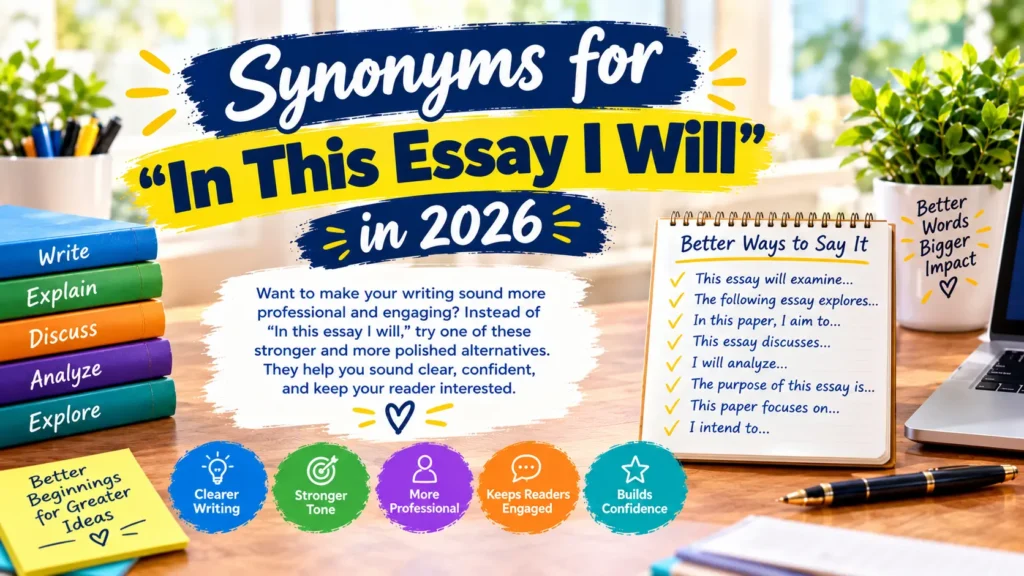
If you are looking for synonyms for “in this essay I will,” you are probably trying to make your introduction sound more polished, natural, and academic. While the phrase is grammatically correct, many teachers and professional writers consider it too repetitive or formulaic. Strong academic writing usually introduces the topic and argument directly instead of telling the reader what the essay will do.
For example, instead of writing, “In this essay, I will discuss the effects of social media,” you could write, “This essay examines the effects of social media on modern communication.”
The best alternative depends on your purpose and tone. Some options sound highly academic, while others work better in reports, presentations, professional communication, or less formal writing.
In this guide, you will find 30 alternatives to “in this essay I will,” along with explanations, examples, tone guidance, and practical advice for choosing the right expression.
What Does “In This Essay I Will” Mean?
The phrase “In this essay, I will…” tells the reader what the writer plans to discuss, explain, analyze, or argue in the following paragraphs.
Literal meaning
The phrase essentially means:
“The following essay will discuss or explain the topic I am about to introduce.”
For example:
“In this essay, I will examine the causes of climate change.”
This tells the reader that the essay will examine the causes of climate change.
Tone
“In this essay, I will” is:
- Grammatically correct
- Clear
- Direct
- Neutral
- Somewhat formulaic
- Common among students
- Less sophisticated than a direct thesis statement
Purpose
Writers often use the phrase to introduce:
- An argument
- A research topic
- A position
- Several points
- A comparison
- A cause-and-effect discussion
- An analysis
- A personal viewpoint
Emotional context
The phrase itself has little emotional weight. It sounds informational rather than persuasive or conversational.
For example:
“In this essay, I will discuss the importance of exercise.”
A more direct academic version is:
“This essay examines the importance of regular exercise.”
The second sentence focuses immediately on the subject rather than announcing the writer’s intentions.
30 Professional and Academic Alternatives to “In This Essay I Will”
1. This essay examines…
Tone: Academic, direct
Best use: Formal essays and research papers
This is one of the strongest alternatives because it removes unnecessary first-person language.
Example:
This essay examines the impact of artificial intelligence on modern education.
2. This essay explores…
Tone: Academic, analytical
Best use: Topics with multiple perspectives
Use “explores” when your essay investigates a subject rather than proving one specific point.
Example:
This essay explores the relationship between technology and workplace productivity.
3. This essay discusses…
Tone: Neutral, academic
Best use: General academic writing
This is a simple replacement when your essay covers several aspects of a topic.
Example:
This essay discusses the major causes of economic inequality.
4. This essay analyzes…
Tone: Formal, analytical
Best use: Critical analysis
“Analyzes” works especially well when you are breaking a subject into parts and evaluating evidence.
Example:
This essay analyzes the effects of remote work on employee performance.
5. This essay evaluates…
Tone: Formal, critical
Best use: Arguments, policies, theories, and evidence
Use this when you intend to judge the effectiveness, value, or importance of something.
Example:
This essay evaluates the effectiveness of renewable energy policies.
6. This essay argues that…
Tone: Strong, persuasive
Best use: Argumentative essays
This is one of the best options when your paper has a clear position.
Example:
This essay argues that schools should provide greater access to mental health resources.
7. This paper examines…
Tone: Formal, academic
Best use: Research papers and scholarly writing
“Paper” often sounds more appropriate than “essay” in university, research, and professional contexts.
Example:
This paper examines the role of leadership in organizational success.
8. This paper explores…
Tone: Academic, professional
Best use: Research and analytical writing
Example:
This paper explores how workplace culture affects employee retention.
9. The following analysis examines…
Tone: Formal and analytical
Best use: Reports and academic assignments
Example:
The following analysis examines the economic consequences of rising inflation.
10. The discussion focuses on…
Tone: Academic, neutral
Best use: Essays, reports, and presentations
This construction immediately identifies the subject.
Example:
The discussion focuses on the challenges faced by small businesses.
11. This discussion considers…
Tone: Formal, thoughtful
Best use: Essays involving different viewpoints
Example:
This discussion considers the advantages and disadvantages of artificial intelligence in education.
12. This paper considers…
Tone: Formal
Best use: Research papers and academic writing
Example:
This paper considers the long-term effects of social media use among teenagers.
13. The purpose of this essay is to…
Tone: Formal, structured
Best use: Assignments and formal academic introductions
This is still somewhat formulaic, but it is more polished than repeatedly saying “I will.”
Example:
The purpose of this essay is to examine the relationship between income and educational opportunity.
14. The purpose of this paper is to…
Tone: Formal and academic
Best use: Research papers
Example:
The purpose of this paper is to evaluate current approaches to employee training.
15. This analysis focuses on…
Tone: Professional and academic
Best use: Analytical writing
Example:
This analysis focuses on the effects of inflation on household spending.
16. The analysis below examines…
Tone: Formal
Best use: Reports and structured academic work
Example:
The analysis below examines the key factors contributing to customer dissatisfaction.
17. The essay considers…
Tone: Academic, concise
Best use: Formal essays
Example:
The essay considers whether technology has improved communication in the workplace.
18. The essay explores…
Tone: Academic but natural
Best use: Humanities and social sciences
Example:
The essay explores the changing role of women in modern society.
19. The essay argues that…
Tone: Persuasive and academic
Best use: Argumentative writing
Example:
The essay argues that public transportation should receive greater government investment.
20. This study investigates…
Tone: Highly academic
Best use: Research papers and scientific writing
Example:
This study investigates the relationship between sleep quality and academic performance.
21. This study examines…
Tone: Formal and research-focused
Best use: Academic research
Example:
This study examines how employee motivation influences workplace performance.
22. This research explores…
Tone: Academic and professional
Best use: Research-based writing
Example:
This research explores the factors that influence consumer purchasing decisions.
23. The following sections examine…
Tone: Formal and organized
Best use: Longer reports, essays, and dissertations
Example:
The following sections examine the economic, social, and environmental effects of urbanization.
24. This paper will examine…
Tone: Formal but future-focused
Best use: Research proposals and academic introductions
Example:
This paper will examine the role of digital communication in modern business.
Although this option still uses “will,” it sounds more natural than “In this essay, I will…”
25. This essay seeks to examine…
Tone: Formal and academic
Best use: Research-oriented essays
Example:
This essay seeks to examine the causes of declining employee engagement.
Use this carefully because “seeks to” can sound overly formal if repeated too often.
26. This essay aims to demonstrate…
Tone: Formal and persuasive
Best use: Essays with a clear conclusion
Example:
This essay aims to demonstrate the importance of effective leadership in organizational development.
27. The central argument is that…
Tone: Strong, academic
Best use: Argumentative essays
This option works particularly well when you want to introduce your thesis rather than your essay structure.
Example:
The central argument is that early education plays a critical role in long-term academic success.
28. This paper demonstrates that…
Tone: Confident and academic
Best use: Essays where evidence supports a clear conclusion
Example:
This paper demonstrates that flexible working arrangements can improve employee satisfaction.
29. This discussion highlights…
Tone: Professional and analytical
Best use: Essays, reports, and presentations
Example:
This discussion highlights the importance of clear communication in successful project management.
30. The focus of this essay is…
Tone: Academic and direct
Best use: Introductions and formal assignments
Example:
The focus of this essay is the impact of social media on political communication.
Quick Comparison Table
| Alternative | Tone | Best Use |
|---|---|---|
| This essay examines… | Academic | Formal essays |
| This essay explores… | Academic | Broad topics |
| This essay discusses… | Neutral | General assignments |
| This essay analyzes… | Analytical | Critical analysis |
| This essay evaluates… | Formal | Evaluation |
| This essay argues that… | Persuasive | Argumentative essays |
| This paper examines… | Formal | Research papers |
| This paper explores… | Academic | Research |
| The discussion focuses on… | Neutral | Essays and reports |
| This discussion considers… | Formal | Multiple viewpoints |
| This paper considers… | Formal | Academic research |
| The purpose of this essay is to… | Formal | Structured assignments |
| This analysis focuses on… | Professional | Reports |
| The essay considers… | Academic | Formal writing |
| The essay explores… | Academic | Humanities |
| The essay argues that… | Persuasive | Arguments |
| This study investigates… | Highly formal | Research |
| This study examines… | Academic | Research papers |
| This research explores… | Professional | Research |
| The following sections examine… | Formal | Long papers |
| This paper will examine… | Formal | Research proposals |
| This essay seeks to examine… | Formal | Academic analysis |
| This essay aims to demonstrate… | Formal | Persuasive writing |
| The central argument is that… | Strong | Thesis statements |
| This paper demonstrates that… | Confident | Evidence-based writing |
| This discussion highlights… | Professional | Analysis |
| The focus of this essay is… | Academic | Introductions |
When Should You Use These Alternatives?
In Academic Essays
Academic writing usually benefits from direct statements.
Instead of:
In this essay, I will discuss the causes of poverty.
Write:
This essay examines the major causes of poverty.
Or:
This essay argues that poverty results from several interconnected social and economic factors.
The second approach gives the reader useful information immediately.
In Research Papers
Research papers often benefit from verbs such as:
- examines
- investigates
- evaluates
- analyzes
- explores
- considers
For example:
This study investigates the relationship between exercise and academic performance.
This sounds more research-focused than:
In this essay, I will talk about how exercise affects students.
In Professional Reports
Business and workplace communication often avoids personal introductions.
Instead of:
In this report, I will discuss the company’s recent performance.
Use:
This report examines the company’s recent performance.
Or:
The following report evaluates the company’s performance during the third quarter.
These versions sound more objective and professional.
In Client Communication
When writing to clients, clarity matters more than sounding overly academic.
For example:
This report outlines the proposed changes to the project timeline.
Instead of:
In this report, I will explain the changes we plan to make.
The first version is shorter and more professional.
In Networking
Networking messages rarely need essay-style introductions. However, similar structures can appear in professional presentations or proposals.
For example:
I would like to briefly outline the key findings from our research.
This is more natural than:
In this presentation, I will discuss the things we discovered.
In Customer Service
Customer service communication should be direct and helpful.
Instead of:
In this email, I will explain why your order was delayed.
Use:
This email provides an update on your delayed order.
Or:
I’m writing to explain the reason for the delay and outline the next steps.
Email Examples
1. Client Email
Less effective:
In this email, I will discuss the changes to your project.
Better:
This email outlines the latest changes to your project.
More personal:
I’m writing to provide an update on the latest project changes.
2. Manager Email
Less natural:
In this email, I will explain the team’s performance.
Better:
This report summarizes the team’s performance over the past quarter.
3. Colleague Email
Less natural:
In this email, I will discuss our meeting yesterday.
Better:
I’d like to summarize the key points from yesterday’s meeting.
4. Customer Email
Less natural:
In this email, I will explain the refund process.
Better:
This email explains the refund process and the steps required to complete your request.
5. Networking Email
Less natural:
In this email, I will tell you about my background.
Better:
I’d like to briefly share my professional background and experience in marketing.
6. Meeting Follow-Up
Less natural:
In this email, I will discuss what we agreed on.
Better:
I’d like to summarize the key points we agreed on during today’s meeting.
Common Mistakes to Avoid
1. Using “In This Essay, I Will” Too Often
The phrase is not incorrect, but repeated use can make academic writing sound predictable.
Avoid:
In this essay, I will discuss X.
In this essay, I will explain Y.
In this essay, I will analyze Z.
Instead, vary your sentence structures.
This essay examines X.
The discussion then considers Y.
Finally, the analysis evaluates Z.
2. Announcing Instead of Making a Point
A strong introduction should communicate your argument, not simply announce your plans.
Weak:
In this essay, I will discuss why exercise is important.
Stronger:
Regular exercise improves physical health, reduces stress, and supports long-term well-being.
The second sentence makes an actual claim.
3. Using Overly Complicated Language
Replacing a simple phrase with unnecessarily complex wording does not automatically improve your writing.
For example:
This scholarly investigation endeavors to elucidate the multifaceted dimensions of…
This sounds unnatural.
A better choice is:
This study examines…
Clear writing is usually stronger than complicated writing.
4. Using the Wrong Verb
Choose a verb that matches your purpose.
Use examines for investigation.
Use analyzes for detailed examination.
Use evaluates when judging effectiveness.
Use explores for broad investigation.
Use argues when presenting a position.
Use discusses when covering several aspects.
5. Using Academic Language in Casual Emails
You would not normally write:
This email explores the circumstances surrounding our lunch meeting.
A natural version is:
I’m writing to confirm the details of our lunch meeting.
Match the language to the audience.
Related Phrases
Here are related expressions that can replace or support “In this essay, I will”:
- This essay examines — introduces an academic analysis.
- This essay explores — introduces a broad investigation.
- This essay argues that — introduces a central position.
- This paper analyzes — introduces detailed examination.
- This study investigates — introduces research.
- This report evaluates — introduces an assessment.
- The purpose of this paper is to — states the objective.
- The focus of this essay is — identifies the main subject.
- The discussion focuses on — introduces the main area of discussion.
- The following analysis examines — introduces formal analysis.
- This research considers — introduces a research question.
- The central argument is that — introduces a thesis.
- This paper demonstrates that — introduces a supported conclusion.
- This discussion highlights — draws attention to an important issue.
- The following sections examine — previews multiple sections.
- This analysis considers — introduces evaluation or discussion.
- The essay evaluates — introduces judgment or assessment.
- The paper investigates — introduces systematic research.
- This study assesses — introduces evaluation.
- The discussion examines — introduces formal consideration of an issue.
“In This Essay I Will” vs. Better Alternatives
| Phrase | Formality | Style | Best Use |
|---|---|---|---|
| In this essay, I will… | Medium | Formulaic | Basic student essays |
| This essay examines… | High | Direct | Academic essays |
| This essay explores… | High | Natural | Broad topics |
| This essay argues that… | High | Persuasive | Argumentative essays |
| This paper analyzes… | High | Analytical | Research papers |
| This study investigates… | Very high | Research-focused | Academic research |
| The discussion focuses on… | High | Objective | Essays and reports |
| The purpose of this essay is to… | High | Structured | Formal assignments |
| The central argument is that… | High | Assertive | Thesis statements |
| I will discuss… | Medium | Personal | Informal academic contexts |
| I will examine… | Medium | Direct | Personal academic writing |
| I’d like to discuss… | Low–medium | Friendly | Presentations and emails |
| This report outlines… | High | Professional | Business reports |
| This email explains… | Medium–high | Practical | Customer communication |
How to Choose the Best Synonym
The best synonym for “in this essay I will” depends on what you actually want the reader to understand.
If you are explaining a topic
Use:
This essay discusses…
If you are examining evidence
Use:
This essay analyzes…
If you are investigating a broad subject
Use:
This essay explores…
If you are judging something
Use:
This essay evaluates…
If you have a clear opinion
Use:
This essay argues that…
If you are conducting research
Use:
This study investigates…
If you are writing a business report
Use:
This report examines…
If you are writing an email
Use:
I’m writing to explain…
If you are introducing a presentation
Use:
Today, I’ll discuss…
Cultural and Regional Usage
US English
American academic writing commonly uses direct constructions such as:
This essay examines…
This paper argues that…
This study investigates…
Many American academic institutions encourage students to prioritize clear thesis statements over unnecessary announcements.
UK English
British academic writing also commonly favors objective constructions:
This essay examines…
The discussion considers…
The analysis demonstrates…
However, individual universities and instructors may have different preferences regarding first-person language.
Corporate Communication
Corporate writing generally favors concise, objective wording.
Instead of:
In this report, I will discuss the company’s results.
Use:
This report outlines the company’s results.
Customer Service
Customer service writing should focus on the customer’s needs.
Instead of:
In this email, I will explain the problem.
Use:
I’m writing to explain the issue and provide the next steps.
Networking
Networking communication should sound personal without becoming overly casual.
Instead of:
In this email, I will tell you about myself.
Use:
I’d like to briefly introduce my background and experience.
Why Is “In This Essay I Will” Sometimes Considered Weak?
The phrase is not grammatically wrong. The main issue is style.
It tells the reader what you plan to do rather than immediately communicating the subject, argument, or finding.
Compare:
In this essay, I will discuss the effects of remote work.
with:
This essay examines how remote work has changed employee productivity.
The second version sounds more direct and informative.
An even stronger thesis might be:
Remote work has improved employee flexibility while creating new challenges for collaboration and communication.
This approach does more than announce the essay. It begins presenting the argument.
Should You Avoid First Person Completely?
No.
Academic writing does not always require avoiding “I.” Whether you should use first person depends on the assignment, institution, discipline, and instructor.
For example, these sentences can both be appropriate:
This essay examines the relationship between education and income.
In this essay, I argue that access to education significantly influences economic opportunity.
The second version can be useful when you need to make your position explicit.
The goal is not to eliminate “I.” The goal is to use it purposefully.
Frequently Asked Questions
1. What is a synonym for “in this essay I will”?
Common alternatives include “This essay examines,” “This essay explores,” “This essay discusses,” “This essay analyzes,” and “This essay argues that.” The best choice depends on what your essay actually does.
2. What is a more formal way to say “in this essay I will”?
A strong formal alternative is:
This essay examines…
For research writing, you can also use:
This study investigates…
3. How can I avoid saying “in this essay I will”?
Start with your topic or thesis instead.
Instead of:
In this essay, I will discuss the importance of education.
Write:
Education plays a central role in improving economic and social opportunity.
You can also use:
This essay examines the importance of education.
4. Is “This essay will discuss” better than “In this essay I will discuss”?
It is slightly more concise, but it still announces what the essay intends to do. A more direct option is:
This essay discusses…
or:
This essay examines…
5. Is “This essay explores” grammatically correct?
Yes. “This essay explores” is a natural and widely useful academic construction. It works particularly well when your essay considers different ideas, perspectives, or relationships.
6. What is the best academic alternative to “I will discuss”?
Try:
This essay examines…
Other choices include “This paper discusses,” “This study explores,” and “The discussion considers.”
7. Can I use “I” in an academic essay?
Yes, depending on your academic discipline and assignment guidelines. First-person writing can be appropriate when presenting your argument, research decisions, or personal analysis.
8. What is the best phrase for an argumentative essay?
Use:
This essay argues that…
This clearly introduces your central position.
For example:
This essay argues that public transportation should receive greater investment.
9. What is the best alternative for a research paper?
Good choices include:
This study investigates…
This paper examines…
This research explores…
Choose the verb that accurately describes your research.
10. What should I use instead of “in this essay I will” in a professional email?
Use a direct business communication phrase such as:
I’m writing to explain…
This email provides an update on…
I’d like to discuss…
This report outlines…
These sound more natural in workplace communication.
Final Summary
The best synonyms for “in this essay I will” usually make your writing more direct, specific, and natural. For academic essays, “This essay examines,” “This essay explores,” “This essay analyzes,” and “This essay argues that” are strong choices. For research papers, use “This study investigates” or “This paper examines.” For professional communication, choose phrases such as “This report outlines” or “I’m writing to explain.” You do not need to avoid first person completely; simply use it when it adds value. The strongest introduction does more than announce your essay—it gives the reader a clear sense of your topic, purpose, or central argument.
Best professional option: This essay examines…
Best formal option: This study investigates…
Best argumentative option: This essay argues that…
Best natural option: This essay explores…
Best email option: I’m writing to explain…




