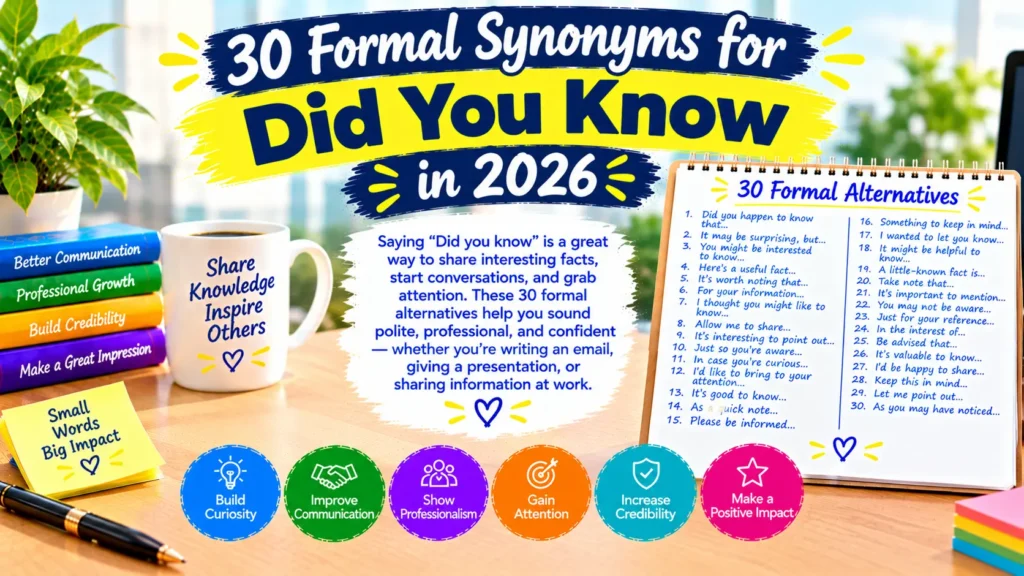
The phrase “did you know” helps you share information, introduce an interesting fact, or bring something important to someone’s attention. However, in professional communication, the best wording depends on your audience, purpose, and tone.
If you are writing an email to a client, updating your manager, speaking during a meeting, or connecting with a new business contact, you may want a more polished expression. Learning formal synonyms for did you know can help you sound professional, respectful, and confident without making your message feel stiff.
For example, instead of writing, “Did you know we offer a new service?” you could say, “I’d like to bring to your attention our new service offering.”
Both sentences share information, but the second sounds more suitable for a formal business email.
In this guide, you will find 30 professional, formal, friendly, and email-ready alternatives to “did you know,” along with practical examples, a comparison table, common mistakes, and answers to frequently asked questions.
What Does “Did You Know” Mean?
“Did you know” is a question that introduces information that the listener or reader may not already know. People often use it to share facts, highlight opportunities, explain changes, or encourage someone to consider a new idea.
Literal meaning
The phrase asks whether someone already has knowledge of a particular fact or situation.
Example: “Did you know our office will close early on Friday?”
The speaker wants to find out whether the listener knows about the schedule change. However, people often use the phrase to share information rather than to ask a question that needs an answer.
Tone and purpose
“Did you know” usually sounds friendly, informative, and conversational. It can also sound promotional when someone uses it to introduce a product, service, or benefit.
Its main purposes include:
- Sharing information: Introducing a fact or update.
- Raising awareness: Making someone aware of a new policy, service, or opportunity.
- Starting a conversation: Encouraging questions or discussion.
- Highlighting benefits: Drawing attention to useful features or advantages.
- Creating curiosity: Introducing an interesting fact that encourages someone to learn more.
Emotional context
The phrase can express curiosity, excitement, concern, or helpfulness, depending on the situation.
For example:
- Friendly: “Did you know we have a new team member?”
- Informative: “Did you know the deadline has changed?”
- Promotional: “Did you know our service includes free support?”
- Concerned: “Did you know the client has requested an earlier delivery?”
In a formal setting, you may want to replace the phrase with a more direct or polished expression. The goal is not simply to sound formal; it is to make your message clear and appropriate for your audience.
When Should You Use a Professional Alternative to “Did You Know”?
The right alternative depends on the situation. Some expressions work well in a business email, while others sound more natural in meetings or friendly conversations.
1. In professional emails
Use a polished alternative when you share an update, introduce a policy, or highlight useful information.
Instead of:
“Did you know we have updated our payment policy?”
Write:
“I’d like to inform you that we have updated our payment policy.”
This version communicates the update directly and professionally.
2. In workplace conversations
When speaking with colleagues, choose language that sounds natural rather than overly formal.
Example:
“Are you aware that the team meeting has moved to Thursday?”
This alternative works well when you want to confirm whether a colleague has received important information.
3. When communicating with clients
Clients often appreciate clear, courteous language that focuses on the information they need.
Example:
“I wanted to make you aware of an additional service that may benefit your team.”
This phrasing sounds helpful without putting pressure on the client.
4. In networking situations
When you connect with a new professional contact, use expressions that encourage conversation and introduce useful information.
Example:
“I thought you might be interested to learn about our upcoming industry event.”
This approach feels more personal than asking a direct question.
5. In customer service
When helping customers, choose clear wording that informs them without making them feel uninformed.
Example:
“Please note that our support team is available on weekends.”
This expression communicates a useful fact politely and efficiently.
30 Formal Synonyms for “Did You Know”: Professional & Polite Alternatives
Below are 30 alternatives organized into five categories: professional, formal, friendly, email-specific, and workplace expressions. Each option includes its tone, best use case, and an example you can adapt.
Professional Alternatives
These expressions suit business communication, client updates, presentations, and professional discussions.
1. I’d Like to Inform You
Tone: Professional, direct, respectful.
Best use: Sharing an important update or explaining a change.
This phrase works when your main goal is to deliver information rather than ask whether someone already knows it.
Example:
“I’d like to inform you that our customer support hours will change starting next Monday.”
2. I’d Like to Bring to Your Attention
Tone: Professional, formal, and purposeful.
Best use: Highlighting an important fact, issue, or opportunity.
This expression draws attention to information that deserves consideration. Use it when the detail matters to the recipient.
Example:
“I’d like to bring to your attention the new reporting requirements for this quarter.”
3. You May Be Interested to Know
Tone: Polite, informative, and engaging.
Best use: Sharing a benefit, opportunity, or relevant update.
This is a useful professional alternative when you believe the information will interest the reader.
Example:
“You may be interested to know that we have introduced a more flexible pricing plan.”
4. I Wanted to Make You Aware
Tone: Courteous, professional, and helpful.
Best use: Informing a client, colleague, or manager about a relevant development.
This phrase works particularly well when you want to keep someone informed without sounding demanding.
Example:
“I wanted to make you aware that the client has requested two additional revisions.”
5. For Your Information
Tone: Neutral, concise, and businesslike.
Best use: Sharing facts, documents, schedules, and updates.
This phrase is useful when the recipient needs information but does not necessarily need to respond.
Example:
“For your information, the updated project timeline is attached to this email.”
Tip: Avoid using this phrase when you need the recipient to take action. State the required action clearly instead.
6. It May Be Helpful to Know
Tone: Supportive, practical, and professional.
Best use: Providing information that helps someone make a decision.
This alternative emphasizes the value of the information instead of testing the recipient’s knowledge.
Example:
“It may be helpful to know that our software integrates with the tools your team already uses.”
Formal Alternatives
These expressions suit official correspondence, senior-level communication, reports, presentations, and situations that require a more measured tone.
7. Please Be Advised
Tone: Formal, official, and direct.
Best use: Communicating policy changes, deadlines, or formal notices.
This phrase is common in administrative and corporate writing. However, it can sound impersonal, so use it when the situation calls for an official tone.
Example:
“Please be advised that the submission deadline has been extended to October 20.”
8. Kindly Note That
Tone: Formal, courteous, and concise.
Best use: Drawing attention to instructions, conditions, or important details.
This expression works well in formal notices and business emails, especially when you want to highlight a specific point.
Example:
“Kindly note that all expense claims must include supporting receipts.”
9. Please Note That
Tone: Neutral, formal, and clear.
Best use: Explaining rules, changes, requirements, or reminders.
This is one of the most practical alternatives because it tells the reader exactly where to focus.
Example:
“Please note that the office will remain closed during the public holiday.”
10. I Would Like to Highlight
Tone: Professional, composed, and authoritative.
Best use: Presentations, reports, proposals, and formal discussions.
Use this expression when you want to emphasize a fact that supports your main point.
Example:
“I would like to highlight the improvements in customer satisfaction over the past quarter.”
11. It Is Worth Noting That
Tone: Formal, analytical, and objective.
Best use: Reports, research summaries, business proposals, and presentations.
This expression introduces a fact that adds context or supports an argument.
Example:
“It is worth noting that customer retention increased by 12% during the last quarter.”
Use it only when the information adds meaningful value. Otherwise, it can make a simple sentence unnecessarily long.
12. I Would Like to Draw Your Attention to
Tone: Highly formal, deliberate, and respectful.
Best use: Official correspondence, reports, compliance matters, and important notices.
This phrase signals that the recipient should pay attention to a particular detail.
Example:
“I would like to draw your attention to the revised terms outlined in Section 4 of the agreement.”
Friendly Alternatives
These options work well with colleagues, familiar clients, professional contacts, and people you want to engage in a natural conversation.
13. Just So You Know
Tone: Casual, friendly, and direct.
Best use: Informal workplace messages and quick updates.
This expression works well when you share a small but useful detail.
Example:
“Just so you know, I’ve uploaded the latest version of the presentation.”
Avoid it in highly formal notices because it may sound too casual.
14. You Might Be Surprised to Learn
Tone: Engaging, curious, and conversational.
Best use: Introducing an unexpected fact or interesting result.
This alternative creates curiosity and encourages the reader to continue.
Example:
“You might be surprised to learn that most of our new customers find us through referrals.”
Use it only when the information is genuinely surprising.
15. Here’s Something You May Not Know
Tone: Friendly, informative, and engaging.
Best use: Sharing a useful tip, company benefit, or interesting fact.
This expression works well in presentations, team chats, and educational content.
Example:
“Here’s something you may not know: employees can access the training library at no additional cost.”
16. I Thought You’d Like to Know
Tone: Warm, thoughtful, and personal.
Best use: Sharing good news, helpful opportunities, or relevant updates.
This phrase suggests that you considered the recipient’s interests before sharing the information.
Example:
“I thought you’d like to know that your proposal received positive feedback from the leadership team.”
17. In Case You Haven’t Heard
Tone: Friendly, conversational, and informative.
Best use: Sharing news, announcements, or updates that may already be circulating.
This phrase works when you are unsure whether the recipient has received the news.
Example:
“In case you haven’t heard, our department will welcome two new team members next month.”
Avoid it when the information is confidential or when you should not assume that news has spread.
18. You May Not Be Aware
Tone: Polite, measured, and slightly formal.
Best use: Clarifying a situation or explaining an overlooked detail.
This alternative works when you need to share information without directly suggesting that the reader should already know it.
Example:
“You may not be aware that the new system allows you to track orders in real time.”
Be careful with your delivery. Depending on the context, this phrase can sound corrective if you use it too often.
Email-Specific Alternatives
These phrases are useful when writing emails to clients, managers, colleagues, vendors, or prospective business partners.
19. I’m Writing to Let You Know
Tone: Clear, courteous, and professional.
Best use: Opening an email that communicates an update or announcement.
This expression immediately tells the reader why you are contacting them.
Example:
“I’m writing to let you know that your account review is complete.”
20. I Wanted to Share
Tone: Warm, collaborative, and professional.
Best use: Sharing news, resources, feedback, or opportunities.
This alternative feels less formal than “I’m writing to inform you” while remaining suitable for most workplace emails.
Example:
“I wanted to share a new resource that may help your team improve its onboarding process.”
21. I’d Like to Bring to Your Notice
Tone: Formal, but less natural in some varieties of English.
Best use: Certain regional business contexts where this wording is customary.
This phrase appears in some professional settings, particularly in South Asian English. In international business communication, “I’d like to bring to your attention” usually sounds more natural.
Example:
“I’d like to bring to your attention a discrepancy in the latest invoice.”
22. Please Be Aware That
Tone: Direct, professional, and cautionary.
Best use: Communicating conditions, possible risks, or important requirements.
Use this expression when the recipient needs to understand a detail before taking action.
Example:
“Please be aware that processing may take up to three business days.”
23. I’d Like to Share an Important Update
Tone: Professional, approachable, and informative.
Best use: Announcements, project updates, and client communications.
This expression gives the reader a clear reason to pay attention.
Example:
“I’d like to share an important update regarding the launch schedule.”
24. For Your Awareness
Tone: Formal, concise, and neutral.
Best use: Brief business emails where the recipient needs context but may not need to act.
This expression can work in internal corporate communication, although “for your information” often sounds more natural.
Example:
“For your awareness, the revised budget has been approved by the finance team.”
Workplace Alternatives
Use these phrases during meetings, team discussions, project reviews, and everyday professional interactions.
25. Are You Aware That…?
Tone: Direct, neutral, and professional.
Best use: Checking someone’s knowledge before explaining a fact.
This is one of the closest alternatives to the original phrase because it keeps the question format.
Example:
“Are you aware that the client has moved the presentation to Wednesday?”
Use a neutral tone so the question does not sound like a criticism.
26. Have You Heard That…?
Tone: Conversational, friendly, and informal.
Best use: Sharing announcements or news with colleagues.
This phrase works best when the information may already be circulating among the team.
Example:
“Have you heard that our department will be expanding next quarter?”
For sensitive business changes, a direct and confirmed announcement is usually better.
27. Did You Happen to Know…?
Tone: Gentle, conversational, and tentative.
Best use: Informal conversations when you want to ask about a specific fact.
This expression softens the question, although it can sound less natural than “Do you happen to know…?” when asking for information.
Example:
“Did you happen to know whether the meeting room is available this afternoon?”
Better for most workplace questions: “Do you happen to know whether the meeting room is available this afternoon?”
28. One Thing to Keep in Mind Is…
Tone: Helpful, thoughtful, and advisory.
Best use: Giving context, explaining a limitation, or helping a team make a decision.
This phrase introduces a relevant consideration without questioning anyone’s knowledge.
Example:
“One thing to keep in mind is that the client needs the final files in an editable format.”
29. Something Worth Mentioning Is…
Tone: Professional, conversational, and explanatory.
Best use: Meetings, presentations, and project discussions.
Use this expression when you want to add an important detail to a broader conversation.
Example:
“Something worth mentioning is that the new process has reduced the review time.”
30. Let Me Point Out…
Tone: Direct, confident, and practical.
Best use: Clarifying a detail, correcting a misunderstanding, or emphasizing a relevant fact.
This expression can sound assertive, so use it carefully when speaking with clients or senior colleagues.
Example:
“Let me point out that the current proposal already includes the requested revisions.”
Quick Comparison Table
The following table helps you choose the best synonym for “did you know” based on tone and intended use.
| Alternative | Tone | Best use |
|---|---|---|
| I’d like to inform you | Professional | Business updates |
| Bring to your attention | Formal | Important issues |
| You may be interested to know | Polite | Client benefits |
| I wanted to make you aware | Courteous | Workplace updates |
| For your information | Neutral | Sharing documents |
| It may be helpful to know | Supportive | Advice and decisions |
| Please be advised | Official | Formal notices |
| Kindly note that | Formal | Instructions |
| Please note that | Neutral | Rules and reminders |
| I would like to highlight | Authoritative | Reports and presentations |
| It is worth noting that | Analytical | Research and reports |
| Draw your attention to | Highly formal | Official correspondence |
| Just so you know | Casual | Quick messages |
| You might be surprised to learn | Engaging | Interesting facts |
| Here’s something you may not know | Friendly | Tips and education |
| I thought you’d like to know | Warm | Personal updates |
| In case you haven’t heard | Conversational | General news |
| You may not be aware | Measured | Clarification |
| I’m writing to let you know | Professional | Emails |
| I wanted to share | Collaborative | Resources and news |
| Bring to your notice | Regional/formal | Certain business contexts |
| Please be aware that | Direct | Conditions and risks |
| Share an important update | Professional | Announcements |
| For your awareness | Neutral/formal | Internal updates |
| Are you aware that? | Direct | Checking knowledge |
| Have you heard that? | Conversational | Workplace news |
| Did you happen to know? | Tentative | Informal questions |
| One thing to keep in mind | Advisory | Recommendations |
| Something worth mentioning | Explanatory | Meetings |
| Let me point out | Assertive | Clarification |
Email Examples: How to Replace “Did You Know” Professionally
Choosing the right phrase is easier when you see how it works in a real message. Here are six email examples for common business situations.
1. Email to a client
Dear [Client Name],
I wanted to make you aware that we have introduced a new service option that may better suit your team’s needs.
I’d be happy to share more details if you’re interested.
Best regards,
[Your Name]
Why it works: It shares relevant information while allowing the client to decide whether they want to learn more.
2. Email to a manager
Hi [Manager Name],
I’d like to bring to your attention a change to the project timeline. The design review has moved to Thursday, which may affect our planned delivery date.
Please let me know if you’d like me to revise the schedule.
Best regards,
[Your Name]
Why it works: It highlights an important change and explains why the manager should care.
3. Email to a colleague
Hi [Colleague Name],
Just so you know, I’ve uploaded the latest project files to the shared folder.
You can find them under the October project directory.
Thanks,
[Your Name]
Why it works: The language feels friendly and natural for everyday workplace communication.
4. Email to a customer
Dear [Customer Name],
Please note that your order is scheduled to ship within three business days.
You can track its progress using the link in your order confirmation email.
Thank you for choosing us.
Kind regards,
Customer Support
Why it works: It gives the customer useful information without asking an unnecessary question.
5. Networking email
Hi [Name],
I thought you might be interested to know that our industry association is hosting a networking event next month.
The event will bring together professionals working in business development and technology. I thought it could be a useful opportunity to connect with others in the field.
Best regards,
[Your Name]
Why it works: It introduces a relevant opportunity in a warm, relationship-focused way.
6. Meeting follow-up email
Hi Team,
One thing to keep in mind is that the revised delivery date depends on receiving the final client feedback by Friday.
Please share any concerns about the timeline before our next check-in.
Best,
[Your Name]
Why it works: It reinforces an important point and gives the team a clear next step.
Common Mistakes to Avoid
Even a good synonym can weaken your message if you use it in the wrong context. Follow these tips to maintain professional communication.
1. Overusing formal expressions
Phrases such as “I would like to draw your attention to” can make everyday emails sound unnecessarily stiff.
Less natural:
“I would like to draw your attention to the fact that our meeting starts in five minutes.”
Better:
“Just a reminder that our meeting starts in five minutes.”
Match the level of formality to the importance of the information.
2. Choosing a phrase that sounds accusatory
“Are you aware that you missed the deadline?” can sound like criticism, even when you only want to clarify the situation.
Better:
“I wanted to check whether you had seen the updated deadline.”
This version encourages a response without placing blame.
3. Using “for your information” when action is required
“For your information” usually signals that you are sharing details, not asking the recipient to do something.
Less effective:
“For your information, the report is incomplete.”
Better:
“The report is still incomplete. Could you please add the missing figures by Thursday?”
If you need action, state the request and deadline directly.
4. Making simple messages too formal
Not every workplace message needs official language.
Overly formal:
“Kindly be advised that I have completed the requested task.”
More natural:
“I’ve completed the task you requested.”
Clear language often sounds more confident than unnecessarily complex wording.
5. Using “did you know” for sensitive information
The phrase can sound cheerful or promotional, which may not suit serious announcements.
Instead of saying:
“Did you know your account has been suspended?”
Write:
“Your account has been suspended. Here are the steps to restore access.”
The second version is direct, respectful, and useful.
6. Asking a question when you only need to share information
If you already know the recipient needs an update, a question may create an unnecessary extra step.
Instead of:
“Did you know the office will close at 3 p.m.?”
Write:
“Please note that the office will close at 3 p.m.”
Choose a question when you genuinely want to check knowledge or invite a response.
7. Using language that sounds culturally unnatural
Some phrases that appear formal in one region may sound awkward in another. For example, “bring to your notice” is familiar in some South Asian business settings, but “bring to your attention” is generally more natural in international business English.
When in doubt, use simple, widely understood expressions.
Related Phrases: 18 Expressions for Sharing Information
These related business email phrases help you communicate facts, updates, reminders, and recommendations without repeating “did you know.”
| Related expression | Meaning | Example |
|---|---|---|
| I’d like to update you | Share new information | “I’d like to update you on the project.” |
| I wanted to let you know | Give someone information | “I wanted to let you know that the files are ready.” |
| Please be informed | Deliver a formal notice | “Please be informed that the policy takes effect Monday.” |
| For your reference | Share material for later use | “For your reference, I’ve attached the latest report.” |
| As you may know | Introduce possibly familiar information | “As you may know, the office is relocating.” |
| As a reminder | Repeat important information | “As a reminder, the deadline is Friday.” |
| In light of this | Connect information to a result | “In light of this, we’ve revised the plan.” |
| It is important to note | Emphasize a key detail | “It is important to note that fees may apply.” |
| You should be aware | Alert someone to a relevant fact | “You should be aware of the updated requirements.” |
| I’d like to clarify | Explain something more clearly | “I’d like to clarify the approval process.” |
| To keep you informed | Explain why you are sharing an update | “I’m writing to keep you informed of our progress.” |
| As an additional point | Introduce another detail | “As an additional point, training begins next week.” |
| One important detail is | Highlight a specific fact | “One important detail is the revised delivery date.” |
| It may interest you to know | Share relevant or interesting information | “It may interest you to know that registration is free.” |
| Please keep in mind | Highlight a consideration | “Please keep in mind that approval takes two days.” |
| I’d like to emphasize | Stress importance | “I’d like to emphasize the need for accurate records.” |
| To clarify the situation | Explain a point that may be unclear | “To clarify the situation, no payment is due today.” |
| Have you had a chance to review? | Ask whether someone has reviewed something | “Have you had a chance to review the proposal?” |
These expressions are related, but they are not exact synonyms. Some introduce new facts, some provide reminders, and others ask the recipient to confirm or review information.
Phrase Comparison: “Did You Know” vs. Professional Alternatives
The most effective phrase depends on whether you want to ask a question, share information, emphasize a point, or request action.
| Phrase | Tone | Formality | Best situation |
|---|---|---|---|
| Did you know? | Conversational | Low to medium | General conversation |
| Are you aware that? | Direct | Medium | Checking knowledge |
| You may be interested to know | Courteous | Medium | Sharing relevant benefits |
| I wanted to make you aware | Helpful | Medium to high | Updates and potential issues |
| I’d like to inform you | Direct | High | Official updates |
| Please note that | Neutral | Medium to high | Instructions and notices |
| It is worth noting that | Analytical | High | Reports and presentations |
| For your information | Neutral | Medium | Sharing documents or facts |
| Just so you know | Casual | Low | Team chats and informal emails |
| I thought you’d like to know | Warm | Low to medium | Personal or positive news |
Which expression should you choose?
- For a professional email: “I wanted to make you aware.”
- For a formal notice: “Please note that.”
- For an official announcement: “I’d like to inform you.”
- For a client relationship: “You may be interested to know.”
- For a presentation: “It is worth noting that.”
- For a casual workplace chat: “Just so you know.”
- For a genuine question: “Are you aware that?”
One important distinction: “Did you know?” and “Are you aware that?” ask about the recipient’s knowledge. Most other alternatives simply communicate information. Choose the question form when the answer matters; use a statement when you only need to share a fact.
Cultural Usage of “Did You Know” in Professional Communication
Professional language varies across regions, industries, and workplace cultures. Understanding these differences helps you choose expressions that sound natural to your audience.
1. US English
In American workplaces, people often prefer direct, friendly, and concise communication. “I wanted to let you know,” “You may be interested to know,” and “Just so you know” are common choices, depending on the relationship.
Example:
“I wanted to let you know that we’ve updated the project schedule.”
This wording feels natural in many American business emails because it shares information without sounding overly formal.
2. UK English
British professional communication often uses courteous, measured wording, although tone varies by industry and individual preference. “Please note that,” “I thought you might like to know,” and “It may be helpful to know” can work well.
Example:
“I thought you might like to know that the meeting has been moved to Thursday.”
This expression sounds polite and approachable without being excessively formal.
3. Corporate communication
In corporate settings, clarity and purpose matter more than formality alone. Employees often need to share policy changes, deadlines, project risks, and performance results.
Example:
“I’d like to highlight a change to the approval process.”
This phrase works well in reports, presentations, and internal announcements because it signals the importance of the information.
4. Customer service
Customer service messages should be clear, respectful, and easy to understand. Avoid wording that makes customers feel they should already know something.
Example:
“Please note that your subscription includes access to our online support center.”
When explaining a problem, use direct language and offer a solution rather than relying on a vague awareness statement.
5. Networking and relationship building
Networking works best when you share information that matters to the other person. A friendly, relevant introduction can create a more natural conversation.
Example:
“I thought you might be interested in an upcoming event for professionals in your industry.”
This wording focuses on the recipient’s interests instead of making the exchange feel like a sales pitch.
Frequently Asked Questions
1. What is a formal way to say “did you know”?
A formal way to say “did you know” is “I’d like to inform you,” “Please note that,” or “I’d like to bring to your attention.” Choose the phrase that best fits the information you want to share.
2. What is the most professional synonym for “did you know”?
“I wanted to make you aware” is a versatile professional alternative. It works well in emails, client updates, and workplace conversations because it sounds clear, polite, and helpful.
3. How do you say “did you know” in a business email?
You can write “I wanted to share,” “I’m writing to let you know,” or “You may be interested to know.” For example: “I’m writing to let you know that we have updated our service options.”
4. Is “are you aware” more formal than “did you know”?
Yes, “are you aware” often sounds more formal and direct. However, it can also sound challenging if you use it to question someone’s knowledge. “I wanted to make you aware” is often softer when sharing information.
5. What is a polite way to share information without asking a question?
Use a statement such as “I wanted to let you know,” “Please note that,” or “It may be helpful to know.” These expressions communicate information without requiring the recipient to answer a question.
6. Can I use “did you know” in a professional email?
Yes. “Did you know” is appropriate when you want to introduce an interesting fact, invite discussion, or highlight a benefit. However, a direct statement may work better for formal announcements, policy changes, and important deadlines.
7. What is a friendly alternative to “did you know”?
Friendly alternatives include “Just so you know,” “I thought you’d like to know,” and “Here’s something you may not know.” These expressions work well with colleagues and familiar professional contacts.
8. What is a formal alternative to “did you know” for a presentation?
“It is worth noting that” and “I would like to highlight” are useful choices for presentations. They help you introduce relevant facts, emphasize results, and guide the audience toward important points.
9. Is “for your information” a good synonym for “did you know”?
“For your information” is useful when you want to share a fact or document, but it does not directly ask whether someone already knows something. It can also sound abrupt in some contexts, so use it with a clear, neutral tone.
10. How can I avoid sounding rude when using these alternatives?
Focus on the information rather than the recipient’s lack of knowledge. Instead of “Are you even aware of the deadline?” write “I wanted to remind you that the deadline is Friday.” Use respectful wording, avoid blame, and state any required action clearly.
Final Summary: Choosing the Best Alternative to “Did You Know”
The best synonym for “did you know” depends on your audience, purpose, and level of formality. For professional communication, “I wanted to make you aware” and “I’d like to inform you” are reliable choices. For formal emails, use “Please note that” or “I’d like to bring to your attention.” For friendly conversations, choose “Just so you know” or “I thought you’d like to know.” In presentations, “It is worth noting that” works well. Remember that effective workplace communication is not about using the most formal words. It is about sharing information clearly, respecting your audience, and choosing a tone that fits the situation.