In professional communication, the phrase “just in case” helps you prepare for possible problems, share backup information, or take precautions. However, it can sound a little casual in formal emails, business proposals, client messages, and workplace discussions.
Learning formal synonyms for just in case helps you communicate clearly while maintaining a polite, confident, and professional tone. Instead of repeating the same phrase, you can choose expressions such as “as a precaution,” “should the need arise,” “in the event that,” or “as a contingency measure.”
The best alternative depends on your purpose. You might want to prepare for an unexpected situation, provide extra information, prevent a problem, or offer a backup plan. This guide covers 30 practical alternatives, with meanings, examples, email templates, and tips to help you choose the right phrase in 2026.
Table of Contents
- What Does “Just in Case” Mean?
- When to Use Formal Alternatives
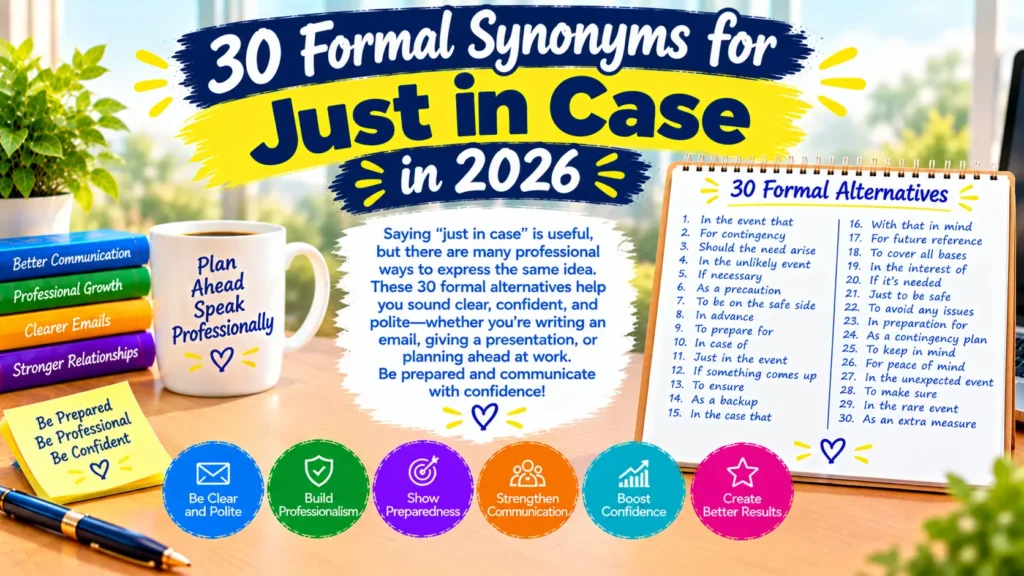
- 30 Formal Synonyms for Just in Case
- Quick Comparison Table
- Professional Email Examples
- Common Mistakes to Avoid
- Related Phrases and Expressions
- Just in Case vs. Its Alternatives
- Cultural Usage in Professional Communication
- Frequently Asked Questions
- Conclusion
What Does “Just in Case” Mean?
“Just in case” means doing something now because a situation might happen later. It describes a precaution, backup plan, or action that prepares you for a possible event.
For example:
- Casual: “I’ll bring an extra copy just in case.”
- Professional: “I’ll bring an additional copy as a precaution.”
- Formal: “An additional copy will be available should the need arise.”
Each sentence communicates the same basic idea, but the tone and level of formality differ.
Literal Meaning
The phrase refers to preparing for a possible situation without knowing whether it will happen.
For example, you might save a backup file in case your computer stops working. You might also send a colleague an extra document in case they need it later.
Tone and Purpose
“Just in case” usually sounds friendly, practical, and conversational. The word “just” softens the statement and makes the precaution sound small or informal.
Its purpose is to help you:
- Prepare for unexpected situations.
- Prevent delays or confusion.
- Share extra information that someone may need.
- Provide an alternative if the original plan fails.
- Show that you have considered possible risks.
Emotional Context
The phrase can also express thoughtfulness. For example, sending a client an additional contact number just in case shows that you want to make their experience easier.
In business writing, the goal is to preserve this helpful meaning while choosing wording that suits the audience.
When to Use Formal Alternatives
A formal alternative to “just in case” works best when you need to sound precise, respectful, or prepared.
1. In Business Emails
Use professional wording when you share extra documents, confirm arrangements, or prepare a recipient for a possible issue.
Example:
“Please find the backup file attached for reference, should you need it.”
2. In Workplace Communication
Use clear, practical phrases when discussing deadlines, schedules, resources, or backup plans.
Example:
“I have prepared an alternative schedule as a precaution.”
3. With Clients
Client communication benefits from wording that shows care without creating unnecessary concern.
Example:
“We have included an alternative contact number in the event that you experience any access issues.”
4. In Networking
When sharing information that may become useful later, choose a friendly but professional expression.
Example:
“I’ve included my contact details for future reference.”
5. In Customer Service
Use reassuring language when explaining backup arrangements or steps a customer can take if a problem occurs.
Example:
“Please retain your confirmation number in case you need assistance.”
A more formal version would be:
“Please retain your confirmation number should you require further assistance.”
30 Formal Synonyms for Just in Case
The following alternatives help you replace “just in case” in emails, reports, meetings, customer service messages, and everyday workplace conversations. Choose the phrase that best matches your intended meaning rather than replacing the original expression automatically.
Professional Alternatives
These expressions work well in most business settings. They sound clear and practical without making your message unnecessarily formal.
1. As a Precaution
Tone: Professional, careful, and reassuring.
Best use: Preventive actions, safety measures, and backup arrangements.
This is one of the best professional ways to say “just in case” when you want to show that you are taking steps to prevent a possible problem.
Example:
“ I’ve saved a backup copy of the report as a precaution.”
Email example:
“We have arranged an alternative meeting room as a precaution in case the original room becomes unavailable.”
2. For Future Reference
Tone: Professional, helpful, and neutral.
Best use: Sharing documents, contact details, instructions, or information that someone may need later.
This phrase focuses on the future usefulness of information rather than the possibility of something going wrong.
Example:
“I’ve included the project timeline for future reference.”
Email example:
“Please keep the attached guidelines for future reference.”
3. As a Backup
Tone: Direct, practical, and business-friendly.
Best use: Alternative files, plans, contacts, systems, or resources.
Use this expression when you have prepared a second option in case the primary one fails.
Example:
“I’ve prepared a second presentation as a backup.”
Email example:
“We have assigned an additional team member as a backup in case the primary contact is unavailable.”
4. To Be on the Safe Side
Tone: Friendly, cautious, and slightly conversational.
Best use: Informal workplace emails and team discussions.
This expression communicates caution without sounding overly technical. Although it is more conversational than “as a precaution,” it remains suitable for many professional settings.
Example:
“To be on the safe side, I’ll send the documents a day before the deadline.”
Email example:
“To be on the safe side, I recommend testing the link before sharing it with the client.”
5. In Preparation for Any Unexpected Issues
Tone: Professional, proactive, and reassuring.
Best use: Project planning, technical support, event management, and risk prevention.
Choose this expression when you want to explain why you have prepared for possible difficulties.
Example:
“We have created a backup schedule in preparation for any unexpected issues.”
Email example:
“In preparation for any unexpected issues, we have arranged additional technical support for the launch.”
6. As a Contingency Measure
Tone: Formal, strategic, and precise.
Best use: Business proposals, risk management, operational planning, and project reports.
A contingency measure is an action taken to address a possible future problem. This phrase sounds more formal than “just in case” and works well when discussing planned responses to risks.
Example:
“We have secured an alternative supplier as a contingency measure.”
Email example:
“As a contingency measure, we have reserved an additional time slot for the presentation.”
Formal Alternatives
These options suit formal emails, official notices, contracts, policies, and communications with senior stakeholders. Some are more natural in written English than in everyday conversation.
7. In the Event That
Tone: Formal, neutral, and precise.
Best use: Policies, instructions, client communication, and conditional arrangements.
This expression introduces a possible event and explains what should happen if it occurs.
Example:
“In the event that the system becomes unavailable, please contact the support team.”
Email example:
“In the event that you cannot attend the scheduled meeting, please notify us in advance.”
8. Should the Need Arise
Tone: Highly formal, courteous, and polished.
Best use: Formal business correspondence, executive communication, and offers of assistance.
This phrase means “if it becomes necessary.” It works particularly well when offering support without assuming that the recipient will need it.
Example:
“We can arrange an additional consultation should the need arise.”
Email example:
“Please feel free to contact our team should the need arise.”
9. If Necessary
Tone: Formal, concise, and neutral.
Best use: Instructions, procedures, approvals, and professional emails.
This is a straightforward alternative when an action may be needed but is not certain.
Example:
“We can extend the deadline if necessary.”
Email example:
“I can arrange a follow-up meeting if necessary.”
10. In Anticipation of Potential Issues
Tone: Formal, analytical, and proactive.
Best use: Project reports, planning documents, risk assessments, and management discussions.
Use this phrase when you have identified possible difficulties and want to show that you are preparing for them.
Example:
“In anticipation of potential issues, we have reviewed the implementation plan.”
Email example:
“In anticipation of potential issues during the transition, we have prepared detailed support instructions.”
11. In Case of an Emergency
Tone: Formal, serious, and safety-focused.
Best use: Emergency procedures, safety instructions, building management, and operational guidance.
This phrase is more specific than “just in case.” Use it when the possible situation involves an emergency, not merely a minor inconvenience.
Example:
“Please keep the emergency contact list accessible in case of an emergency.”
More concise alternative:
“Keep the emergency contact list accessible for emergency situations.”
12. As a Preventive Measure
Tone: Formal, practical, and risk-conscious.
Best use: Quality control, cybersecurity, workplace safety, and process management.
A preventive measure aims to reduce the chance of a problem occurring.
Example:
“We have updated the software as a preventive measure.”
Email example:
“As a preventive measure, please verify the recipient list before sending the announcement.”
Friendly and Polite Alternatives
These phrases help you sound approachable while still maintaining professional communication.
13. In Case You Need It
Tone: Friendly, helpful, and natural.
Best use: Team emails, sharing attachments, and offering additional resources.
This is one of the closest alternatives to “just in case.” It sounds natural and keeps your message warm.
Example:
“I’ve attached the meeting notes in case you need them.”
Email example:
“I’ve also included the presentation slides in case you need them for your discussion.”
14. If It Helps
Tone: Friendly, considerate, and collaborative.
Best use: Offering suggestions, resources, or additional information.
Use this expression when you want to provide something without pressuring the recipient to use it.
Example:
“If it helps, I can share a sample project plan.”
Email example:
“I’ve included a short checklist if it helps with your preparation.”
15. For Your Convenience
Tone: Polite, thoughtful, and service-oriented.
Best use: Customer service, client emails, and sharing useful resources.
This phrase emphasizes making things easier for the recipient rather than preparing for a specific risk.
Example:
“For your convenience, I’ve included the payment instructions below.”
Email example:
“For your convenience, I’ve attached both the PDF and editable versions of the document.”
16. In Case Anything Changes
Tone: Friendly, flexible, and practical.
Best use: Scheduling, travel arrangements, project timelines, and meeting coordination.
This expression works when circumstances may change after you make an initial plan.
Example:
“I’ll keep the afternoon free in case anything changes.”
Email example:
“I’ve shared my alternative contact details in case anything changes before the meeting.”
17. If You Need Anything Further
Tone: Courteous, supportive, and professional.
Best use: Client communication, customer service, and follow-up emails.
This phrase offers additional help without suggesting that a problem will occur.
Example:
“Please let me know if you need anything further.”
Email example:
“I’ve included the relevant documents. Please contact me if you need anything further.”
18. Just to Be Prepared
Tone: Friendly, proactive, and conversational.
Best use: Team discussions, informal workplace emails, and project planning.
This phrase explains that an action is intended to help you prepare for a possible situation.
Example:
“I’m bringing an extra charger just to be prepared.”
Email example:
“I’ve created a second version of the presentation just to be prepared for any last-minute changes.”
Email-Ready Alternatives
These options fit naturally into written communication. They are particularly useful when sharing attachments, adding context, or explaining a backup plan.
19. For Reference
Tone: Neutral, concise, and professional.
Best use: Emails with attachments, reports, meeting notes, and supporting documents.
Use this expression when the recipient may want to consult the information later.
Example:
“Please find the project summary attached for reference.”
Email example:
“I’ve included the previous correspondence for reference as you review the updated proposal.”
20. In Case This Is Helpful
Tone: Polite, considerate, and approachable.
Best use: Sharing optional resources, advice, templates, or examples.
This phrase signals that you are offering information that may be useful but is not essential.
Example:
“I’ve included a sample template in case this is helpful.”
Email example:
“In case this is helpful, I’ve also attached a checklist for preparing your presentation.”
21. For Your Records
Tone: Professional, administrative, and formal.
Best use: Invoices, receipts, agreements, confirmations, and official documents.
This expression is best when the recipient should retain information, not simply when a problem might occur.
Example:
“Please keep the signed agreement for your records.”
Email example:
“I’m sending a copy of the approved invoice for your records.”
22. In the Interest of Being Prepared
Tone: Formal, thoughtful, and proactive.
Best use: Business planning, internal updates, and project coordination.
This phrase explains that an action supports readiness for a possible future situation.
Example:
“In the interest of being prepared, we have reviewed the alternative delivery options.”
Email example:
“In the interest of being prepared, I’ve circulated the revised agenda before tomorrow’s meeting.”
23. To Avoid Any Potential Issues
Tone: Professional, preventive, and direct.
Best use: Quality checks, scheduling, document reviews, and operational emails.
This phrase works when your goal is to reduce the risk of a problem.
Example:
“Please review the figures again to avoid any potential issues.”
Email example:
“To avoid any potential issues, please confirm that the attached figures match the final report.”
24. In Case of Any Unforeseen Circumstances
Tone: Very formal, careful, and procedural.
Best use: Contracts, formal notices, event planning, and contingency instructions.
“Unforeseen circumstances” refers to events that were not expected or planned for. This phrase can sound heavy in routine emails, so reserve it for situations where that level of formality makes sense.
Example:
“In case of any unforeseen circumstances, the event may be rescheduled.”
More formal version:
“The event may be rescheduled in the event of unforeseen circumstances.”
Workplace and Planning Alternatives
Use these expressions when you are discussing resources, deadlines, potential risks, and team responsibilities.
25. As a Safeguard
Tone: Professional, cautious, and protective.
Best use: Data security, quality assurance, and risk reduction.
A safeguard is something that helps protect against a possible problem or loss.
Example:
“We have retained a copy of the original file as a safeguard.”
Email example:
“As a safeguard, please save a local copy before installing the update.”
26. As a Precautionary Step
Tone: Formal, careful, and procedural.
Best use: Internal processes, compliance checks, and operational planning.
This expression describes a specific action taken to reduce possible risk.
Example:
“We have completed an additional review as a precautionary step.”
Email example:
“As a precautionary step, please verify the account details before processing the payment.”
27. To Account for Possible Changes
Tone: Professional, analytical, and flexible.
Best use: Budgeting, scheduling, forecasting, and project management.
This phrase is useful when you make room for changes that may affect a plan.
Example:
“We have added two days to the timeline to account for possible changes.”
Email example:
“The revised schedule includes additional time to account for possible changes in client requirements.”
28. In Case of Delays
Tone: Practical, clear, and professional.
Best use: Shipping, deadlines, event planning, and project coordination.
This expression is more specific than “just in case” and works when the possible problem is a delay.
Example:
“We have allowed an extra hour in case of delays.”
Email example:
“Please share the updated tracking details in case of delays with the delivery.”
29. If Circumstances Require It
Tone: Formal, measured, and diplomatic.
Best use: Policies, business proposals, scheduling decisions, and management communication.
This phrase means that an action will take place if the situation makes it necessary.
Example:
“We can revise the implementation schedule if circumstances require it.”
Email example:
“We will arrange an additional review if circumstances require it.”
30. As an Alternative Option
Tone: Professional, practical, and solution-oriented.
Best use: Presenting backup plans, alternative suppliers, meeting times, or procedures.
This phrase focuses on another available choice. It is useful when you want the recipient to have a second option ready.
Example:
“We have reserved a second meeting room as an alternative option.”
Email example:
“I’ve included a second delivery method as an alternative option if the standard service is unavailable.”
Quick Comparison Table
Use this table to find the best synonym for “just in case” based on tone and purpose.
| Alternative | Tone | Best use |
|---|---|---|
| As a precaution | Professional | Preventive action |
| For future reference | Neutral | Useful information |
| As a backup | Direct | Backup plans |
| To be on the safe side | Friendly | Everyday work |
| As a contingency measure | Formal | Risk management |
| In the event that | Formal | Conditional instructions |
| Should the need arise | Very formal | Offers of assistance |
| If necessary | Concise | Conditional action |
| As a preventive measure | Formal | Risk reduction |
| In case you need it | Friendly | Sharing resources |
| If it helps | Approachable | Optional assistance |
| For your convenience | Polite | Client service |
| In case anything changes | Practical | Scheduling |
| If you need anything further | Courteous | Follow-up emails |
| For reference | Professional | Supporting documents |
| In case this is helpful | Friendly | Optional information |
| For your records | Administrative | Official documents |
| To avoid any potential issues | Direct | Quality checks |
| As a safeguard | Professional | Protection |
| To account for possible changes | Analytical | Project planning |
The strongest all-purpose choices are “as a precaution,” “if necessary,” “in the event that,” and “in case you need it.” They cover most professional situations while keeping the meaning clear.
Professional Email Examples
The right alternative depends on who receives your message and what you want to communicate. Here are six ready-to-use examples for common business situations.
1. Email to a Client
Dear [Client Name],
Please find the updated project documents attached. We have also included a backup copy as a precaution in case you experience any access issues.
Please let me know if you need any additional information.
Best regards,
[Your Name]
Why it works: “As a precaution” communicates preparation without suggesting that a problem is likely.
2. Email to Your Manager
Dear [Manager’s Name],
I’ve attached the revised project schedule for your review. I’ve also included an alternative timeline to account for possible changes to the delivery date.
Please let me know if you would like me to make any adjustments.
Best regards,
[Your Name]
Why it works: The message shows initiative and offers a practical backup plan.
3. Email to a Colleague
Hi [Colleague’s Name],
I’ve shared the meeting notes and presentation slides for future reference. I’ve also included the action items in case you need to check any details later.
Thanks,
[Your Name]
Why it works: “For future reference” and “in case you need to” sound natural in everyday workplace communication.
4. Email to a Customer
Dear [Customer Name],
Your order confirmation is attached. Please keep a copy for your records.
If you experience any difficulties accessing your order details, our support team will be happy to assist you.
Kind regards,
[Your Name]
Why it works: “For your records” gives the customer a clear reason to retain the document, while the second paragraph explains what to do if a problem occurs.
5. Networking Email
Hi [Name],
It was a pleasure connecting with you. I’ve included my contact details below for future reference, and I’d be happy to stay in touch.
Please feel free to reach out if I can ever be of assistance.
Best regards,
[Your Name]
Why it works: “For future reference” keeps the message professional without making it sound overly formal.
6. Meeting Follow-Up Email
Hi Team,
Thank you for your time during today’s meeting. I’ve attached the meeting summary and action items for reference.
I’ve also included an alternative meeting time should the need arise.
Please let me know if anything needs clarification.
Best,
[Your Name]
Why it works: “Should the need arise” offers flexibility while maintaining a formal business tone.
Common Mistakes to Avoid
Even a good synonym can sound awkward when you use it in the wrong context. Keep these common mistakes in mind.
1. Overusing Formal Expressions
Using phrases such as “should the need arise” in every email can make your writing sound stiff.
Instead of:
“Should the need arise, please contact me should you require further assistance.”
Write:
“Please contact me if you need further assistance.”
Tip: Use formal language when it adds value. Simple wording often communicates your message more effectively.
2. Choosing the Wrong Tone
A phrase suitable for a legal document may sound unnatural in a quick message to a teammate.
- Formal document: “In the event that the system becomes unavailable…”
- Everyday email: “If the system becomes unavailable…”
- Friendly message: “If anything goes wrong…”
Tip: Match your wording to your audience and the importance of the situation.
3. Confusing Preparation With Record-Keeping
“As a precaution” and “for your records” do not mean the same thing.
- As a precaution: You take action to prevent or reduce a possible problem.
- For your records: You provide information that someone may want to retain.
For example, saving a backup file as a precaution is different from sending a signed contract for someone’s records.
4. Making a Minor Issue Sound Like a Crisis
Phrases such as “in case of any unforeseen circumstances” can make routine tasks sound serious.
Instead of:
“In case of any unforeseen circumstances, I have attached another copy.”
Write:
“I’ve attached another copy in case you need it.”
Tip: Reserve serious or technical expressions for situations that genuinely require them.
5. Using “Just in Case” Without Explaining the Action
Sometimes the reader needs to know what they should do, not simply that a precaution exists.
Vague:
“Keep this just in case.”
Clear:
“Please save this backup file in case the original becomes unavailable.”
Tip: State the action and, when useful, explain the possible situation.
6. Creating Unnecessary Email Length
Formal wording should not make a short message longer than necessary.
Wordy:
“In anticipation of the possibility that you may require the information at a later date, I have attached the document.”
Concise:
“I’ve attached the document for future reference.”
Tip: Prefer short, specific expressions whenever they preserve the intended meaning.
Related Phrases and Expressions
These 18 expressions are closely related to “just in case.” Some describe preparation, while others introduce conditions, offer help, or explain why you are sharing information.
| Related phrase | Meaning | Example |
|---|---|---|
| In case | If something happens | Save the file in case your computer shuts down. |
| In case of | If a specified event occurs | In case of an emergency, contact security. |
| Just to be safe | To reduce possible risk | Just to be safe, I’ll verify the figures. |
| To be on the safe side | To avoid unnecessary risk | To be on the safe side, arrive early. |
| As a precaution | To prevent or reduce risk | We created a backup as a precaution. |
| As a safeguard | To protect against a problem | Keep a second copy as a safeguard. |
| For future reference | For later use | Save the guide for future reference. |
| For your records | For someone to retain | I’ve attached the receipt for your records. |
| If needed | If it becomes necessary | Additional support is available if needed. |
| If necessary | If circumstances require it | We can reschedule if necessary. |
| If required | If something is needed or requested | Please provide supporting documents if required. |
| If applicable | If relevant to the situation | Complete the additional section if applicable. |
| If the need arises | If something becomes necessary | We can arrange another session if the need arises. |
| Should the need arise | A formal version of the phrase above | Contact our office should the need arise. |
| In the event of | If a particular event occurs | In the event of a delay, notify the client. |
| As a backup plan | As an alternative arrangement | We have a second supplier as a backup plan. |
| To prevent potential issues | To reduce the chance of problems | Review the figures to prevent potential issues. |
| In anticipation of | In preparation for something expected or possible | We added staff in anticipation of higher demand. |
These expressions overlap, but they are not interchangeable in every sentence. For example, “if applicable” means something may or may not be relevant, whereas “as a precaution” describes an action taken to reduce risk.
Just in Case vs. Its Alternatives
The phrase “just in case” is flexible, but different alternatives communicate different intentions. Use this comparison to choose a more precise expression.
| Phrase | Formality | Main emphasis | Example |
|---|---|---|---|
| Just in case | Casual to neutral | Possible future need | I’ll save a copy just in case. |
| As a precaution | Professional | Preventing problems | I’ll save a copy as a precaution. |
| If necessary | Neutral to formal | Conditional action | I’ll prepare another copy if necessary. |
| In the event that | Formal | A specific possible event | In the event that the file is lost, use the backup. |
| Should the need arise | Very formal | Future need or assistance | We can provide support should the need arise. |
| For future reference | Neutral to professional | Later use of information | I’ve saved the document for future reference. |
| As a contingency measure | Formal | A planned response to risk | We’ve arranged a second supplier as a contingency measure. |
| In case you need it | Friendly | Helping the recipient | I’ve attached the guide in case you need it. |
Which Alternative Should You Choose?
- For a professional email: “As a precaution” or “for future reference.”
- For a formal report: “In the event that” or “as a contingency measure.”
- For a client message: “In case you need it” or “for your convenience.”
- For a workplace conversation: “If necessary” or “to be on the safe side.”
- For offering future assistance: “Should the need arise.”
- For preventing errors: “As a preventive measure” or “to avoid any potential issues.”
The key is to match the phrase to your actual purpose. If you want to share information, use “for future reference.” If you want to prepare for a possible problem, use “as a precaution.”
Cultural Usage in Professional Communication
The meaning of “just in case” stays broadly consistent across English-speaking workplaces, but expectations about formality can vary by audience and industry.
US English
American business communication often favors concise, direct, and approachable wording. “Just in case,” “if needed,” “as a precaution,” and “in case you need it” can all sound natural, depending on the context.
Example:
“I’ve attached a backup copy in case you need it.”
For most routine emails in the United States, this sounds professional without being stiff.
UK English
British professional writing also uses “just in case,” especially in everyday workplace conversations. In formal correspondence, “should the need arise,” “if required,” and “as a precaution” may suit the context.
Example:
“Please contact our team should the need arise.”
However, these expressions are not automatically better in every situation. Clear, straightforward wording works well in both British and American English.
Corporate Communication
Large organizations may use more specific terms when discussing operational risks, compliance, security, and project planning.
For example:
“We have established a contingency plan in the event of a service interruption.”
This wording works because it identifies both the preparation and the situation it addresses.
For routine tasks, simpler language is usually more effective:
“We have a backup plan if the service goes down.”
Customer Service
Customer-facing messages should reassure people and explain what to do next. Avoid language that unnecessarily suggests danger or failure.
Instead of:
“In anticipation of any unforeseen circumstances, retain your reference number.”
Write:
“Please keep your reference number in case you need further assistance.”
The second version sounds helpful and is easier to understand.
Networking and Relationship Building
Networking messages should feel warm, respectful, and natural. Expressions such as “for future reference,” “if it helps,” and “please feel free to reach out” work well when you share resources or offer future assistance.
Example:
“I’ve included my contact details for future reference. Please feel free to reach out if I can help with anything.”
This keeps the conversation open without putting pressure on the recipient.
Frequently Asked Questions
1. What is a formal way to say “just in case”?
“As a precaution” is one of the best formal alternatives. You can also use “in the event that,” “should the need arise,” or “as a contingency measure,” depending on the context.
Example: “We have prepared an alternative plan as a precaution.”
2. What is the most professional synonym for “just in case”?
“As a precaution” is a strong all-purpose choice for professional communication. It sounds clear and responsible when you explain why you have prepared a backup or taken preventive action.
Example: “I’ve saved a backup copy as a precaution.”
3. How do you say “just in case” in a formal email?
Choose a phrase that fits the purpose of your email. Use “for future reference” when sharing information, “as a precaution” when preventing a problem, or “should the need arise” when offering future assistance.
Example: “I’ve attached the additional document for future reference.”
4. Is “just in case” professional?
Yes. “Just in case” is acceptable in many professional emails and workplace conversations. It sounds conversational rather than highly formal, so you may prefer a more precise alternative in policies, reports, or official correspondence.
5. Is “as a precaution” the same as “just in case”?
They have similar meanings, but their emphasis differs. “Just in case” describes preparing for a possible situation, while “as a precaution” highlights an action taken to prevent or reduce risk.
Example: “I’ve saved the file as a precaution.”
6. What is another way to say “just in case you need it”?
You can say “in case this is helpful,” “for future reference,” or “if you need it later.” The best option depends on whether you are sharing optional information or something the recipient may need to use.
Example: “I’ve attached the template in case this is helpful.”
7. What is a polite alternative to “just in case”?
“In case you need it” and “for your convenience” are polite, friendly alternatives. Use the first when offering optional information and the second when making a task easier for the recipient.
Example: “For your convenience, I’ve included the instructions below.”
8. What is a formal alternative to “just in case something happens”?
You can use “in the event that an issue arises,” “in anticipation of potential issues,” or “should unforeseen circumstances arise.”
Example: “In the event that an issue arises, please contact our support team.”
Use the simplest option that accurately describes the situation.
9. Can I use “should the need arise” in a business email?
Yes. “Should the need arise” is a formal and polite expression that means “if it becomes necessary.” It works especially well when offering assistance or describing a possible future action.
Example: “We can arrange an additional consultation should the need arise.”
10. How can I avoid repeating “just in case” in professional writing?
Identify what you mean before choosing a replacement. If you are preparing for a risk, use “as a precaution.” If you are sharing information, use “for future reference.” If an action depends on a condition, use “if necessary” or “in the event that.”
Vary your wording based on meaning, not just to avoid repetition. This makes your professional communication clearer and more natural.
Conclusion
Choosing the right alternative to “just in case” helps you sound clear, confident, and professional. Use “as a precaution” for preventive action, “in the event that” for formal conditions, and “should the need arise” when offering future assistance. For friendly emails, “in case you need it” and “for future reference” are natural choices. Always consider your audience, purpose, and level of formality before selecting a phrase. Good business writing does not require complicated language. It requires precise words that communicate your intentions, prepare others when necessary, and build trust through thoughtful, effective communication.