In professional communication, the way you express an opinion can shape how others understand your message. Whether you are writing a business email, sharing an idea in a meeting, speaking with a client, or contributing to a team discussion, choosing the right words helps you sound clear, confident, and respectful.
There are many formal ways to say “in my opinion” without repeating the same phrase in every conversation. Alternatives such as “from my perspective,” “I believe,” and “based on my assessment” can make your message sound more natural and professional.
The best phrase depends on your audience, purpose, and level of formality. Some expressions work well in academic writing, while others suit workplace communication, client emails, and professional networking.
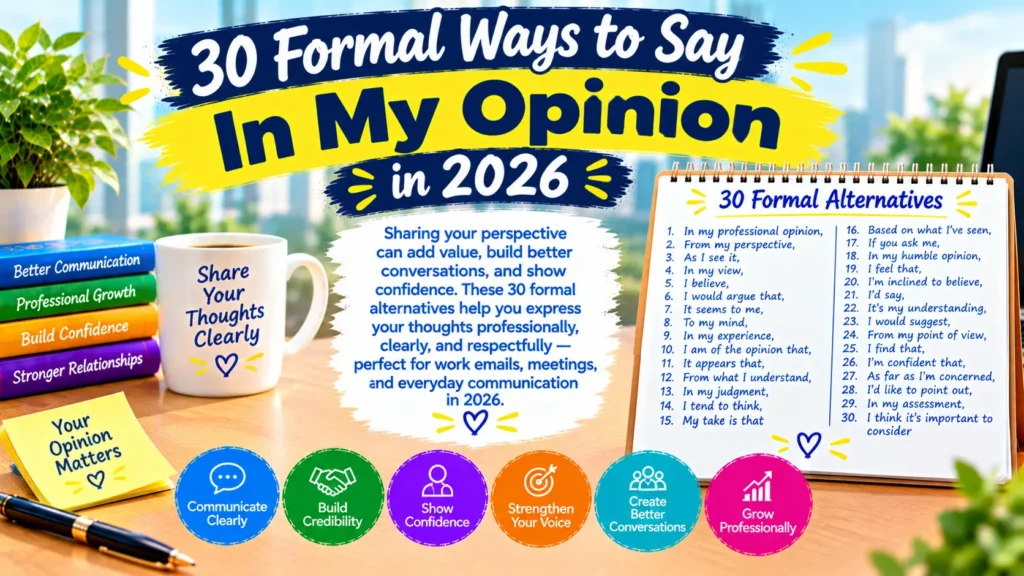
This guide covers 30 professional, formal, friendly, and email-ready alternatives, with practical examples to help you choose the right expression in 2026.
What Does “In My Opinion” Mean?
“In my opinion” means that you are sharing your personal view, judgment, or belief about a subject. It tells the reader or listener that your statement reflects how you see a situation rather than an established fact.
For example:
- “In my opinion, we should update the project timeline.”
- “In my opinion, this approach offers better value.”
- “In my opinion, the team needs more time to prepare.”
Each sentence communicates a personal judgment. The speaker presents an idea without claiming that everyone must agree.
Literal Meaning
The phrase combines “in,” “my,” and “opinion” to show that a statement comes from your own thinking or judgment.
It does not automatically mean that you lack confidence. You can use it to introduce a carefully considered view, a recommendation, or a professional assessment.
Tone and Purpose
“In my opinion” generally sounds neutral, polite, and moderately formal. It serves three main purposes:
- Expresses a personal view: It separates your judgment from verified facts.
- Shows respect: It leaves room for others to disagree.
- Introduces a recommendation: It helps you explain what you think should happen next.
However, repeating the phrase too often can make business writing sound predictable. A suitable synonym can improve variety and make your message more precise.
Emotional Context
The phrase can sound confident, cautious, diplomatic, or even defensive depending on the surrounding words.
Compare these examples:
- Confident: “In my opinion, this is the strongest option.”
- Diplomatic: “From my perspective, we may benefit from another review.”
- Cautious: “I would suggest considering a different approach.”
- Analytical: “Based on my assessment, the current plan meets our needs.”
The goal is not simply to replace one phrase with another. It is to communicate your viewpoint in a way that suits the situation.
When Should You Use a Professional Alternative?
A professional synonym for “in my opinion” can help you communicate more naturally across different business settings.
1. In Business Emails
Email communication often benefits from direct, polite wording. Instead of beginning every message with “In my opinion,” choose a phrase that matches your purpose.
Example:
“In my opinion, we should revise the proposal before sending it to the client.”
More polished:
“Based on my assessment, we should revise the proposal before sending it to the client.”
The second version sounds more analytical and connects your recommendation to a considered judgment.
2. In Workplace Discussions
During meetings, you may need to share ideas without sounding overly forceful.
Example:
“From my perspective, we should focus on customer retention before expanding.”
This expression invites discussion while keeping your position clear.
3. When Communicating With Clients
Client communication requires tact, clarity, and confidence. Choose wording that explains your recommendation without making the client feel dismissed.
Example:
“Based on our current findings, I recommend prioritizing the website updates.”
This is more specific than “In my opinion, the website needs work” because it presents a recommendation and gives it a professional basis.
4. In Professional Networking
When discussing industry trends or exchanging ideas with colleagues, a friendly expression may feel more natural than a highly formal one.
Example:
“From my experience, clear communication makes cross-team projects easier.”
This works especially well when your opinion draws on personal experience.
5. In Customer Service
Customer service messages should sound respectful and helpful. Avoid wording that makes your response seem like an unsupported personal preference.
Example:
“I would recommend the annual plan if you expect to use the service throughout the year.”
This focuses on the customer’s needs and offers a practical suggestion.
30 Formal and Professional Ways to Say “In My Opinion”
The following alternatives cover formal writing, business emails, workplace discussions, and friendly professional conversations. Each includes its tone, best use, and an example.
Professional Alternatives
These expressions work well in meetings, reports, presentations, and everyday business communication.
1. From My Perspective
Tone: Professional, balanced, and diplomatic.
Best use: Sharing your viewpoint during meetings, team discussions, or client conversations.
Example: “From my perspective, improving the onboarding process would help new employees settle in faster.”
This phrase highlights your personal viewpoint without suggesting that it represents everyone’s opinion.
2. I Believe
Tone: Confident, clear, and professional.
Best use: Presenting an idea, recommendation, or considered judgment.
Example: “I believe we can improve customer satisfaction by reducing response times.”
“I believe” is one of the most versatile alternatives because it sounds natural in both spoken and written communication.
3. I Would Suggest
Tone: Polite, constructive, and collaborative.
Best use: Offering an idea without making it sound like an order.
Example: “I would suggest reviewing the budget before approving the additional expenses.”
This expression works particularly well when you want colleagues to consider your recommendation.
4. In My View
Tone: Neutral, concise, and moderately formal.
Best use: Business reports, professional emails, and workplace discussions.
Example: “In my view, the revised schedule gives the team enough time to complete the project.”
This is a direct synonym for “in my opinion” and often works as a simple replacement.
5. As I See It
Tone: Conversational, thoughtful, and professional.
Best use: Explaining how you understand a situation.
Example: “As I see it, we have two practical options for resolving the issue.”
This phrase is especially useful in discussions where people may interpret the same situation differently.
6. From Where I Stand
Tone: Personal, confident, and conversational.
Best use: Team conversations and informal professional discussions.
Example: “From where I stand, the current proposal addresses our main concerns.”
Use this expression when you want to emphasize your position. It is less formal than “based on my assessment.”
Formal Alternatives
Choose these expressions for reports, proposals, executive communication, academic writing, and situations that call for a more measured tone.
7. In My Considered Judgment
Tone: Highly formal and deliberate.
Best use: Formal recommendations and written assessments.
Example: “In my considered judgment, the proposed changes will improve operational efficiency.”
This phrase suggests that you have thought carefully about the issue. It may sound too formal for a quick email or casual meeting.
8. Based on My Assessment
Tone: Analytical, objective-sounding, and professional.
Best use: Project reviews, performance evaluations, reports, and recommendations.
Example: “Based on my assessment, the team can meet the deadline if we allocate additional resources.”
This phrase works best when you have reviewed relevant information or considered the available evidence.
9. It Is My View That
Tone: Formal, measured, and authoritative.
Best use: Formal reports, policy discussions, and professional correspondence.
Example: “It is my view that the proposed policy requires further review before implementation.”
The expression sounds more formal than “I think,” although it can also make simple sentences unnecessarily wordy.
10. I Am of the View That
Tone: Formal and restrained.
Best use: Formal business correspondence, policy documents, and some British English contexts.
Example: “I am of the view that the revised terms provide a fairer outcome for both parties.”
This is a more formal construction. In everyday American business writing, “I believe” or “in my view” will often sound more natural.
11. My Assessment Is That
Tone: Professional, analytical, and direct.
Best use: Reports, project updates, and management discussions.
Example: “My assessment is that the launch date remains achievable with the current resources.”
This phrase presents your opinion as a reasoned assessment. Use it when you can explain the basis for your conclusion.
12. From an Analytical Standpoint
Tone: Technical, structured, and formal.
Best use: Business analysis, research, financial discussions, and strategic planning.
Example: “From an analytical standpoint, the second proposal offers a more sustainable cost structure.”
This expression works when you are evaluating information logically rather than sharing a personal preference.
Friendly and Diplomatic Alternatives
These options help you express an opinion while keeping conversations open and respectful.
13. I Would Say
Tone: Friendly, natural, and moderately confident.
Best use: Everyday workplace conversations and informal professional emails.
Example: “I would say the first design is a better fit for our target audience.”
This phrase sounds conversational and avoids the stiffness of more formal expressions.
14. The Way I See It
Tone: Friendly, thoughtful, and approachable.
Best use: Team discussions, brainstorming, and collaborative problem-solving.
Example: “The way I see it, we can save time by combining the two review stages.”
It presents your viewpoint as one interpretation rather than the only possible answer.
15. I Tend to Think That
Tone: Cautious, reflective, and open-minded.
Best use: Situations where you want to express a belief without sounding too certain.
Example: “I tend to think that a shorter presentation would be more effective.”
Use this when you want to show that your position is a judgment rather than an absolute fact.
16. I Would Argue That
Tone: Confident, reasoned, and persuasive.
Best use: Debates, presentations, strategic discussions, and persuasive writing.
Example: “I would argue that investing in employee training will produce stronger long-term results.”
This phrase suggests that you can support your position with reasons. It may sound confrontational if the discussion calls for a softer approach.
17. I Feel That
Tone: Personal, gentle, and conversational.
Best use: Discussions involving preferences, team relationships, or subjective judgments.
Example: “I feel that we should give the new process another week before making changes.”
For evidence-based business recommendations, “I believe” or “based on my assessment” may sound more authoritative.
18. My Take Is
Tone: Friendly, direct, and modern.
Best use: Informal meetings, internal messages, and conversations with familiar colleagues.
Example: “My take is that we should test the idea with a smaller group first.”
This expression is common in conversational business English but may be too casual for formal reports or sensitive client communications.
Email-Ready Alternatives
These phrases help you share an opinion in writing without sounding repetitive or overly forceful.
19. I Would Recommend
Tone: Professional, helpful, and confident.
Best use: Client emails, business proposals, and advice.
Example: “I would recommend scheduling the training session before the new system goes live.”
This is a strong choice when your opinion includes a clear action that the reader can take.
20. I Am Inclined to Think That
Tone: Formal, cautious, and thoughtful.
Best use: Emails where you want to express a preliminary conclusion.
Example: “I am inclined to think that the revised timeline will work better for both teams.”
This expression leaves room for new information to change your view.
21. My Recommendation Would Be
Tone: Polished, advisory, and professional.
Best use: Client proposals, project updates, and management emails.
Example: “My recommendation would be to complete the security review before launching the product.”
This phrase emphasizes practical advice rather than personal preference alone.
22. I Would Be of the Opinion That
Tone: Very formal and somewhat wordy.
Best use: Rare cases that require a deliberately formal style.
Example: “I would be of the opinion that further consultation is necessary before a final decision.”
Although grammatically acceptable, this phrase often sounds unnecessarily complicated. In most business emails, “I believe further consultation is necessary” communicates the same idea more clearly.
23. My Understanding Is That
Tone: Careful, diplomatic, and clarifying.
Best use: Confirming information, discussing expectations, and checking shared understanding.
Example: “My understanding is that the revised contract will take effect next month.”
This is not an exact synonym for “in my opinion.” It signals your current understanding of a situation, which others can correct if needed.
24. From My Experience
Tone: Credible, practical, and conversational.
Best use: Giving advice based on past work or personal experience.
Example: “From my experience, sending a short agenda before the meeting helps everyone prepare.”
Use this phrase when experience supports your point. Do not use it to imply that personal experience proves a general claim.
Workplace and Decision-Making Alternatives
These options are especially useful when you need to evaluate a proposal, explain a decision, or contribute to a team discussion.
25. Based on What I Have Seen
Tone: Practical, measured, and evidence-oriented.
Best use: Sharing observations from a project or workplace situation.
Example: “Based on what I have seen, the new process has reduced the number of support requests.”
This expression connects your view to observed results. Make sure the observation supports the conclusion.
26. I Would Maintain That
Tone: Formal, firm, and assertive.
Best use: Defending a reasoned position during a debate or review.
Example: “I would maintain that the original deadline remains realistic if we prioritize the critical tasks.”
This phrase is stronger than “I believe” and suggests that you stand by your position despite possible disagreement.
27. My Position Is That
Tone: Direct, formal, and confident.
Best use: Policy discussions, negotiations, and decisions that require a clear stance.
Example: “My position is that all proposed changes should undergo a security review.”
Use this when you need to state a clear position. It can sound rigid if you want to invite open discussion.
28. The Evidence Suggests That
Tone: Analytical, objective, and authoritative.
Best use: Research, reports, performance reviews, and data-driven decisions.
Example: “The evidence suggests that shorter response times improve customer satisfaction.”
This is not a direct synonym for “in my opinion.” It points to evidence rather than personal belief. Use it only when relevant evidence supports the claim.
29. On Balance
Tone: Measured, thoughtful, and formal.
Best use: Comparing options or weighing advantages against disadvantages.
Example: “On balance, the benefits of extending the pilot program outweigh the additional costs.”
This phrase shows that you have considered competing factors before reaching a conclusion.
30. I Would Be Inclined to Recommend
Tone: Formal, diplomatic, and cautious.
Best use: Sensitive recommendations, client discussions, and decisions with some uncertainty.
Example: “I would be inclined to recommend a phased rollout to minimize disruption.”
This phrase softens a recommendation without hiding your position. For routine workplace messages, however, “I would recommend” is usually more concise.
Quick Comparison Table
Use this table to choose the best alternative based on tone and context.
| Alternative | Tone | Best use |
|---|---|---|
| From my perspective | Diplomatic | Meetings and teamwork |
| I believe | Confident | General business communication |
| I would suggest | Polite | Offering ideas |
| In my view | Neutral | Emails and reports |
| As I see it | Conversational | Explaining your viewpoint |
| In my considered judgment | Highly formal | Formal assessments |
| Based on my assessment | Analytical | Reviews and recommendations |
| It is my view that | Formal | Reports and policy discussions |
| My assessment is that | Professional | Project updates |
| From an analytical standpoint | Technical | Research and analysis |
| The way I see it | Friendly | Brainstorming |
| I tend to think that | Cautious | Uncertain situations |
| I would argue that | Persuasive | Debates and presentations |
| My take is | Casual | Internal conversations |
| I would recommend | Advisory | Client emails |
| My recommendation would be | Polished | Proposals |
| My understanding is that | Clarifying | Confirming information |
| From my experience | Practical | Sharing lessons |
| Based on what I have seen | Observational | Workplace reviews |
| My position is that | Assertive | Negotiations |
| The evidence suggests that | Evidence-based | Reports and research |
| On balance | Measured | Comparing options |
| I am inclined to think that | Cautious | Preliminary conclusions |
| I would be inclined to recommend | Diplomatic | Sensitive advice |
The remaining alternatives—“I would say,” “I feel that,” “I am of the view that,” “I would be of the opinion that,” “I would maintain that,” and “from where I stand”—offer additional choices for matching your wording to the audience.
Email Examples: How to Use These Alternatives Naturally
Knowing the right synonym is useful, but seeing it in a complete message makes it easier to apply. Here are six examples for common professional situations.
1. Email to a Client
Dear [Client Name],
Based on my assessment, I would recommend extending the project timeline by one week. This would give our team enough time to complete the final checks and maintain the expected quality.
Please let me know your thoughts.
Best regards,
[Your Name]
Why it works: The message explains the recommendation clearly and gives the client room to respond.
2. Email to a Manager
Hi [Manager Name],
From my perspective, simplifying the approval process could help us complete tasks more efficiently. I would be happy to discuss a few practical options if you think this would be helpful.
Best regards,
[Your Name]
Why it works: “From my perspective” introduces the idea without making it sound like a demand.
3. Message to a Colleague
I think we should review the first draft together before sharing it with the wider team. The way I see it, a quick review now could save us time later.
Why it works: The language sounds friendly and collaborative without becoming too casual.
4. Email to a Customer
Hello [Customer Name],
Based on your current needs, I would recommend the standard plan. It includes the main features you mentioned and may be a suitable option for your team.
Please feel free to contact me if you would like to compare the available plans.
Kind regards,
[Your Name]
Why it works: The recommendation focuses on the customer’s needs instead of presenting a personal preference as a fact.
5. Professional Networking Message
It was great connecting with you. From my experience, collaboration between teams can lead to some valuable ideas. I enjoyed hearing your perspective on the industry and hope we can stay in touch.
Why it works: “From my experience” adds a personal touch while keeping the conversation professional.
6. Meeting Follow-Up Email
Hi Team,
On balance, I believe the phased rollout is our strongest option because it gives us time to test the process and address any issues before the full launch.
Please share any additional concerns before we finalize the plan.
Best,
[Your Name]
Why it works: The email gives a clear position, explains the reasoning, and invites further input.
Common Mistakes to Avoid
Even a suitable synonym can sound awkward if you use it in the wrong context. These common mistakes can weaken your professional communication.
1. Repeating the Same Phrase Too Often
Using “in my opinion” in every paragraph can make your writing sound repetitive.
Less effective:
“In my opinion, the report needs changes. In my opinion, the deadline is too short. In my opinion, we should meet again.”
Better:
“I believe the report needs changes. The current deadline also seems too short. From my perspective, another meeting would help us agree on the next steps.”
Vary your wording only when it improves clarity. You do not need a different phrase for every sentence.
2. Using an Overly Formal Expression in a Simple Email
Phrases such as “I would be of the opinion that” can make a short message feel stiff.
Instead of:
“I would be of the opinion that we should reschedule the call.”
Write:
“I think we should reschedule the call.”
Choose direct language for routine workplace communication.
3. Making a Personal Opinion Sound Like a Fact
An opinion and a verified fact are not the same thing.
Less effective: “The evidence proves, in my opinion, that this is the best option.”
Better: “Based on the available information, I believe this is the strongest option.”
If you have reliable evidence, explain it. If you are sharing a personal judgment, make that clear.
4. Sounding Uncertain When You Need to Be Decisive
Too many cautious expressions can weaken an important recommendation.
Less effective: “I might possibly be inclined to think that we could consider another option.”
Better: “I recommend considering another option.”
Use cautious language when uncertainty is genuine, not simply because you want to sound polite.
5. Using Casual Expressions in Formal Reports
“My take is” works well in an informal team discussion, but it may not suit a formal proposal.
Instead, write:
“Based on my assessment, the proposed approach offers several advantages.”
Match the phrase to the document, audience, and purpose.
6. Using “In My Opinion” to Disguise Criticism
The phrase does not automatically make a critical statement polite.
Less effective: “In my opinion, your plan is poorly thought out.”
Better: “From my perspective, the plan would benefit from further review, particularly in the budget and implementation stages.”
Focus on specific issues and practical improvements rather than personal judgments about someone’s work.
7. Forgetting Email Etiquette
An opinion in a business email should usually have a clear purpose. Avoid adding unnecessary phrases that delay the main point.
Instead of: “I just wanted to say that, in my opinion, we may perhaps need to think about changing the date.”
Write: “I suggest moving the date to Friday so the team has more time to prepare.”
Clear, respectful language helps readers understand your recommendation quickly.
Related Phrases: 18 Expressions for Sharing Your View
These related expressions can help you expand your vocabulary for professional communication. Some express an opinion, while others introduce evidence, suggestions, or personal interpretations.
| Expression | Meaning | Example |
|---|---|---|
| I think | Expresses a personal thought | “I think the revised plan is practical.” |
| I believe | Expresses a considered belief | “I believe we can meet the deadline.” |
| In my view | Introduces a personal viewpoint | “In my view, the change is necessary.” |
| From my perspective | Shares an individual standpoint | “From my perspective, the process needs improvement.” |
| As far as I am concerned | States a personal position | “As far as I am concerned, the proposal is ready.” |
| Personally, I think | Emphasizes a personal view | “Personally, I think we should wait.” |
| I would suggest | Offers a polite idea | “I would suggest another review.” |
| I would recommend | Gives practical advice | “I would recommend the updated version.” |
| My impression is that | Shares an initial interpretation | “My impression is that the client is satisfied.” |
| My understanding is that | States current understanding | “My understanding is that the meeting starts at ten.” |
| It seems to me that | Introduces an interpretation | “It seems to me that we need more time.” |
| I suspect that | Expresses a tentative belief | “I suspect that the delay came from the supplier.” |
| I would argue that | Presents a reasoned position | “I would argue that training should come first.” |
| My assessment is that | Gives a considered evaluation | “My assessment is that the risk is manageable.” |
| On balance | Summarizes a weighing of factors | “On balance, the benefits outweigh the costs.” |
| From what I can see | Shares a view based on available information | “From what I can see, the files are complete.” |
| The evidence suggests that | Points to supporting evidence | “The evidence suggests that the change has helped.” |
| I take the view that | States a considered position | “I take the view that clear rules benefit everyone.” |
Remember that these expressions are related, not interchangeable in every situation. “I suspect that” signals uncertainty, while “the evidence suggests that” points to supporting information. Choosing the right phrase makes your meaning more precise.
“In My Opinion” vs. Its Alternatives
The best synonym depends on whether you want to express a personal belief, give advice, analyze evidence, or state a firm position.
| Phrase | Formality | Confidence | Best context |
|---|---|---|---|
| In my opinion | Moderate | Neutral | General discussions |
| I think | Low to moderate | Neutral | Everyday communication |
| I believe | Moderate | Confident | Meetings and emails |
| In my view | Moderate to high | Neutral | Reports and discussions |
| From my perspective | Moderate | Diplomatic | Collaboration and teamwork |
| Based on my assessment | High | Analytical | Business decisions |
| I would suggest | Moderate | Gentle | Offering ideas |
| I would recommend | Moderate to high | Confident | Client advice |
| My position is that | High | Firm | Negotiations and policy |
| The evidence suggests that | High | Evidence-based | Research and analysis |
| On balance | High | Measured | Evaluating competing options |
| My take is | Low to moderate | Conversational | Informal team chats |
Which Alternative Sounds Most Professional?
There is no single best phrase for every situation. These are useful starting points:
- For a professional email: “I believe” or “from my perspective.”
- For a formal report: “Based on my assessment.”
- For a recommendation: “I would recommend.”
- For a diplomatic disagreement: “I see this somewhat differently.”
- For an evidence-based conclusion: “The evidence suggests that.”
- For a firm position: “My position is that.”
- For a friendly conversation: “The way I see it.”
The most professional wording is usually the clearest wording that fits your audience and purpose.
Cultural Usage: How to Express Opinions Professionally
The meaning of an opinion phrase stays similar across English-speaking workplaces, but its tone can change with the culture, audience, and situation.
1. US English
American business communication often favors concise, direct language. Expressions such as “I believe,” “I think,” and “I would recommend” work well in emails and meetings.
Example: “I believe we should move forward with the revised proposal.”
In many US workplaces, a clear recommendation followed by a short reason sounds more effective than a long formal introduction.
2. UK English
British professional communication also uses direct expressions, but phrases such as “in my view,” “I would suggest,” and “I am of the view that” may suit more formal settings.
Example: “In my view, we should review the proposal before making a final decision.”
The most suitable phrase depends on the organization and relationship, rather than nationality alone.
3. Corporate Communication
Corporate writing often values clarity, accountability, and sound reasoning.
Instead of writing, “In my opinion, this plan is better,” consider:
“Based on our current priorities, I recommend the revised plan.”
This version connects your opinion to business goals and makes your next step clear.
4. Customer Service
Customer-facing communication should sound helpful rather than self-focused.
Instead of: “In my opinion, you should choose the premium plan.”
Try: “Based on the features you need, I would recommend the premium plan.”
This approach connects your recommendation to the customer’s requirements.
5. Professional Networking
Networking calls for a balance of confidence and openness. You want to share your thoughts without sounding as though you have all the answers.
Example: “From my experience, cross-functional collaboration can make a real difference.”
When discussing a new idea, you can also say, “I would be interested to hear your perspective.” This encourages a genuine exchange rather than a one-sided conversation.
Frequently Asked Questions
1. What is a formal way to say “in my opinion”?
“Based on my assessment,” “in my considered judgment,” and “it is my view that” are formal alternatives. Choose “based on my assessment” when you have evaluated information and want to explain a professional conclusion.
2. What is the most professional synonym for “in my opinion”?
“From my perspective” is a versatile professional alternative. For evidence-based recommendations, “based on my assessment” may be more suitable because it emphasizes your evaluation.
3. How do I say “in my opinion” in a formal email?
You can write “I believe,” “in my view,” or “I would recommend.” For example: “I would recommend reviewing the proposal before the next meeting.”
4. Is “in my view” more formal than “in my opinion”?
Both phrases have a similar level of formality. “In my view” can sound slightly more polished in reports and business writing, but the difference is small.
5. What is a polite way to express an opinion without sounding rude?
Use phrases such as “From my perspective,” “I would suggest,” and “I see this somewhat differently.” Explain your reasoning and focus on the issue rather than criticizing the person.
6. What can I use instead of “I think” at work?
You can use “I believe,” “from my perspective,” “my assessment is that,” or “I would recommend.” The best choice depends on whether you are sharing a thought, evaluating a situation, or proposing an action.
7. Is “I believe” appropriate for professional communication?
Yes. “I believe” works well in emails, meetings, reports, and presentations. It expresses a considered view without sounding overly formal or unnecessarily complicated.
8. How can I express an opinion confidently?
State your position directly, explain your reasons, and avoid excessive qualifiers.
For example: “I recommend launching the pilot program first because it will help us identify potential issues.”
This sounds more confident than “I might possibly think we could consider trying a pilot program.”
9. What is an academic alternative to “in my opinion”?
“In my view,” “I would argue that,” and “the evidence suggests that” can work in academic writing, depending on the claim. Academic writing often benefits from evidence-based language rather than relying on personal opinion alone.
10. Should I use “in my opinion” in every business email?
No. Use it when you need to distinguish your personal view from a fact or another person’s position. In many emails, a direct statement such as “I recommend reviewing the document” is clearer and more useful.
Conclusion: Choose the Right Words for Professional Communication
Choosing the right alternative to “in my opinion” helps you express ideas with confidence, clarity, and respect. For everyday business emails, “I believe,” “in my view,” and “from my perspective” are reliable choices. When you need to make a formal recommendation, use “based on my assessment” or “I would recommend.” For friendly workplace discussions, “the way I see it” keeps your tone natural and approachable. Always consider your audience, purpose, and evidence before choosing a phrase. The goal is not to sound complicated but to communicate your thoughts clearly, professionally, and effectively.