
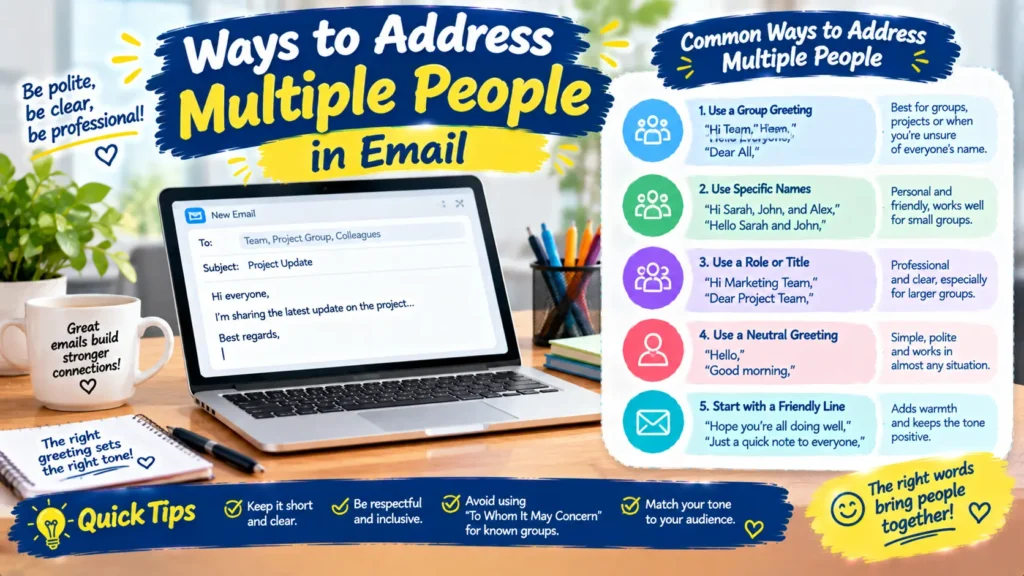
Knowing the right ways to address multiple people in an email can make your message sound more professional, respectful, and natural. The best greeting depends on who you are writing to, how well you know the recipients, and how formal the situation is.
For example, “Dear Team,” works well for a group of coworkers, while “Dear Mr. Ahmed and Ms. Taylor,” may suit a formal message to two specific people. In a casual workplace setting, “Hi everyone,” may feel more natural.
Choosing the right greeting is a small part of professional communication, but it can shape the tone of the entire email. A good opening shows that you understand email etiquette and respect your audience.
This guide explains professional, formal, friendly, and workplace-ready ways to address several people in one email, with practical examples for clients, managers, colleagues, customers, networking contacts, and meetings.
What Does It Mean to Address Multiple People in an Email?
Addressing multiple people means choosing an opening greeting that appropriately refers to two or more recipients in the same message.
Common examples include:
- Dear Team,
- Dear All,
- Hi Everyone,
- Hello Team,
- Dear Colleagues,
- Hi John, Sarah, and David,
- Hello everyone,
- Dear Hiring Committee,
- Dear Members of the Board,
- Good morning, everyone.
Literal meaning
The phrase simply refers to greeting or identifying several email recipients at the beginning of a message.
For example:
Dear John, Sarah, and Michael,
directly addresses three people.
A group greeting such as:
Dear Team,
addresses everyone collectively rather than naming each person.
Tone
The tone can range from highly formal to casual:
| Greeting | Tone |
|---|---|
| Dear Mr. Smith and Ms. Jones, | Very formal |
| Dear Colleagues, | Formal |
| Dear Team, | Professional |
| Hello everyone, | Neutral |
| Hi everyone, | Friendly |
| Hi all, | Casual-professional |
| Good morning, team, | Warm and professional |
Purpose
The greeting should make it immediately clear who the message is intended for while establishing the right relationship and level of formality.
Emotional context
A thoughtful greeting can make recipients feel included and respected.
Compare:
Dear Team,
with:
Hey guys,
The first works in many professional environments. The second may feel too casual, especially when the group includes clients, senior leaders, or people you do not know well.
Professional Ways to Address Multiple People in an Email
1. Dear Team
Tone: Professional, neutral
Best use: Internal workplace emails
Dear Team,
I’m writing to share an update about next week’s project schedule.
“Dear Team” is one of the safest professional greetings when everyone belongs to the same team.
2. Dear All
Tone: Professional and direct
Best use: Group announcements and internal communication
Dear All,
Please review the attached report before Friday’s meeting.
This greeting is concise and commonly understood in business communication.
However, some writers prefer “Hello everyone” or “Dear Team” because “Dear All” can sound slightly impersonal.
3. Dear Colleagues
Tone: Formal and respectful
Best use: Professional groups, departments, organizations
Dear Colleagues,
Thank you for your contributions to this quarter’s project.
This is particularly useful when addressing coworkers who are not all on the same immediate team.
4. Hello Everyone
Tone: Polite, neutral, approachable
Best use: Internal and external group emails
Hello Everyone,
I’d like to confirm the details for tomorrow’s meeting.
“Hello Everyone” provides a balanced tone when you want to sound professional without being overly formal.
5. Hi Everyone
Tone: Friendly and professional
Best use: Familiar coworkers and established teams
Hi Everyone,
Just a quick update on the client presentation.
This is one of the most natural choices for everyday workplace communication.
6. Hello Team
Tone: Warm and professional
Best use: Team updates and project communication
Hello Team,
We have received the client’s feedback on the latest draft.
“Hello Team” is slightly warmer than “Dear Team” while remaining professional.
Formal Ways to Address Multiple People
7. Dear Mr. Smith and Ms. Taylor
Tone: Formal and respectful
Best use: Clients, senior professionals, formal correspondence
Dear Mr. Smith and Ms. Taylor,
Thank you for taking the time to meet with us.
When you know the recipients’ names and titles, this can be an excellent formal option.
8. Dear John, Sarah, and Michael
Tone: Professional and personal
Best use: Small groups where you know everyone
Dear John, Sarah, and Michael,
Thank you for your feedback on the proposal.
Naming recipients individually makes the message feel more personal.
9. Dear Members of the Committee
Tone: Highly formal
Best use: Committees, panels, boards, formal organizations
Dear Members of the Committee,
I am writing to provide the requested documentation.
This is useful when the group has a recognized organizational identity.
10. Dear Hiring Committee
Tone: Formal and professional
Best use: Job applications and recruitment
Dear Hiring Committee,
Thank you for considering my application.
This is generally more appropriate than addressing several recruiters individually when you do not know their names.
11. Dear Members of the Board
Tone: Very formal
Best use: Board communication and corporate correspondence
Dear Members of the Board,
Please find the quarterly financial report attached.
This greeting clearly recognizes the recipients’ shared role.
Friendly Ways to Address Multiple People
12. Hi All
Tone: Friendly and concise
Best use: Internal workplace messages
Hi All,
I wanted to share the updated meeting schedule.
“Hi All” is common in workplace communication, although some organizations prefer “Hi everyone” because it sounds more natural.
13. Hi Team
Tone: Friendly and professional
Best use: Coworkers and project teams
Hi Team,
Thanks for your hard work on the launch.
This is particularly useful when you already have a comfortable relationship with the recipients.
14. Hi Everyone
Tone: Warm and approachable
Best use: Internal teams, groups, and familiar business contacts
Hi Everyone,
I hope you’re all doing well.
It is friendly without becoming overly casual.
15. Hello All
Tone: Neutral and polite
Best use: General workplace communication
Hello All,
Please see the revised schedule attached.
It works when you want something more neutral than “Hi All.”
16. Good Morning, Everyone
Tone: Warm and professional
Best use: Morning announcements or meetings
Good morning, everyone.
Thank you for joining today’s meeting.
This greeting works especially well for live meetings and group updates.
Email-Specific Ways to Address Multiple People
17. Dear [Department] Team
Tone: Professional
Best use: Cross-department communication
Dear Marketing Team,
Please review the attached campaign brief.
This is more specific than simply saying “Dear Team.”
18. Hello [Company/Organization] Team
Tone: Professional and approachable
Best use: External business communication
Hello ABC Solutions Team,
Thank you for your response.
This is useful when contacting a company rather than one specific employee.
19. Dear Project Team
Tone: Professional and focused
Best use: Project-related correspondence
Dear Project Team,
I’m writing to confirm our next project milestone.
20. Hello Everyone,
Tone: Neutral and inclusive
Best use: Group announcements
Hello everyone,
Please find the final agenda attached.
This is particularly useful when recipients have different positions or roles.
Workplace Ways to Address Multiple People
21. Dear Team Members
Tone: Professional
Best use: Internal workplace communication
Dear Team Members,
Thank you for your continued support.
This is slightly more formal than “Dear Team.”
22. Hi Colleagues
Tone: Friendly-professional
Best use: Coworkers and professional groups
Hi Colleagues,
I wanted to share a quick update.
23. Hello Department Team
Tone: Professional
Best use: Department-wide communication
Hello Finance Team,
Please submit your reports by Thursday.
24. Dear Sales Team
Tone: Professional and specific
Best use: Department communication
Dear Sales Team,
Please review the updated pricing guidelines.
25. Hi Project Team
Tone: Friendly-professional
Best use: Project collaboration
Hi Project Team,
Here are the action items from today’s discussion.
26. Dear Partners
Tone: Formal and respectful
Best use: Business partners and professional relationships
Dear Partners,
We appreciate your continued collaboration.
27. Dear Guests
Tone: Formal and courteous
Best use: Events, invitations, and group announcements
Dear Guests,
We look forward to welcoming you to the event.
28. Dear Participants
Tone: Formal and neutral
Best use: Events, workshops, surveys, and training
Dear Participants,
Thank you for attending yesterday’s workshop.
Quick Comparison Table
| Alternative | Tone | Best Use |
|---|---|---|
| Dear Team | Professional | Internal teams |
| Dear All | Professional | Group announcements |
| Dear Colleagues | Formal | Professional groups |
| Hello Everyone | Neutral | General group emails |
| Hi Everyone | Friendly | Familiar coworkers |
| Hello Team | Warm | Team updates |
| Hi Team | Friendly | Everyday workplace emails |
| Hi All | Casual-professional | Internal communication |
| Dear Partners | Formal | Business partners |
| Dear Participants | Formal | Events and workshops |
| Dear Guests | Formal | Invitations |
| Dear Hiring Committee | Formal | Job applications |
| Dear Members of the Committee | Very formal | Committees |
| Dear Members of the Board | Very formal | Corporate communication |
| Dear Project Team | Professional | Projects |
| Dear Sales Team | Professional | Department communication |
| Good morning, everyone | Warm | Morning messages |
| Dear Mr. Smith and Ms. Taylor | Formal | Clients |
| Dear John, Sarah, and Michael | Personal-professional | Small groups |
| Hello [Company] Team | Professional | External companies |
Email Examples for Different Situations
Client Email
Dear Mr. Smith and Ms. Taylor,
Thank you for meeting with us yesterday. We appreciate your feedback and will incorporate the requested changes into the next draft.
For clients, use names and titles when appropriate. Avoid overly casual greetings unless you have an established relationship.
Manager Email
Hello Sarah and David,
I’m writing to provide an update on the project timeline. We have completed the first phase and expect to finish the remaining work by Friday.
When addressing managers, choose a respectful greeting without making the email unnecessarily stiff.
Colleague Email
Hi John, Sarah, and Michael,
Thanks for your help with the presentation. I’ve attached the final version for your review.
For familiar coworkers, naming people directly can feel natural and collaborative.
Customer Email
Dear Customers,
We appreciate your continued support. Please note that our customer service hours will change beginning Monday.
For a broad customer audience, a collective greeting can be clearer than listing names.
Networking Email
Hello James and Priya,
It was a pleasure speaking with you at yesterday’s networking event. I enjoyed learning more about your work.
Using individual names makes a networking message feel more personal.
Meeting Follow-Up
Hi everyone,
Thank you for joining today’s meeting. As discussed, I’ve attached the updated project timeline and action items.
This is a natural choice for a group meeting follow-up.
Common Mistakes When Addressing Multiple People
1. Using an overly casual greeting
Avoid greetings such as:
Hey guys,
when the group includes senior executives, clients, or people you do not know well.
A safer alternative is:
Hello everyone,
2. Using an overly formal greeting
A greeting such as:
Dear Esteemed Members of Our Organization,
may sound unnatural for a normal internal email.
Instead, use:
Dear Team,
Professional communication should match the relationship.
3. Ignoring recipient names
If you are emailing only two people you know well, a generic greeting may feel impersonal.
Instead of:
Dear All,
consider:
Hi Maria and James,
4. Using “Dear All” repeatedly
“Dear All” is acceptable in many business settings, but repeating it in every email can make your writing feel formulaic.
Try:
- Hello everyone
- Hi team
- Dear colleagues
- Good morning, everyone
5. Using “Hey guys” for mixed audiences
“Hey guys” is common in casual speech, but it may not fit every professional audience.
Use:
Hi everyone,
or:
Hello team,
instead.
6. Forgetting cultural and organizational differences
Different workplaces have different expectations. Some companies favor relaxed communication, while others maintain formal email etiquette.
Consider the organization’s culture before selecting your greeting.
7. Naming too many people individually
If an email goes to 15 or 20 people, listing every recipient in the greeting can make the opening difficult to read.
Instead, use:
Dear Team,
or:
Hello everyone,
Related Business Email Phrases
Here are useful expressions related to addressing groups in professional communication:
- Dear Team — addresses a specific work group.
- Dear Colleagues — addresses professional peers.
- Hello Everyone — neutral group greeting.
- Hi Everyone — friendly group greeting.
- Dear All — concise collective greeting.
- Hi All — casual-professional group greeting.
- Hello Team — warm workplace greeting.
- Dear Partners — addresses business partners.
- Dear Participants — addresses event participants.
- Dear Guests — addresses event guests.
- Dear Members — addresses members of an organization.
- Dear Committee Members — addresses a committee.
- Dear Board Members — addresses a corporate board.
- Dear Hiring Committee — addresses recruiters or hiring decision-makers.
- Good morning, everyone — warm morning greeting.
- Good afternoon, everyone — appropriate for afternoon communication.
- Hello colleagues — professional but approachable.
- Hi team members — friendly workplace greeting.
Example
Instead of:
Hey everyone, just wanted to let you know…
you could write:
Hello everyone, I wanted to share an update regarding the project timeline.
The second version sounds more polished without becoming overly formal.
Primary Phrase vs. Common Alternatives
| Phrase | Formality | Tone | Best Use |
|---|---|---|---|
| Dear Team | Medium-high | Professional | Internal email |
| Dear All | Medium | Direct | Group announcements |
| Dear Colleagues | High | Respectful | Professional groups |
| Hello Everyone | Medium | Neutral | General communication |
| Hi Everyone | Medium-low | Friendly | Familiar groups |
| Hi Team | Medium-low | Warm | Coworkers |
| Dear Partners | High | Respectful | Business partners |
| Dear Participants | High | Formal | Events |
| Dear Guests | High | Courteous | Events |
| Individual names | Varies | Personal | Small groups |
There is no single synonym for “ways to address multiple people in an email” that works in every situation. The best choice depends on audience, relationship, and purpose.
How to Choose the Right Greeting
A simple three-question test can help.
1. Who are you emailing?
Are they:
- coworkers?
- managers?
- clients?
- customers?
- business partners?
- networking contacts?
- event participants?
2. How formal should you sound?
Choose based on the relationship:
Formal:
Dear Members of the Committee,
Professional:
Dear Team,
Neutral:
Hello everyone,
Friendly:
Hi everyone,
3. Do you know their names?
If you are emailing two or three people you know, individual names can work well:
Hi Emma, Daniel, and James,
For a larger group, a collective greeting is usually easier:
Hi everyone,
Cultural Usage
US English
American business communication often favors relatively direct and friendly greetings. “Hi everyone,” “Hello team,” and “Dear Team” can all work depending on the workplace.
UK English
British business writing may use slightly more formal greetings in traditional professional environments. “Dear colleagues” and “Dear all” are common choices, while “Hi everyone” is also widely appropriate in modern workplaces.
Corporate Communication
Corporate environments often favor greetings that clearly identify the group:
Dear Finance Team,
or:
Hello Project Team,
This approach keeps communication professional and specific.
Customer Service
Customer-facing communication generally benefits from polite, inclusive language:
Dear Customers,
or:
Hello everyone,
When individual customer names are available, personal greetings are often preferable.
Networking
Networking messages benefit from personalization. If you are contacting two people:
Hello Daniel and Sarah,
can feel more intentional than:
Dear All,
Personalization is particularly useful when building professional relationships.
Frequently Asked Questions
1. What is the best way to address multiple people in an email?
For most professional situations, “Dear Team,” “Hello everyone,” or “Hi everyone” are reliable choices. Select the greeting based on the formality and relationship.
2. Is “Dear All” professional?
Yes. “Dear All” is a professional group greeting used in many workplaces. However, “Hello everyone” or “Dear Team” may sound more natural in some organizations.
3. Can I say “Hi all” in a business email?
Yes. “Hi all” is suitable for many internal workplace emails, particularly when you already know the recipients.
4. How do I address three people in an email?
You can use their names:
Hi John, Sarah, and David,
For a more formal message:
Dear John, Sarah, and David,
If their roles matter more than their names, you can use a group greeting instead.
5. How do I address a group of clients?
Use a respectful collective greeting such as:
Dear Clients,
or a more specific group name:
Dear Valued Partners,
If the group is small, individual names may create a more personal tone.
6. Is “Dear Team” formal?
“Dear Team” is professional rather than extremely formal. It works particularly well for internal business communication.
7. What is a friendly way to address multiple people?
Good options include:
- Hi everyone
- Hi team
- Hello everyone
- Hello team
- Good morning, everyone
8. Should I list everyone’s name in the greeting?
Not always. Listing names works well for two or three recipients. For larger groups, use a collective greeting to keep the email clean and readable.
9. Is “Hey guys” appropriate for professional emails?
It depends on the workplace culture, but it can be too casual for clients, senior professionals, or unfamiliar recipients. “Hi everyone” is usually a safer professional alternative.
10. What should I write when emailing a group I don’t know?
Choose a neutral professional greeting such as:
Hello everyone,
or:
Dear Team,
If you know the group’s official name, use it:
Dear Hiring Committee,
Final Summary
The best ways to address multiple people in an email depend on your audience, relationship, and level of formality. For professional emails, “Dear Team,” “Dear Colleagues,” and “Hello everyone” are dependable choices. For friendly workplace communication, use “Hi everyone” or “Hi team.” For formal situations, consider “Dear Members of the Committee” or individual names and titles. When emailing clients or networking contacts, personalization often creates a warmer impression. Good email etiquette is not about choosing the most complicated greeting—it is about matching your words to the people receiving your message and the purpose of your communication.




