
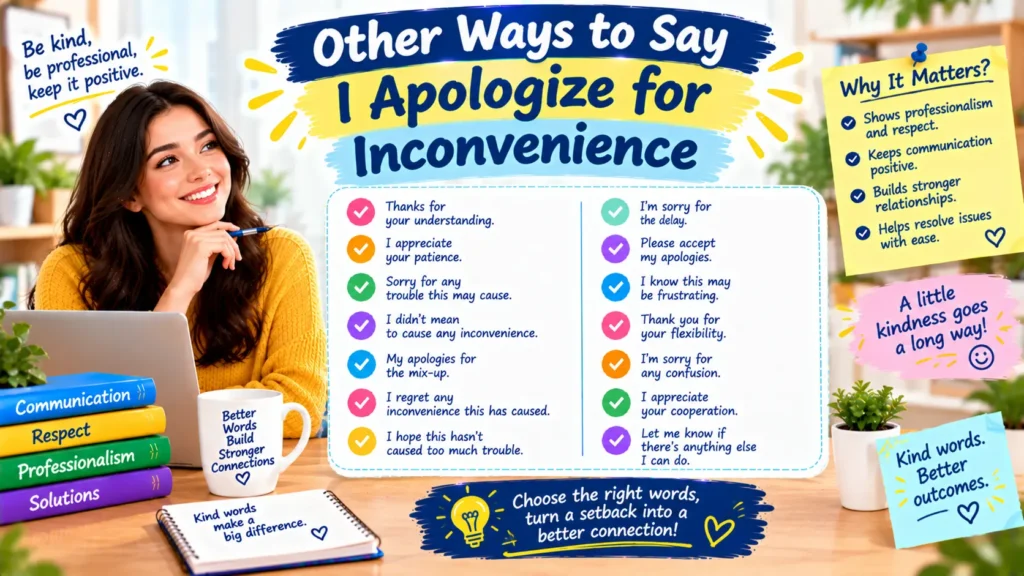
Finding other ways to say I apologize for the inconvenience can help you make business communication sound more natural, thoughtful, and appropriate for the situation. While “I apologize for the inconvenience” is professional and widely accepted, repeating it in every email can make your writing feel routine or impersonal.
You may want a professional way to say I apologize for the inconvenience when writing to a client, customer, manager, colleague, or business contact. In other situations, you may need a warmer, more formal, or more direct expression.
The right wording depends on what happened, how serious the issue is, and your relationship with the reader. For example, a customer-service email may require empathy, while a message to a colleague may simply need a brief acknowledgment.
This guide explains the meaning, tone, appropriate contexts, and 28 professional, formal, friendly, and email-ready alternatives you can use in 2026.
What Does “I Apologize for the Inconvenience” Mean?
“I apologize for the inconvenience” means that you recognize that something has caused difficulty, disruption, delay, or frustration for another person and you are expressing regret about it.
Literal meaning
The phrase has two main parts:
- “I apologize” — I am expressing regret.
- “for the inconvenience” — I recognize that the situation caused difficulty or disruption.
For example:
I apologize for the inconvenience caused by the delayed delivery.
The writer acknowledges the problem without necessarily explaining who caused it.
Tone
The phrase generally sounds:
- Professional
- Polite
- Respectful
- Neutral
- Slightly formal
- Appropriate for customer service
Purpose
You can use it to:
- Acknowledge a problem
- Show empathy
- Maintain professionalism
- Smooth over a difficult interaction
- Recognize a delay or disruption
- Respond to a complaint
- Explain an unexpected issue
Emotional context
The phrase is useful when someone has experienced inconvenience, but it can sometimes sound generic if you use it repeatedly.
Compare:
I apologize for the inconvenience.
with:
I’m sorry this delay disrupted your plans.
The second sentence feels more personal because it identifies the effect of the problem.
When Should You Use This Phrase Professionally?
“I apologize for the inconvenience” works in many forms of professional communication, but the best alternative depends on your audience.
In Emails
Use it when:
- A response is delayed
- A service is temporarily unavailable
- A meeting changes unexpectedly
- A technical problem affects someone
- A request cannot be completed immediately
Example:
I apologize for the inconvenience. Our system is currently unavailable, but we expect service to resume shortly.
In the Workplace
The phrase works when communicating with colleagues, managers, or team members about disruptions.
Example:
I apologize for the inconvenience caused by the schedule change. I’ll send the revised timetable this afternoon.
With Clients
A client-facing message should usually sound empathetic and specific.
Example:
I apologize for the inconvenience caused by the delay. We are working to resolve the issue as quickly as possible.
In Networking
Networking messages generally benefit from a lighter tone.
Instead of:
I apologize for the inconvenience of reaching out again.
you could write:
I hope you don’t mind my following up.
In Customer Service
Customer-service communication often requires both an apology and a solution.
Example:
We’re sorry for the disruption. We understand how frustrating this may be and are working to resolve the issue.
28 Other Ways to Say “I Apologize for the Inconvenience”
Below are practical alternatives organized by tone and situation.
Professional Alternatives
1. I’m sorry for the inconvenience.
Tone: Professional, polite, natural
Best use: General business emails and customer communication
This is one of the simplest alternatives. It sounds slightly warmer and less formal than “I apologize.”
Example:
I’m sorry for the inconvenience caused by the delayed response.
2. I apologize for any inconvenience this may have caused.
Tone: Professional, courteous
Best use: Formal emails and service communication
This wording softens the statement slightly by recognizing the possibility of inconvenience.
Example:
I apologize for any inconvenience this may have caused and appreciate your patience.
3. I’m sorry for any disruption this has caused.
Tone: Professional, empathetic
Best use: Workplace and operational issues
Use “disruption” when the problem affects someone’s schedule, workflow, or plans.
Example:
I’m sorry for any disruption this has caused to your schedule.
4. Please accept my apologies for the inconvenience.
Tone: Polite, formal
Best use: Client emails and formal correspondence
This is a stronger formal alternative.
Example:
Please accept my apologies for the inconvenience caused by the unexpected delay.
5. I regret the inconvenience this has caused.
Tone: Formal, restrained
Best use: Corporate communication
“Regret” creates a more formal tone than “I’m sorry.”
Example:
I regret the inconvenience this situation has caused.
6. Thank you for your patience and understanding.
Tone: Professional, appreciative
Best use: Delays, technical problems, customer service
This expression does not directly apologize, but it can work well when the reader already understands the situation.
Example:
Thank you for your patience and understanding while we resolve this issue.
Formal Alternatives
7. Please accept my sincere apologies.
Tone: Very polite, formal
Best use: Significant mistakes or serious delays
Example:
Please accept my sincere apologies for the delay in providing the requested documents.
8. I sincerely apologize for the disruption.
Tone: Formal, sincere
Best use: Clients, partners, business correspondence
Example:
I sincerely apologize for the disruption to your scheduled service.
9. I regret any difficulty this may have caused.
Tone: Formal, diplomatic
Best use: Corporate and administrative communication
Example:
I regret any difficulty this may have caused and appreciate your understanding.
10. We sincerely regret the inconvenience caused.
Tone: Formal, corporate
Best use: Company statements and customer service
Example:
We sincerely regret the inconvenience caused by the temporary service interruption.
11. Please accept our apologies for the disruption.
Tone: Formal and corporate
Best use: Company-to-client communication
Example:
Please accept our apologies for the disruption to your scheduled appointment.
12. We apologize for the disruption and appreciate your understanding.
Tone: Formal, courteous
Best use: Service announcements
Example:
We apologize for the disruption and appreciate your understanding while maintenance is underway.
Friendly Alternatives
13. I’m sorry about the trouble.
Tone: Friendly, natural
Best use: Colleagues and familiar contacts
Example:
I’m sorry about the trouble. I’ve attached the corrected file.
14. Sorry for the trouble.
Tone: Casual, friendly
Best use: Informal workplace communication
Example:
Sorry for the trouble. Everything should be working now.
15. I’m sorry this caused you extra work.
Tone: Warm, empathetic
Best use: Colleagues and team members
This option is particularly useful when your mistake creates additional work for someone.
Example:
I’m sorry this caused you extra work. I’ve corrected the document now.
16. I’m sorry for the delay and any trouble it caused.
Tone: Friendly, professional
Best use: Email follow-ups
Example:
I’m sorry for the delay and any trouble it caused. Thank you for your patience.
17. Thanks for bearing with me.
Tone: Friendly and conversational
Best use: Colleagues and familiar professional contacts
Example:
Thanks for bearing with me while I worked through the issue.
Email-Ready Alternatives
18. I apologize for the delay and appreciate your patience.
Tone: Professional
Best use: Delayed responses
Example:
I apologize for the delay and appreciate your patience. Please find the completed report attached.
19. Thank you for your patience while we resolve this matter.
Tone: Professional and reassuring
Best use: Customer or client emails
Example:
Thank you for your patience while we resolve this matter. We expect to have an update by Friday.
20. I’m sorry for the disruption to your schedule.
Tone: Professional and empathetic
Best use: Rescheduled meetings or appointments
Example:
I’m sorry for the disruption to your schedule. Would Tuesday at 2 p.m. work instead?
21. We apologize for the delay in responding.
Tone: Professional and direct
Best use: Business emails and customer service
Example:
We apologize for the delay in responding to your request.
22. I’m sorry for any inconvenience caused by the change.
Tone: Polite and clear
Best use: Schedule or process changes
Example:
I’m sorry for any inconvenience caused by the change in meeting time.
Workplace Alternatives
23. I’m sorry for the mix-up.
Tone: Friendly, professional
Best use: Mistakes or misunderstandings
Example:
I’m sorry for the mix-up. The correct meeting room is Conference Room B.
24. I apologize for the misunderstanding.
Tone: Professional
Best use: Miscommunication
Example:
I apologize for the misunderstanding. To clarify, the deadline is Friday, not Thursday.
25. I’m sorry for the confusion.
Tone: Professional and approachable
Best use: Unclear instructions or communication
Example:
I’m sorry for the confusion. Please use the revised instructions attached.
26. I apologize for the oversight.
Tone: Formal, accountable
Best use: Missed details or mistakes
Example:
I apologize for the oversight. I’ve now included the missing information.
27. I take responsibility for the error and apologize for the impact.
Tone: Direct, accountable, professional
Best use: Meaningful workplace mistakes
Example:
I take responsibility for the error and apologize for the impact it had on the team.
28. I appreciate your understanding regarding this issue.
Tone: Professional, diplomatic
Best use: Business communication where you want to close an apology positively
Example:
I appreciate your understanding regarding this issue and will keep you updated on our progress.
Quick Comparison Table
| Alternative | Tone | Best Use |
|---|---|---|
| I’m sorry for the inconvenience. | Professional | General emails |
| Please accept my apologies. | Formal | Clients and formal letters |
| I sincerely apologize. | Formal | Serious issues |
| I regret the inconvenience. | Formal | Corporate communication |
| Sorry for the trouble. | Friendly | Colleagues |
| I’m sorry for the mix-up. | Friendly | Minor mistakes |
| I apologize for the oversight. | Professional | Missed details |
| I’m sorry for the confusion. | Professional | Miscommunication |
| Thank you for your patience. | Appreciative | Delays |
| I appreciate your understanding. | Professional | Issue resolution |
| I’m sorry for the delay. | Neutral | Late responses |
| I apologize for the disruption. | Formal | Service interruptions |
| I’m sorry this caused extra work. | Empathetic | Workplace |
| I take responsibility for the error. | Accountable | Significant mistakes |
Email Examples for Different Situations
1. Client Email
Dear Ms. Carter,
I apologize for the delay in sending the revised proposal. I’ve attached the updated version for your review.
Thank you for your patience and understanding.
This version combines an apology with an action, which makes it more useful than an apology alone.
2. Email to a Manager
Hi Daniel,
I’m sorry for the delay in submitting the report. I’ve completed it and attached the final version for your review.
Thank you for your understanding.
3. Email to a Colleague
Hi Sarah,
Sorry for the mix-up. I accidentally sent you the earlier version of the document. The corrected file is attached.
Thanks for bearing with me.
4. Customer Email
Dear Customer,
We sincerely apologize for the disruption to your service. Our team is working to restore normal service as quickly as possible.
Thank you for your patience and understanding.
5. Networking Email
Hi James,
I’m sorry for the delayed response. It was great connecting with you at the conference, and I appreciate you following up.
I’d be happy to continue our conversation.
6. Meeting Follow-Up
Hi everyone,
I apologize for the last-minute change to today’s meeting. I understand that schedule changes can be disruptive.
Thank you for your flexibility. We’ll meet tomorrow at 10 a.m.
Common Mistakes When Apologizing in Professional Communication
1. Overusing the Same Apology
Repeating “I apologize for the inconvenience” in every email can make your writing sound automated.
Instead, match your wording to the situation:
- Delay → “I apologize for the delay.”
- Confusion → “I’m sorry for the confusion.”
- Mistake → “I apologize for the oversight.”
- Schedule change → “I’m sorry for the disruption to your schedule.”
2. Using an Overly Formal Expression
Not every situation requires:
Please accept my sincerest apologies for any inconvenience that may have been experienced.
That sentence may sound excessive for a simple workplace mistake.
A better option could be:
I’m sorry for the mix-up.
3. Being Too Casual With Clients
Expressions such as:
Sorry about that!
may work with a close colleague but can sound too informal with an important client.
Use:
I apologize for the inconvenience.
or:
I’m sorry for the disruption this caused.
4. Apologizing Without Taking Action
An apology becomes stronger when you explain what you are doing to fix the problem.
Weak:
I apologize for the inconvenience.
Stronger:
I apologize for the inconvenience. I’ve corrected the issue and attached the updated document.
5. Using “If” When the Problem Is Certain
Consider:
I’m sorry if this caused any inconvenience.
“If” can sound as though you are uncertain whether your actions affected the other person.
If you know they were affected, use:
I’m sorry for the inconvenience this caused.
Related Professional Phrases
Here are related business email phrases that can help you express regret, empathy, accountability, or appreciation.
| Phrase | Meaning | Example |
|---|---|---|
| I apologize for the delay. | Expresses regret for lateness | I apologize for the delay in responding. |
| I’m sorry for the confusion. | Acknowledges unclear communication | I’m sorry for the confusion regarding the deadline. |
| I apologize for the oversight. | Accepts responsibility for missing something | I apologize for the oversight in the report. |
| Please accept my apologies. | Formal apology | Please accept my apologies for the error. |
| Thank you for your patience. | Shows appreciation | Thank you for your patience while we investigate. |
| Thank you for understanding. | Recognizes empathy | Thank you for understanding the situation. |
| I regret the inconvenience. | Formal expression of regret | I regret the inconvenience caused. |
| We regret the disruption. | Corporate apology | We regret the disruption to your service. |
| I’m sorry for the trouble. | Friendly apology | I’m sorry for the trouble this caused. |
| I appreciate your patience. | Thanks someone for waiting | I appreciate your patience during the delay. |
| I take responsibility. | Accepts accountability | I take responsibility for the mistake. |
| I understand your frustration. | Shows empathy | I understand your frustration with the delay. |
| Thank you for bringing this to my attention. | Acknowledges a complaint or issue | Thank you for bringing this to my attention. |
| We are working to resolve this. | Shows action | We are working to resolve this as quickly as possible. |
| We appreciate your cooperation. | Thanks someone for helping | We appreciate your cooperation during the transition. |
| We value your patience. | Shows appreciation | We value your patience while we address the issue. |
| We’ll keep you updated. | Promises communication | We’ll keep you updated as we investigate. |
“I Apologize for the Inconvenience” vs. Other Alternatives
The best alternative depends on what you want the reader to feel or understand.
“I apologize for the inconvenience”
This is a neutral professional apology. It works in many business situations.
“I’m sorry for the inconvenience”
This has essentially the same meaning but sounds somewhat warmer and more conversational.
“Please accept my apologies”
This is more formal and works well in official correspondence.
“I apologize for the delay”
Use this when the exact problem is lateness. It is more specific than “inconvenience.”
“I apologize for the oversight”
Use this when you missed something or made an administrative error.
“I’m sorry for the confusion”
Use this when unclear information or communication caused the problem.
“I’m sorry for the disruption”
Use this when someone’s plans, workflow, schedule, or service was interrupted.
“Thank you for your patience”
This focuses on appreciation rather than the apology itself. It works especially well after a delay.
“I take responsibility for the error”
This is stronger because it explicitly accepts accountability.
Cultural and Professional Usage
US English
In American business communication, both “I apologize” and “I’m sorry” are common.
“I apologize” often feels more formal:
I apologize for the delay.
“I’m sorry” generally feels warmer:
I’m sorry for the delay.
The appropriate choice depends on the relationship and situation.
UK English
British professional communication also commonly uses “I apologize” and “I’m sorry.” Formal correspondence may use:
Please accept my apologies for the inconvenience.
However, overly elaborate apologies can sound unnatural in everyday workplace communication.
Corporate Communication
Companies often use “we apologize” when speaking on behalf of an organization.
For example:
We apologize for the temporary disruption to our services.
This is particularly common in customer announcements and service updates.
Customer Service
Customer-service messages should usually combine three elements:
- Acknowledge the problem.
- Show empathy or apologize.
- Explain the next step.
For example:
We apologize for the delay. We understand how frustrating this may be and are working to resolve the issue today.
Networking
Networking messages usually benefit from a lighter approach.
Instead of:
Please accept my sincere apologies for the inconvenience caused by my delayed response.
you could write:
I’m sorry for the delayed response, and thank you for following up.
The second version sounds more natural for a professional relationship.
FAQs About Other Ways to Say “I Apologize for the Inconvenience”
1. What is a professional way to say “I apologize for the inconvenience”?
A strong professional alternative is:
I’m sorry for any inconvenience this may have caused.
Other options include:
I apologize for the disruption.
I regret the inconvenience this has caused.
Thank you for your patience and understanding.
2. What is a formal alternative to “I apologize for the inconvenience”?
For formal communication, use:
Please accept my sincere apologies for the inconvenience.
Another option is:
I sincerely regret the inconvenience this has caused.
These expressions work well in formal business correspondence.
3. What is a synonym for “I apologize for the inconvenience”?
There is no single perfect synonym because the best wording depends on the situation. Useful alternatives include:
- I’m sorry for the inconvenience.
- I apologize for the disruption.
- I regret the inconvenience.
- Please accept my apologies.
- I’m sorry for the trouble.
- Thank you for your patience and understanding.
4. How do I apologize professionally in an email?
Be clear, brief, and specific. A useful structure is:
I apologize for [specific issue]. I have [action taken]. Thank you for [patience/understanding].
For example:
I apologize for the delay. I’ve attached the completed report. Thank you for your patience.
5. Is “I’m sorry for the inconvenience” professional?
Yes. “I’m sorry for the inconvenience” is professional and widely appropriate. It sounds slightly warmer and more conversational than “I apologize for the inconvenience.”
6. Is “I apologize for any inconvenience” too formal?
No. It is a standard business expression. However, it can sound generic when overused. When possible, make the apology more specific.
Instead of:
I apologize for any inconvenience.
Try:
I apologize for the delay in processing your request.
7. How do I apologize for a delay without sounding repetitive?
Mention the specific issue rather than using the same generic apology every time.
For example:
I apologize for the delayed response.
or:
Thank you for your patience while I reviewed the information.
This makes your professional communication sound more natural.
8. How do I apologize to a customer professionally?
A customer apology should acknowledge the inconvenience and explain what you are doing to resolve it.
For example:
We apologize for the disruption and understand how inconvenient this may be. Our team is working to resolve the issue as quickly as possible.
9. What can I say instead of “sorry for the inconvenience” at work?
You can say:
- I apologize for the disruption.
- I’m sorry for the confusion.
- I apologize for the oversight.
- I’m sorry for the delay.
- Thank you for your patience.
- I appreciate your understanding.
Choose the phrase that identifies the actual problem.
10. Should I say “I apologize” or “I’m sorry” in a business email?
Both are appropriate. “I apologize” usually sounds more formal, while “I’m sorry” often sounds warmer and more conversational.
For a client:
I apologize for the delay.
For a colleague:
I’m sorry for the delay.
The relationship and seriousness of the situation should guide your choice.
Final Summary
The best other ways to say I apologize for the inconvenience depend on your audience, purpose, and tone. For professional emails, “I’m sorry for the inconvenience,” “I apologize for the delay,” and “I apologize for the disruption” are natural choices. For formal communication, “Please accept my sincere apologies” works well. For friendly workplace messages, “I’m sorry for the mix-up” or “Sorry for the trouble” can sound more natural. In customer service, combine an apology with empathy and a clear next step. The strongest business email phrases are specific, concise, and focused on resolving the issue rather than simply repeating an apology.




