
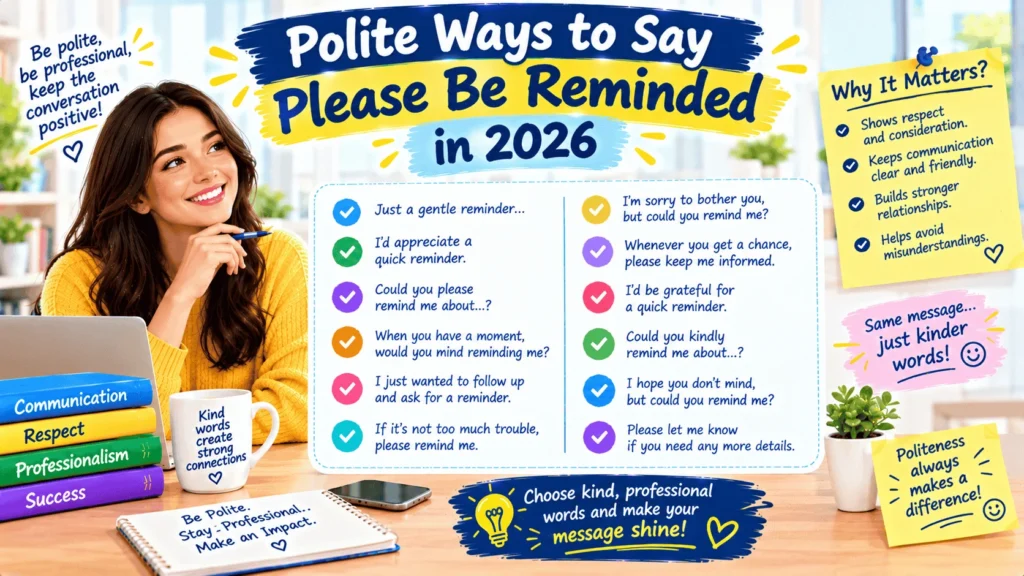
Finding polite ways to say please be reminded can make a noticeable difference in professional communication. The phrase “please be reminded” is understandable, but it can sometimes sound stiff, repetitive, or overly formal, especially in everyday business emails.
Whether you are reminding a client about a deadline, asking a colleague to complete a task, following up with a customer, or mentioning an upcoming meeting, the right wording can keep your message clear without sounding demanding.
In this guide, you will find professional, formal, friendly, workplace, and email-ready alternatives, along with examples showing when to use each expression.
What Does “Please Be Reminded” Mean?
Literal meaning
“Please be reminded” means please remember or keep in mind something that was previously communicated.
For example:
Please be reminded that the payment is due on Friday.
The sender wants the recipient to remember an important date, rule, task, appointment, or requirement.
Tone
The phrase is generally:
- Polite
- Formal
- Direct
- Administrative
- Slightly stiff
It often appears in notices, official communications, policies, invoices, and business emails.
Purpose
People use the expression to:
- Remind someone about a deadline
- Confirm an appointment
- Mention an upcoming event
- Reinforce a company policy
- Request an outstanding action
- Prevent someone from overlooking important information
Emotional context
“Please be reminded” is not necessarily rude, but it can feel impersonal because it focuses on the instruction rather than the relationship.
Compare:
Please be reminded that your report is due tomorrow.
with:
Just a friendly reminder that your report is due tomorrow.
The second version sounds warmer and more conversational.
28 Professional and Polite Alternatives to “Please Be Reminded”
Below are practical alternatives grouped by tone and situation.
Professional Alternatives
1. Just a friendly reminder that…
Tone: Professional and warm
Best use: Everyday business emails
Just a friendly reminder that our meeting is scheduled for Thursday at 10 a.m.
This is one of the most natural business email phrases for routine reminders.
2. Please remember that…
Tone: Polite and direct
Best use: Important instructions or deadlines
Please remember that all documents must be submitted by Friday.
This keeps the original meaning while sounding more natural.
3. Please keep in mind that…
Tone: Professional and considerate
Best use: Policies, conditions, or important details
Please keep in mind that processing may take up to five business days.
This works well when you want to remind someone without sounding like you are issuing an order.
4. Please note that…
Tone: Formal and professional
Best use: Important information
Please note that the office will be closed on Monday.
“Please note” is particularly common in corporate communication.
5. A quick reminder that…
Tone: Friendly and concise
Best use: Short emails and follow-ups
A quick reminder that the registration deadline is tomorrow.
This is less formal than “please be reminded.”
6. This is a reminder that…
Tone: Neutral and professional
Best use: Formal notices and administrative communication
This is a reminder that your annual review is scheduled for December 15.
It is straightforward without sounding overly personal.
Formal Alternatives
7. Kindly note that…
Tone: Formal and courteous
Best use: Official emails and notices
Kindly note that applications received after the deadline cannot be considered.
“Kindly” adds a formal tone, although it may sound less natural in casual American business communication.
8. We would like to remind you that…
Tone: Formal and diplomatic
Best use: Client communication
We would like to remind you that your subscription will renew on October 15.
This is an excellent choice when communicating with customers or clients.
9. We wish to remind you that…
Tone: Very formal
Best use: Official correspondence
We wish to remind you that all invoices must be paid within 30 days.
This wording is more formal and may suit institutional or administrative communication.
10. Please be advised that…
Tone: Formal and official
Best use: Policies, announcements, and notices
Please be advised that the building will be closed for maintenance on Saturday.
This is useful when the information has some official importance.
11. We would like to bring to your attention…
Tone: Formal and diplomatic
Best use: Important information
We would like to bring to your attention that your account requires additional documentation.
This is useful when the reminder involves an issue that needs attention.
12. We would appreciate your remembering…
Tone: Formal and courteous
Best use: Requests requiring cooperation
We would appreciate your remembering to include your reference number with future correspondence.
This is more formal than ordinary workplace language.
Friendly Alternatives
13. Just a quick reminder…
Tone: Friendly and natural
Best use: Colleagues and familiar clients
Just a quick reminder to send over the revised file when you have a chance.
This is one of the safest choices for everyday email.
14. Just wanted to remind you that…
Tone: Friendly and conversational
Best use: Colleagues and informal professional relationships
I just wanted to remind you that our call starts at 2 p.m.
It sounds personal without becoming overly casual.
15. A gentle reminder that…
Tone: Warm and polite
Best use: Sensitive follow-ups
A gentle reminder that the registration form is due tomorrow.
This works well when you want to avoid sounding pushy.
16. A friendly reminder that…
Tone: Warm and professional
Best use: Clients, colleagues, and customers
A friendly reminder that your appointment is scheduled for Tuesday.
This expression balances professionalism and friendliness.
17. Just a heads-up that…
Tone: Casual and friendly
Best use: Colleagues and informal workplace communication
Just a heads-up that the meeting room has changed to Room 204.
Avoid this expression in highly formal letters or official notices.
Email-Ready Alternatives
18. I wanted to remind you that…
Tone: Polite and personal
Best use: Professional emails
I wanted to remind you that the proposal is due by Friday.
This sounds natural because it avoids the impersonal structure of “please be reminded.”
19. I’m writing to remind you that…
Tone: Formal and professional
Best use: Formal email reminders
I’m writing to remind you that your contract expires at the end of the month.
This is particularly useful when the reminder itself is the main purpose of the email.
20. As a reminder,…
Tone: Neutral and professional
Best use: Follow-ups
As a reminder, please submit your feedback by Wednesday.
It is concise and works well at the beginning of a sentence.
21. As a gentle reminder,…
Tone: Polite and diplomatic
Best use: Follow-up requests
As a gentle reminder, we would appreciate receiving the completed form by Friday.
This is useful when you have already asked for something once.
22. I’d like to remind you that…
Tone: Professional and direct
Best use: Workplace emails
I’d like to remind you that all expense reports must be submitted within 10 days.
This is clear without sounding unnecessarily harsh.
Workplace Alternatives
23. Please remember to…
Tone: Direct and polite
Best use: Tasks and responsibilities
Please remember to update the project tracker before the meeting.
Use this when you want someone to take a specific action.
24. Please make sure to…
Tone: Friendly and direct
Best use: Workplace instructions
Please make sure to save a copy of the final presentation.
This is natural in internal communication.
25. Don’t forget to…
Tone: Casual and friendly
Best use: Colleagues and familiar teams
Don’t forget to submit your timesheet by Friday.
Although perfectly acceptable in casual workplace communication, use a softer alternative with senior leaders or external clients.
26. When you have a moment, please remember to…
Tone: Very polite and considerate
Best use: Non-urgent requests
When you have a moment, please remember to review the attached document.
This reduces the pressure of a reminder.
27. Please keep this deadline in mind.
Tone: Professional and concise
Best use: Deadlines
Please keep this deadline in mind as you finalize the report.
It is particularly useful when you want to emphasize timing without issuing a command.
28. We wanted to make sure you’re aware that…
Tone: Polite and considerate
Best use: Clients and customer communication
We wanted to make sure you’re aware that the service will be unavailable this weekend.
This focuses on keeping the recipient informed rather than simply telling them to remember something.
Quick Comparison Table
| Alternative | Tone | Best Use |
|---|---|---|
| Just a friendly reminder that… | Friendly | Everyday emails |
| Please remember that… | Direct | Deadlines |
| Please keep in mind that… | Considerate | Conditions |
| Please note that… | Formal | Important information |
| A quick reminder that… | Friendly | Short emails |
| Kindly note that… | Formal | Official communication |
| We would like to remind you that… | Formal | Client emails |
| We wish to remind you that… | Very formal | Official notices |
| Please be advised that… | Formal | Policies |
| Just a quick reminder… | Friendly | Colleagues |
| A gentle reminder that… | Warm | Sensitive follow-ups |
| I wanted to remind you that… | Professional | General emails |
| I’m writing to remind you that… | Formal | Reminder emails |
| As a reminder,… | Neutral | Follow-ups |
| As a gentle reminder,… | Polite | Requests |
| Please remember to… | Direct | Tasks |
| Please make sure to… | Friendly | Workplace tasks |
| Don’t forget to… | Casual | Familiar colleagues |
| Please keep this deadline in mind. | Professional | Deadlines |
| We wanted to make sure you’re aware that… | Considerate | Clients |
Email Examples for Different Situations
1. Client Email
Dear Ms. Carter,
I wanted to remind you that the renewal documents are due by October 15. Please let me know if you have any questions.
Best regards,
Daniel
This approach sounds professional without being overly formal.
2. Email to a Manager
Hi James,
Just a quick reminder that the quarterly report is ready for your review. I’ve attached the latest version for your convenience.
Best,
Sarah
“Just a quick reminder” works well when communicating upward without sounding demanding.
3. Email to a Colleague
Hi Alex,
Just wanted to remind you to add your updates to the project tracker before tomorrow’s meeting.
Thanks!
This is friendly and appropriate for internal workplace communication.
4. Customer Email
Dear Customer,
Please note that our support center will be unavailable from 6 p.m. Friday through 9 a.m. Saturday due to scheduled maintenance.
Thank you for your understanding.
“Please note” is clear and professional for customer communication.
5. Networking Email
Hi Maria,
I just wanted to remind you about our conversation scheduled for Thursday. I’m looking forward to speaking with you.
Best,
Michael
The wording is professional while maintaining a warm networking tone.
6. Meeting Follow-Up
Hi Team,
As a reminder, our project meeting will take place tomorrow at 11 a.m. Please review the agenda beforehand and bring any questions you may have.
Thanks,
Olivia
This combines the reminder with a clear action request.
Common Mistakes When Using “Please Be Reminded”
1. Using it for every reminder
Repeatedly writing “please be reminded” can make your emails sound mechanical.
Instead, vary your language:
Please note that…
Just a quick reminder that…
I wanted to remind you that…
As a reminder,…
Variety makes professional communication sound more natural.
2. Making the reminder sound like a warning
Compare:
Please be reminded that your payment is overdue.
with:
Just a reminder that your payment is now due.
The second version can sound less confrontational.
When dealing with sensitive issues, consider whether a softer construction would preserve the relationship.
3. Being too casual with clients
“Don’t forget!” might work with a close colleague, but it can sound too familiar in client communication.
Instead:
Just a friendly reminder that we’ll need the signed agreement by Friday.
4. Being unnecessarily formal
The opposite problem can also occur.
We wish to remind you that the aforementioned documentation must be submitted forthwith.
This sounds unnecessarily stiff.
A clearer alternative is:
Please remember to submit the documents by Friday.
Simple language often improves professional communication.
5. Sending a reminder without context
Avoid:
Please remember this.
The recipient may not know what “this” refers to.
Instead:
Please remember to submit the expense report by Friday.
A good reminder should identify what needs attention and, when relevant, when it is due.
Related Phrases and Their Meanings
Here are additional expressions that belong to the same semantic group.
1. Please note that…
Used to highlight important information.
Please note that the deadline has changed.
2. Please remember to…
Used for a specific action.
Please remember to attach the invoice.
3. As a reminder,…
Used to introduce previously shared information.
As a reminder, the meeting begins at 9 a.m.
4. Just a quick reminder…
A friendly way to follow up.
Just a quick reminder to send your feedback.
5. Kindly note…
A formal way to highlight information.
Kindly note that the office closes at 5 p.m.
6. Please keep in mind…
Used for conditions or considerations.
Please keep in mind that delivery times may vary.
7. Please be advised…
Used for formal announcements.
Please be advised that the policy has been updated.
8. We would like to remind you…
A formal client-facing expression.
We would like to remind you that your membership expires soon.
9. I wanted to remind you…
Personal and professional.
I wanted to remind you about tomorrow’s meeting.
10. A gentle reminder…
Useful for sensitive follow-ups.
A gentle reminder that the form is still outstanding.
11. A friendly reminder…
Warm and professional.
A friendly reminder that registration closes Friday.
12. Please make sure…
Used when an action is required.
Please make sure all fields are completed.
13. Don’t forget…
Casual workplace language.
Don’t forget to bring your ID.
14. Keep this in mind…
Useful for advice or conditions.
Keep this deadline in mind when planning your schedule.
15. Just wanted to flag…
Informal professional language.
I just wanted to flag that the deadline has moved.
16. We wanted to make you aware…
Considerate client communication.
We wanted to make you aware of the updated schedule.
“Please Be Reminded” vs. Other Alternatives
| Phrase | Formality | Tone | Best Use |
|---|---|---|---|
| Please be reminded | High | Administrative | Formal notices |
| Please remember | Medium | Direct | General reminders |
| Please note | Medium-high | Neutral | Important information |
| Kindly note | High | Formal | Official communication |
| Just a quick reminder | Low-medium | Friendly | Everyday emails |
| A gentle reminder | Medium | Warm | Sensitive follow-ups |
| I wanted to remind you | Medium | Personal | Professional emails |
| We would like to remind you | High | Diplomatic | Clients |
| As a reminder | Medium | Neutral | Follow-ups |
| Please be advised | High | Official | Policies and notices |
| Don’t forget | Low | Casual | Familiar colleagues |
The best synonym for “please be reminded” depends on the relationship, urgency, and purpose of the message.
Cultural and Professional Usage
US English
American business communication often favors direct but friendly language.
Natural choices include:
- Just a quick reminder…
- I wanted to remind you…
- Please note…
- Please remember…
- As a reminder…
“Please be reminded” is understandable but can sound more formal than necessary in everyday corporate emails.
UK English
British professional communication often uses polite and indirect wording.
Examples include:
Kindly note that the deadline has been extended.
or:
We would like to remind you that payment is due by Friday.
However, context matters more than simply choosing British or American wording.
Corporate Communication
Corporate messages often need to balance clarity and authority.
For policies and formal announcements:
Please be advised that the policy takes effect on November 1.
For routine internal reminders:
Just a quick reminder that the training session starts at 2 p.m.
The audience should determine the level of formality.
Customer Service
Customer-facing communication should generally avoid language that sounds accusatory.
Instead of:
Please be reminded that you failed to submit the form.
Try:
We wanted to remind you that the form is still awaiting submission.
The second version focuses on the situation rather than assigning blame.
Networking
Networking communication usually benefits from warmth.
Instead of:
Please be reminded of our appointment.
Try:
I just wanted to remind you about our conversation on Thursday.
This feels more natural and relationship-focused.
FAQs About Polite Ways to Say “Please Be Reminded”
1. What is a polite way to say “please be reminded”?
Some natural alternatives include “Just a friendly reminder that…”, “Please note that…”, “I wanted to remind you that…”, and “As a reminder…”. The best choice depends on the level of formality.
2. Is “please be reminded” professional?
Yes. “Please be reminded” is grammatically acceptable and professional, but it can sound formal or administrative. In everyday emails, more conversational alternatives may sound more natural.
3. What is a formal alternative to “please be reminded”?
Formal options include:
- Kindly note that…
- We would like to remind you that…
- We wish to remind you that…
- Please be advised that…
- We would like to bring to your attention that…
4. What is the most natural phrase for an email?
“I wanted to remind you that…” is a versatile choice. “Just a quick reminder that…” also works well for friendly professional emails.
5. How do I politely remind someone about a deadline?
Try:
Just a friendly reminder that the deadline is Friday.
Or:
I wanted to remind you that the completed document is due by Friday.
Both communicate the deadline without sounding unnecessarily forceful.
6. How can I remind a client without sounding rude?
Use diplomatic language:
We wanted to remind you that the signed agreement is due by Friday.
You can also add:
Please let us know if you need any assistance.
This makes the message more supportive.
7. Is “kindly be reminded” correct?
“Kindly be reminded” can be understood, but it is less natural than alternatives such as “Kindly note that…” or “We would like to remind you that…”.
8. What is a friendly way to remind a coworker?
Try:
Just a quick reminder to update the project tracker.
Or:
I just wanted to remind you about the report.
These sound natural in workplace communication.
9. What is a polite way to remind someone without saying “reminder”?
You can say:
Please note that the deadline is Friday.
Or:
Please keep in mind that all forms must be submitted by Friday.
This communicates the reminder without using the word “remind.”
10. Should I use “please be reminded” in a business email?
You can, especially in formal notices or administrative messages. However, for ordinary professional communication, phrases such as “Please note,” “As a reminder,” and “I wanted to remind you” often sound more natural.
Final Summary
The best alternative to “please be reminded” depends on your audience and purpose. For professional emails, “I wanted to remind you that…” is natural and versatile. For friendly workplace messages, “Just a quick reminder…” works well. For formal notices, “Kindly note that…”, “Please be advised that…”, or “We would like to remind you that…” may fit better. For sensitive follow-ups, “A gentle reminder…” creates a softer tone.
Good workplace communication is not only about being polite. It is also about choosing wording that matches the relationship, urgency, and context. When possible, make the reminder specific, state the action or deadline clearly, and avoid language that feels unnecessarily stiff or demanding. This makes your emails easier to understand and more professional.




