
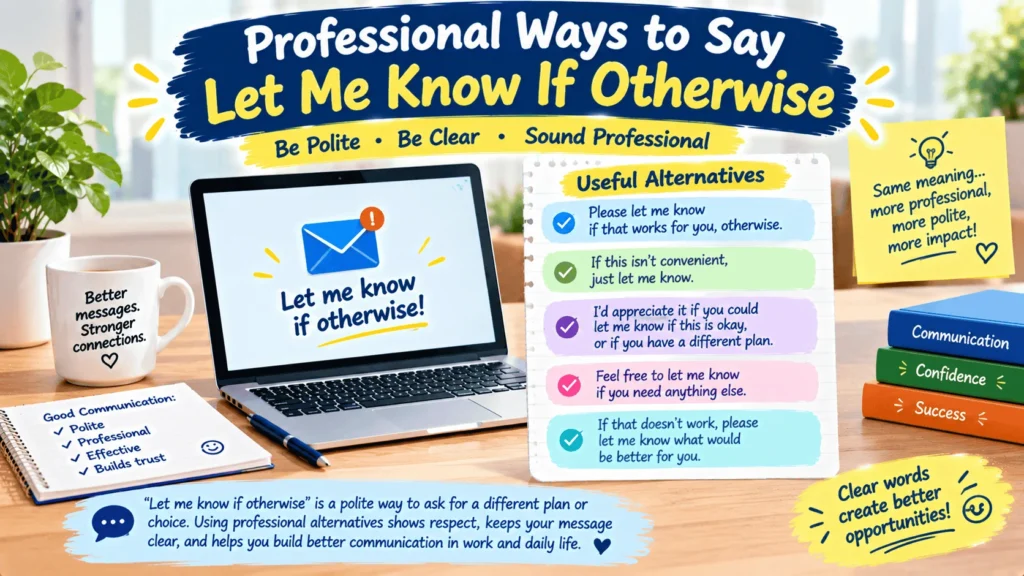
In business communication, “let me know if otherwise” means you want the other person to tell you if the situation is different from what you currently understand or expect. While the phrase is understandable, it can sound incomplete or slightly unnatural in some professional emails.
If you are looking for professional ways to say let me know if otherwise, you have several clearer options. Depending on the situation, you can say “Please let me know if this is not the case,” “Please let me know if anything has changed,” or “Kindly advise if this differs from your understanding.”
Choosing the right wording can make your emails sound more polished, respectful, and easy to understand. The best expression depends on your relationship with the recipient, the level of formality, and whether you are discussing a client matter, workplace task, meeting, deadline, or general update.
What Does “Let Me Know If Otherwise” Mean?
Literal Meaning
The phrase “let me know if otherwise” means:
“Please tell me if the situation is different from what I have stated or assumed.”
For example:
“The meeting is scheduled for 3 p.m. Please let me know if otherwise.”
The writer assumes that the meeting is at 3 p.m. and asks the recipient to correct them if that information is wrong.
Tone
The phrase is generally:
- Polite
- Neutral
- Professional
- Direct
- Slightly formal
However, “if otherwise” can sometimes feel incomplete because “otherwise” refers to something previously stated rather than clearly naming the alternative.
For greater clarity, many professional writers prefer:
“Please let me know if this is not the case.”
or:
“Please let me know if anything has changed.”
Purpose
The phrase is useful when you want to:
- Confirm information
- Check whether circumstances have changed
- Avoid making an incorrect assumption
- Give someone an opportunity to correct you
- Confirm a deadline or appointment
- Verify instructions
- Keep communication open
Emotional Context
The wording can also show that you are open to correction. Instead of presenting your understanding as a fact, you invite the recipient to clarify it.
For example:
“I understand that the revised proposal is due Friday. Please let me know if this is not the case.”
This sounds more collaborative than simply saying:
“The proposal is due Friday.”
When Should You Use This Expression Professionally?
In Emails
This type of phrase works well when you are confirming information.
Example:
I understand that the documents should be submitted by Thursday. Please let me know if this is not the case.
This is especially useful when you want written confirmation without sounding demanding.
In the Workplace
You can use it when confirming tasks, schedules, deadlines, responsibilities, or procedures.
Example:
I understand that Sarah will handle the presentation. Please let me know if anything has changed.
With Clients
Client communication usually benefits from extra clarity. Instead of using the somewhat vague “if otherwise,” consider directly referring to the information you are confirming.
Example:
We understand that you would like the final report by Monday. Please let us know if your timeline has changed.
In Networking
Networking messages are usually warmer and less formal.
Example:
I understand that you are available next Tuesday. Please let me know if your schedule has changed.
In Customer Service
Customer service communication should be clear and easy to understand.
Example:
We have your delivery scheduled for Friday. Please let us know if you would prefer a different date.
30 Professional Ways to Say “Let Me Know If Otherwise”
Below are practical alternatives organized by tone and use case.
Professional Alternatives
1. Please let me know if this is not the case.
Tone: Professional and neutral
Best use: General business emails
This is one of the clearest alternatives because it directly explains what you want the recipient to correct.
Example:
I understand that the contract will be finalized tomorrow. Please let me know if this is not the case.
2. Please let me know if anything has changed.
Tone: Professional and natural
Best use: Schedules, deadlines, plans
Example:
We are planning to meet at 10 a.m. Please let me know if anything has changed.
3. Please let me know if my understanding is incorrect.
Tone: Professional and precise
Best use: Confirming information
Example:
My understanding is that the revised proposal is due Friday. Please let me know if my understanding is incorrect.
4. Please advise if this is not correct.
Tone: Formal and direct
Best use: Business correspondence
Example:
I understand that the payment has been processed. Please advise if this is not correct.
5. Please let me know if I have misunderstood.
Tone: Polite and humble
Best use: Sensitive or detailed communication
Example:
I understand that the project will begin next month. Please let me know if I have misunderstood.
6. Please let me know if there are any changes.
Tone: Professional and straightforward
Best use: Plans and arrangements
Example:
We will proceed with the current schedule. Please let me know if there are any changes.
Formal Alternatives
7. Kindly advise if this differs from your understanding.
Tone: Formal
Best use: Business letters and formal emails
Example:
We understand that the agreement is ready for review. Kindly advise if this differs from your understanding.
8. Please advise if the above is incorrect.
Tone: Formal and concise
Best use: Written business communication
Example:
The delivery is scheduled for June 15. Please advise if the above is incorrect.
9. Kindly let me know if this information is inaccurate.
Tone: Formal
Best use: Confirming factual information
Example:
Our records show that the account will expire next month. Kindly let me know if this information is inaccurate.
10. Please confirm whether my understanding is correct.
Tone: Formal and precise
Best use: Contracts, instructions, projects
Example:
Please confirm whether my understanding is correct regarding the revised payment terms.
11. Kindly confirm if any of the above requires correction.
Tone: Formal
Best use: Detailed emails
Example:
I have summarized the agreed action items below. Kindly confirm if any of the above requires correction.
12. Please notify me if the circumstances differ.
Tone: Formal
Best use: Formal business communication
Example:
We will proceed based on the current schedule. Please notify me if the circumstances differ.
Friendly Professional Alternatives
13. Please let me know if anything is different.
Tone: Friendly and professional
Best use: Colleagues and familiar contacts
Example:
I believe we are still meeting at 2 p.m. Please let me know if anything is different.
14. Let me know if anything has changed.
Tone: Friendly and natural
Best use: Everyday workplace communication
Example:
I’ll prepare the presentation for Friday. Let me know if anything has changed.
15. Just let me know if that’s not the case.
Tone: Casual professional
Best use: Colleagues and familiar business contacts
Example:
I believe the client call is still scheduled for Monday. Just let me know if that’s not the case.
16. Feel free to let me know if anything is different.
Tone: Warm and polite
Best use: Friendly professional emails
Example:
I understand that you will send the final files tomorrow. Feel free to let me know if anything is different.
17. Let me know if I have that wrong.
Tone: Friendly and conversational
Best use: Internal workplace communication
Example:
I believe James will lead the meeting. Let me know if I have that wrong.
Email-Ready Alternatives
18. Please let me know if this understanding is incorrect.
Tone: Professional
Best use: Email confirmations
Example:
I understand that you would like the proposal by Friday. Please let me know if this understanding is incorrect.
19. Please let me know if the information above needs to be updated.
Tone: Professional
Best use: Reports and project updates
Example:
I have included the latest project details above. Please let me know if the information needs to be updated.
20. Please let me know if there have been any changes.
Tone: Polite and professional
Best use: Follow-up emails
Example:
I understand that the launch remains scheduled for July 10. Please let me know if there have been any changes.
21. Please confirm if the above remains accurate.
Tone: Formal-professional
Best use: Confirming written details
Example:
I have summarized the project requirements below. Please confirm if the above remains accurate.
22. Please let me know if you have a different understanding.
Tone: Professional and collaborative
Best use: Discussions and decisions
Example:
My understanding is that the first phase will begin next week. Please let me know if you have a different understanding.
Workplace Alternatives
23. Let me know if I’m missing anything.
Tone: Collaborative
Best use: Meetings and task discussions
Example:
These are the three action items I captured from the meeting. Let me know if I’m missing anything.
24. Please let me know if I have missed any changes.
Tone: Professional
Best use: Project updates
Example:
I have updated the schedule based on our discussion. Please let me know if I have missed any changes.
25. Please let me know if you see things differently.
Tone: Collaborative and respectful
Best use: Team communication
Example:
I suggest we prioritize the client requests first. Please let me know if you see things differently.
26. Please correct me if I’m mistaken.
Tone: Polite and humble
Best use: Meetings and workplace discussions
Example:
Please correct me if I’m mistaken, but I believe the deadline is next Wednesday.
27. Please let me know if my understanding differs from yours.
Tone: Professional and diplomatic
Best use: Team discussions and decisions
Example:
My understanding is that the revised strategy will be presented on Monday. Please let me know if my understanding differs from yours.
28. Please let me know if there is anything I should clarify.
Tone: Helpful and professional
Best use: Instructions and project communication
Example:
I have outlined the next steps below. Please let me know if there is anything I should clarify.
29. Please let me know if you would like anything handled differently.
Tone: Polite and service-oriented
Best use: Clients and managers
Example:
I will prepare the report using the current format. Please let me know if you would like anything handled differently.
30. Please let me know if your plans have changed.
Tone: Professional and direct
Best use: Scheduling and appointments
Example:
We have reserved the meeting room for Thursday. Please let me know if your plans have changed.
Quick Comparison Table
| Alternative | Tone | Best Use |
|---|---|---|
| Please let me know if this is not the case. | Professional | General emails |
| Please let me know if anything has changed. | Neutral | Plans and schedules |
| Please advise if this is not correct. | Formal | Business correspondence |
| Please confirm whether my understanding is correct. | Formal | Important details |
| Kindly advise if this differs from your understanding. | Very formal | Formal business writing |
| Please let me know if I have misunderstood. | Polite | Sensitive discussions |
| Let me know if anything has changed. | Friendly | Colleagues |
| Just let me know if that’s not the case. | Casual | Familiar contacts |
| Please confirm if the above remains accurate. | Professional | Email confirmations |
| Please correct me if I’m mistaken. | Humble | Meetings |
| Let me know if I’m missing anything. | Collaborative | Teamwork |
| Please let me know if you see things differently. | Diplomatic | Workplace discussions |
| Please let me know if there are any changes. | Neutral | Project updates |
| Please let me know if your plans have changed. | Professional | Scheduling |
| Please let me know if you would like anything handled differently. | Service-oriented | Clients |
Email Examples
To a Client
Hi Sarah,
I understand that you would like the revised proposal by Friday afternoon. Please let me know if this is not the case or if your timeline has changed.
Best regards,
James
To a Manager
Hi Michael,
My understanding is that I should finalize the report before Thursday’s meeting. Please let me know if I have misunderstood.
Best,
Daniel
To a Colleague
Hi Alex,
I believe we are still reviewing the presentation at 2 p.m. tomorrow. Let me know if anything has changed.
Thanks,
Emma
To a Customer
Hello,
We currently have your delivery scheduled for Friday. Please let us know if you would prefer a different delivery date.
Kind regards,
Customer Support Team
For Networking
Hi David,
I understand that you will be attending the conference on Thursday. I would be glad to connect while we are there. Please let me know if your plans have changed.
Best regards,
Michael
Meeting Follow-Up
Hi Team,
Based on today’s discussion, the next project review will take place on Monday at 10 a.m. Please let me know if I have missed anything or if any details need to be updated.
Thanks,
Laura
Common Mistakes to Avoid
1. Using “If Otherwise” Without Enough Context
The phrase can sound vague if the reader does not know exactly what “otherwise” refers to.
Instead of:
Let me know if otherwise.
Use:
Please let me know if this is not the case.
The second version tells the reader exactly what you want them to confirm.
2. Making Every Email Too Formal
“Kindly advise if this differs from your understanding” may be appropriate in formal correspondence, but it can sound stiff in a quick message to a colleague.
For internal communication, use:
Let me know if anything has changed.
3. Using Casual Language With Clients
“Let me know if I’ve got that wrong” may work with a close colleague, but it may not be ideal for a formal client relationship.
A safer option is:
Please let me know if my understanding is incorrect.
4. Failing to State What You Are Confirming
Avoid sending:
Please let me know if otherwise.
when the recipient has to search through a long email to determine what you mean.
Instead, identify the specific point:
I understand that the revised contract will be ready by Friday. Please let me know if this is not the case.
5. Overusing “Kindly”
“Kindly” is not automatically more professional. Repeating it in every email can make your writing sound stiff or formulaic.
Use it when a formal tone fits the situation.
Related Phrases and Expressions
Here are useful business email phrases that communicate a similar idea:
- Please confirm. — Asks the recipient to verify information.
Example: Please confirm that the meeting time still works. - Please advise. — Requests information or clarification.
Example: Please advise if the schedule has changed. - Please correct me if I’m mistaken. — Invites correction.
Example: Please correct me if I’m mistaken, but I believe the deadline is Friday. - Please let me know if this is accurate. — Requests confirmation.
Example: Please let me know if this information is accurate. - Please let me know if anything has changed. — Checks for updates.
Example: Please let me know if anything has changed since our last discussion. - Please confirm whether this remains the case. — Checks whether a previous situation still applies.
- Please let me know if my understanding is correct. — Confirms the writer’s interpretation.
- Please let me know if I have misunderstood. — Shows openness to correction.
- Please let me know if there are any updates. — Requests new information.
- Please keep me informed of any changes. — Requests future updates.
- Please notify me of any changes. — More formal version of the previous phrase.
- Let me know if your plans have changed. — Useful for appointments and scheduling.
- Please let me know if you have a different understanding. — Encourages discussion.
- Please let me know if anything needs to be corrected. — Invites corrections.
- Please let me know if I have missed anything. — Useful after meetings or discussions.
- Please confirm that the above is correct. — Direct confirmation request.
- Please advise if there are any discrepancies. — Useful for records, documents, and financial information.
- Please let me know if further clarification is needed. — Offers additional explanation.
“Let Me Know If Otherwise” vs. Professional Alternatives
The primary phrase is understandable, but alternatives can provide greater clarity.
| Phrase | Formality | Tone | Best Use |
|---|---|---|---|
| Let me know if otherwise. | Moderate | Neutral | Simple confirmations |
| Please let me know if this is not the case. | Moderate | Clear | General business emails |
| Please let me know if anything has changed. | Moderate | Natural | Plans and schedules |
| Please advise if this is not correct. | High | Direct | Formal emails |
| Please confirm whether my understanding is correct. | High | Precise | Important information |
| Please let me know if I have misunderstood. | Moderate | Humble | Sensitive discussions |
| Let me know if I’m missing anything. | Low–moderate | Friendly | Colleagues |
| Just let me know if that’s not the case. | Low–moderate | Casual | Familiar contacts |
| Kindly advise if this differs from your understanding. | High | Formal | Corporate correspondence |
| Please correct me if I’m mistaken. | Moderate | Respectful | Meetings and discussions |
Cultural and Regional Usage
US English
In American business communication, direct and clear wording is generally preferred. Expressions such as:
“Please let me know if this is not the case.”
and:
“Please let me know if anything has changed.”
sound natural and professional.
UK English
British business communication also uses these expressions, although more formal correspondence may use wording such as:
“Please advise if this differs from your understanding.”
The appropriate choice depends more on the organization and relationship than on nationality alone.
Corporate Communication
Corporate emails often favor precise language over indirect wording. When discussing deadlines, contracts, budgets, or responsibilities, clearly state the information being confirmed.
For example:
“Our understanding is that the revised agreement will be signed by Friday. Please confirm whether this remains correct.”
Customer Service
Customer service communication should prioritize clarity and warmth.
Instead of:
“Let me know if otherwise.”
try:
“Please let us know if you would prefer a different option.”
This tells the customer exactly what action they can take.
Networking
Networking communication usually benefits from a friendly but professional tone.
For example:
“I believe we are still scheduled to meet next Tuesday. Please let me know if your availability has changed.”
This is polite without sounding overly formal.
FAQs
1. What is a professional way to say “let me know if otherwise”?
A clear professional alternative is:
“Please let me know if this is not the case.”
Other options include “Please let me know if anything has changed” and “Please advise if this is not correct.”
2. Is “let me know if otherwise” grammatically correct?
It can be understood, but it may sound incomplete or unnatural because “otherwise” depends on earlier context. A clearer option is “Please let me know if this is not the case.”
3. What is a formal alternative to “let me know if otherwise”?
For formal communication, use:
“Kindly advise if this differs from your understanding.”
Another option is:
“Please confirm whether my understanding is correct.”
4. What is a polite synonym for “let me know if otherwise”?
A polite alternative is:
“Please let me know if this is not the case.”
It is clear, respectful, and suitable for most professional emails.
5. How do I say “let me know if anything changes” professionally?
You can write:
“Please let me know if there are any changes.”
or:
“Please keep me informed of any changes.”
6. How do I ask someone to correct me professionally?
Try:
“Please correct me if I’m mistaken.”
For a more formal email, use:
“Please let me know if my understanding is incorrect.”
7. What is the best phrase for a client email?
A strong client-friendly option is:
“Please let me know if this is not the case or if your requirements have changed.”
It is clear without being overly formal.
8. What can I say to a coworker instead?
For a colleague, a natural choice is:
“Let me know if anything has changed.”
You can also say:
“Let me know if I have that wrong.”
9. Is “please advise if otherwise” professional?
Yes, it can be professional, but it is somewhat formal and may sound less natural than “Please advise if this is not correct.”
10. What is the clearest alternative for business emails?
“Please let me know if this is not the case” is one of the clearest choices because it directly identifies what the recipient should correct.
Final Summary
The best professional ways to say let me know if otherwise depend on your audience and the situation. For general business emails, “Please let me know if this is not the case” is clear and versatile. For formal communication, use “Please confirm whether my understanding is correct” or “Kindly advise if this differs from your understanding.” For colleagues, “Let me know if anything has changed” sounds natural and friendly. For clients, focus on clarity and service, such as “Please let me know if your requirements have changed.” Good professional communication makes the situation being confirmed clear, matches the recipient’s expectations, and avoids unnecessary formality. When in doubt, choose a direct, polite sentence that tells the reader exactly what you want them to clarify.




