
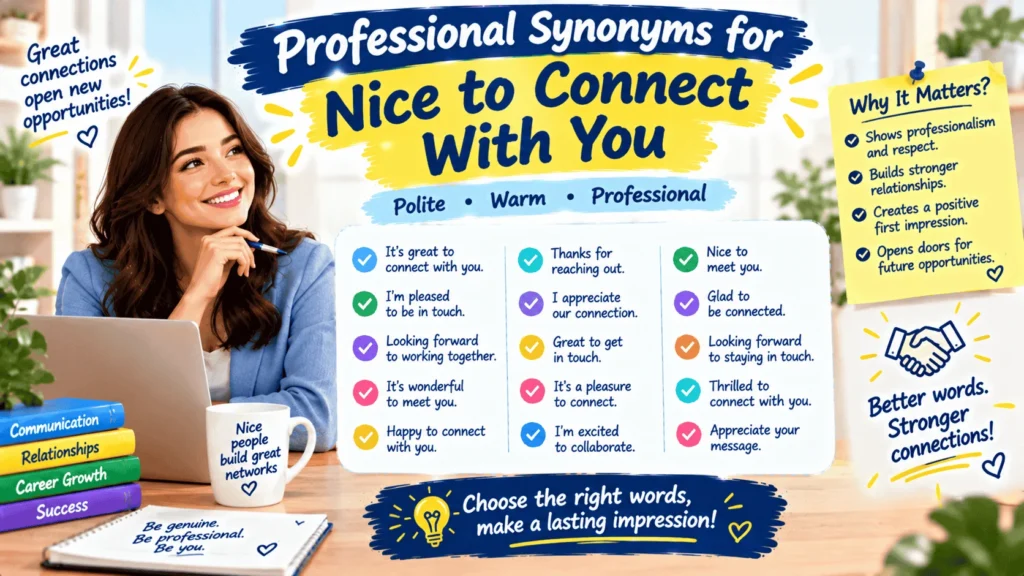
Finding the right professional synonyms for nice to connect with you can help you sound more polished without losing warmth. The phrase “nice to connect with you” is friendly and natural, but it may feel too casual or repetitive in business emails, client conversations, networking messages, and workplace communication.
A good alternative depends on your relationship with the reader and the situation. You might want a formal expression for a new client, a warm phrase for a networking contact, or a simple email-friendly sentence for a colleague.
In this guide, you will find professional, formal, friendly, and workplace-ready alternatives, along with examples showing exactly when to use each one.
What Does “Nice to Connect With You” Mean?
“Nice to connect with you” means that you are pleased to establish communication or make contact with another person.
It commonly appears after:
- Meeting someone for the first time
- Connecting on LinkedIn
- Exchanging emails
- Joining a professional meeting
- Being introduced by a colleague
- Starting a new business relationship
- Following up after an event
Literal Meaning
The phrase communicates that you are happy to establish a connection with someone.
Example:
Nice to connect with you. I look forward to learning more about your work.
Tone
The phrase usually has a friendly, positive, and professional tone. However, it is less formal than expressions such as “It is a pleasure to make your acquaintance.”
Purpose
You can use it to:
- Acknowledge a new relationship
- Create a positive first impression
- Show openness to future communication
- Make an email sound warmer
- Establish rapport with a client or colleague
Emotional Context
The phrase communicates goodwill without sounding overly personal. It works particularly well when you want to be professional while still sounding approachable.
28 Professional Synonyms for Nice to Connect With You
Below are practical alternatives grouped by tone and context.
1. It’s a Pleasure to Connect With You
Tone: Professional and warm
Best use: Clients, executives, networking, introductory emails
This is one of the safest alternatives when you want to sound polished but approachable.
Example:
It’s a pleasure to connect with you. I look forward to discussing the project further.
2. It’s Great to Connect With You
Tone: Friendly and professional
Best use: Networking, colleagues, LinkedIn, business emails
This sounds natural and conversational while remaining appropriate for most professional settings.
Example:
It’s great to connect with you. Thank you for reaching out about our services.
3. I’m Glad We Connected
Tone: Friendly and positive
Best use: Networking and follow-up messages
Use this after you have already established contact.
Example:
I’m glad we connected at the conference. I enjoyed our conversation about digital marketing.
4. It Was a Pleasure Connecting With You
Tone: Polite and professional
Best use: After meetings, calls, conferences, and networking events
This works especially well in follow-up emails.
Example:
It was a pleasure connecting with you during yesterday’s meeting. I appreciate your insights.
5. I’m Pleased to Connect With You
Tone: Formal and professional
Best use: Client communication and formal introductions
This is a slightly more formal alternative to “nice.”
Example:
I’m pleased to connect with you and look forward to working together.
6. I’m Delighted to Connect With You
Tone: Warm and polished
Best use: Clients, partners, networking
“Delighted” adds more warmth than “pleased,” but it can still work in professional communication.
Example:
I’m delighted to connect with you and explore how we can support your team.
7. It’s a Pleasure Making Your Acquaintance
Tone: Very formal
Best use: Formal introductions and traditional business correspondence
This phrase is more formal than everyday workplace language.
Example:
It’s a pleasure making your acquaintance. I look forward to staying in touch.
8. I’m Happy We Had the Opportunity to Connect
Tone: Professional and warm
Best use: Meetings, conferences, networking
This option sounds sincere without being overly formal.
Example:
I’m happy we had the opportunity to connect at the industry event.
9. I’m Happy to Be in Touch
Tone: Friendly and professional
Best use: Emails and ongoing business relationships
Use this when you want to emphasize continued communication.
Example:
I’m happy to be in touch and look forward to discussing the next steps.
10. It’s Wonderful to Connect With You
Tone: Warm and enthusiastic
Best use: Friendly networking and relationship-building
This works best when the conversation has a positive or personal business tone.
Example:
It’s wonderful to connect with you. I enjoyed hearing about your company’s recent growth.
11. It’s Great Speaking With You
Tone: Friendly and professional
Best use: After phone calls or virtual meetings
This is better than “connect” when you have actually spoken with the person.
Example:
It’s great speaking with you today. I’ll send the requested information shortly.
12. It Was Great Meeting You
Tone: Friendly and professional
Best use: In-person meetings and events
Use this after physically meeting someone.
Example:
It was great meeting you at the networking event. I hope we can stay in touch.
13. I Appreciate the Opportunity to Connect
Tone: Professional and respectful
Best use: Clients, senior professionals, interviews, networking
This expression emphasizes gratitude.
Example:
I appreciate the opportunity to connect and learn more about your organization.
14. Thank You for Connecting With Me
Tone: Polite and appreciative
Best use: LinkedIn, networking, business introductions
This is particularly useful when the other person initiated the connection.
Example:
Thank you for connecting with me on LinkedIn. I look forward to staying in touch.
15. Thank You for Reaching Out
Tone: Professional and natural
Best use: Email, customer service, clients, business inquiries
This works better when someone contacts you first.
Example:
Thank you for reaching out. I’m glad to connect and discuss your requirements.
16. I Look Forward to Working With You
Tone: Professional and confident
Best use: New clients, colleagues, partners
This focuses on the future relationship rather than simply acknowledging the connection.
Example:
It’s a pleasure to connect with you. I look forward to working with you on this project.
17. I Look Forward to Staying in Touch
Tone: Friendly and professional
Best use: Networking and follow-up emails
Use this when you want to maintain the relationship.
Example:
It was a pleasure meeting you. I look forward to staying in touch.
18. I Look Forward to Our Future Conversations
Tone: Professional and warm
Best use: Networking, clients, business relationships
This works well when you expect further discussions.
Example:
I appreciate the opportunity to connect and look forward to our future conversations.
19. I’m Looking Forward to Getting to Know You and Your Work
Tone: Warm and professional
Best use: Networking and new colleagues
This is useful when you want to build a professional relationship.
Example:
I’m looking forward to getting to know you and learning more about your work.
20. I’m Glad to Have the Opportunity to Work With You
Tone: Professional and appreciative
Best use: New projects and workplace relationships
This is particularly appropriate once collaboration has been confirmed.
Example:
I’m glad to have the opportunity to work with you on this initiative.
21. I’m Pleased to Be in Contact With You
Tone: Formal
Best use: Formal business correspondence
This is a strong choice when you want a traditional business tone.
Example:
I’m pleased to be in contact with you regarding your recent inquiry.
22. It’s a Pleasure to Be in Touch
Tone: Polished and professional
Best use: Emails, clients, partners
This phrase is concise and works well in business correspondence.
Example:
It’s a pleasure to be in touch. Please let me know how I can assist.
23. I’m Grateful for the Opportunity to Connect
Tone: Formal and appreciative
Best use: Senior professionals, networking, business introductions
This sounds more deliberate and appreciative.
Example:
I’m grateful for the opportunity to connect and discuss potential areas of collaboration.
24. I Appreciate Your Time and the Opportunity to Connect
Tone: Respectful and formal
Best use: Interviews, client meetings, executive communication
Use this when the person has invested time in speaking with you.
Example:
I appreciate your time and the opportunity to connect. Your feedback was very helpful.
25. I’m Looking Forward to Building a Professional Relationship
Tone: Formal and relationship-focused
Best use: Clients, partnerships, networking
This makes the purpose of the connection clear.
Example:
I’m looking forward to building a professional relationship and exploring opportunities to work together.
26. I’m Glad to Have Connected With You
Tone: Friendly and professional
Best use: Follow-up emails and networking
This is a natural way to refer to a connection that has already happened.
Example:
I’m glad to have connected with you at the conference.
27. I’m Looking Forward to Staying Connected
Tone: Friendly and modern
Best use: LinkedIn, networking, colleagues
This sounds less formal and more conversational.
Example:
Thank you again for the conversation. I’m looking forward to staying connected.
28. I Look Forward to Further Discussions
Tone: Formal and business-focused
Best use: Clients, negotiations, professional correspondence
This is ideal when you expect the relationship to involve additional business discussions.
Example:
Thank you for your time today. I look forward to further discussions regarding the proposal.
Quick Comparison Table
| Alternative | Tone | Best Use |
|---|---|---|
| It’s a pleasure to connect with you | Professional | Clients and networking |
| It’s great to connect with you | Friendly | General business emails |
| I’m glad we connected | Warm | Networking |
| It was a pleasure connecting with you | Polite | Follow-ups |
| I’m pleased to connect with you | Formal | Client communication |
| I’m delighted to connect with you | Warm | Relationship building |
| Thank you for connecting with me | Appreciative | LinkedIn and networking |
| Thank you for reaching out | Professional | Business inquiries |
| I appreciate the opportunity to connect | Respectful | Senior professionals |
| I look forward to working with you | Professional | New projects |
| I look forward to staying in touch | Friendly | Networking |
| It’s a pleasure to be in touch | Polished | Business emails |
| I’m pleased to be in contact with you | Formal | Formal correspondence |
| I’m glad to have connected with you | Friendly | Follow-ups |
| I look forward to further discussions | Formal | Clients and negotiations |
Email Examples
Client Email
Hi Sarah,
It’s a pleasure to connect with you. Thank you for sharing your project requirements. I look forward to discussing the next steps with you.
Best regards,
James
Email to a Manager
Hi Mr. Davis,
I appreciate the opportunity to connect. I’m looking forward to learning more about the team and contributing to the upcoming project.
Best,
Alex
Email to a Colleague
Hi Daniel,
It’s great to connect with you. I’m looking forward to working together and supporting the project.
Best,
Emily
Customer Service Email
Hello Ms. Carter,
Thank you for reaching out. It’s a pleasure to be in touch, and I’ll be happy to help resolve your request.
Kind regards,
Customer Support Team
Networking Email
Hi Michael,
It was a pleasure meeting you at the conference. I enjoyed our conversation about industry trends and look forward to staying in touch.
Best regards,
Rachel
Meeting Follow-Up
Hi Team,
It was great speaking with everyone today. I appreciate the productive discussion and look forward to our next meeting.
Best,
Olivia
When Should You Use “Nice to Connect With You”?
The original phrase is perfectly acceptable in many situations. You do not always need to replace it.
Use “nice to connect with you” when:
- The conversation is friendly but professional.
- You are writing to someone at a similar professional level.
- You have recently connected online.
- You want a simple and approachable tone.
- The relationship does not require highly formal language.
For example:
Nice to connect with you, John. I enjoyed learning about your work.
For a more formal audience, consider:
It’s a pleasure to connect with you, John.
Common Mistakes to Avoid
1. Using the Same Phrase Too Often
Repeatedly writing “nice to connect with you” can make business emails sound formulaic.
Instead, vary your language naturally:
It was a pleasure connecting with you.
or:
I appreciate the opportunity to connect.
2. Being Too Formal
Not every professional interaction requires highly formal language.
For example, “It is a pleasure making your acquaintance” may sound unnatural in a casual LinkedIn conversation.
A simpler option may work better:
It’s great to connect with you.
3. Using “Meeting” When You Only Exchanged Messages
Do not say:
It was great meeting you.
if you only connected through LinkedIn or email.
Use:
It was great connecting with you.
instead.
4. Choosing “Speaking” When You Did Not Have a Conversation
“It was great speaking with you” implies an actual conversation.
If you only exchanged emails, use:
It was great connecting with you.
5. Sounding Too Enthusiastic
Words such as “wonderful” and “delighted” can add warmth, but they may not fit every corporate setting.
Match your expression to the relationship.
6. Forgetting the Purpose of the Email
A professional greeting should support the main purpose of your message.
Instead of ending with:
Nice to connect with you.
you can make the message more useful:
It’s a pleasure to connect with you. I look forward to discussing the proposal on Thursday.
This connects the greeting to the next action.
Related Business Phrases
Here are related expressions you can use in professional communication.
1. Great to hear from you
Meaning: You are pleased that someone contacted you.
Example: Great to hear from you. I hope everything is going well.
2. It was a pleasure meeting you
Meaning: You enjoyed meeting someone in person.
Example: It was a pleasure meeting you at the event.
3. I enjoyed our conversation
Meaning: You found the discussion valuable.
Example: I enjoyed our conversation about the new project.
4. I look forward to working with you
Meaning: You expect future collaboration.
Example: I look forward to working with you on the campaign.
5. I look forward to staying in touch
Meaning: You want to maintain communication.
Example: I look forward to staying in touch after the conference.
6. Thank you for reaching out
Meaning: You appreciate someone’s contact.
Example: Thank you for reaching out about our services.
7. Thank you for getting in touch
Meaning: You acknowledge someone’s message.
Example: Thank you for getting in touch. I’d be happy to help.
8. I appreciate your time
Meaning: You recognize someone’s effort.
Example: I appreciate your time and thoughtful feedback.
9. I appreciate the introduction
Meaning: You are grateful for being introduced.
Example: I appreciate the introduction and look forward to connecting with her.
10. I’m glad we had the chance to speak
Meaning: You value the conversation.
Example: I’m glad we had the chance to speak about the proposal.
11. I’m pleased to be in touch
Meaning: You are happy to communicate.
Example: I’m pleased to be in touch regarding your inquiry.
12. I look forward to our conversation
Meaning: You anticipate a future discussion.
Example: I look forward to our conversation tomorrow.
13. I look forward to our continued collaboration
Meaning: You expect the business relationship to continue.
Example: I look forward to our continued collaboration.
14. I hope we can work together
Meaning: You express interest in collaboration.
Example: I hope we can work together on future projects.
15. I’m happy to continue the conversation
Meaning: You welcome further discussion.
Example: I’m happy to continue the conversation whenever convenient.
16. I’m pleased we had the opportunity to meet
Meaning: You value a recent meeting.
Example: I’m pleased we had the opportunity to meet during the conference.
Primary Phrase vs. Professional Alternatives
| Phrase | Formality | Tone | Best Context |
|---|---|---|---|
| Nice to connect with you | Moderate | Friendly | General communication |
| Great to connect with you | Moderate | Warm | Networking |
| It’s a pleasure to connect with you | High | Warm | Clients |
| I’m pleased to connect with you | High | Formal | Business emails |
| I’m delighted to connect with you | High | Enthusiastic | Relationship building |
| Thank you for connecting with me | Moderate | Appreciative | |
| I appreciate the opportunity to connect | High | Respectful | Executives |
| It was a pleasure connecting with you | High | Polite | Follow-ups |
| I’m glad we connected | Moderate | Friendly | Networking |
| I look forward to working with you | Moderate | Professional | New projects |
| I look forward to staying in touch | Moderate | Warm | Networking |
| I look forward to further discussions | High | Formal | Clients |
Cultural and Professional Usage
US English
American business communication often favors direct, friendly expressions.
Common choices include:
It’s great to connect with you.
It’s nice to connect with you.
I’m glad we connected.
These phrases work well in emails, LinkedIn messages, meetings, and networking.
UK English
British professional communication can also use friendly expressions, but some formal contexts may favor slightly more reserved wording.
For example:
It’s a pleasure to connect with you.
or:
I’m pleased to be in touch.
The appropriate choice still depends on the organization and relationship.
Corporate Communication
Corporate communication often benefits from clarity over excessive formality.
Instead of using an elaborate expression, consider:
It’s a pleasure to connect with you. I look forward to working together.
The sentence is professional while remaining easy to understand.
Customer Service
Customer-facing communication should generally sound helpful and welcoming.
Good options include:
Thank you for reaching out.
It’s a pleasure to be in touch.
I’m happy to assist.
Avoid overly personal or informal expressions when communicating with customers.
Networking
Networking allows for a warmer tone.
Good options include:
It was great connecting with you.
I’m glad we connected.
I enjoyed our conversation.
I look forward to staying in touch.
How to Choose the Right Alternative
The best professional synonym depends on four factors: relationship, context, formality, and purpose.
For a New Client
Use:
It’s a pleasure to connect with you.
For a LinkedIn Contact
Use:
It’s great to connect with you.
After a Conference
Use:
It was a pleasure connecting with you at the conference.
For a Senior Executive
Use:
I appreciate the opportunity to connect.
After a Phone Call
Use:
It was great speaking with you.
For a New Project
Use:
I look forward to working with you.
For a Future Relationship
Use:
I look forward to staying in touch.
FAQs
1. What is a professional way to say “nice to connect with you”?
A strong professional option is “It’s a pleasure to connect with you.” Other choices include “I’m pleased to connect with you,” “It’s great to connect with you,” and “I appreciate the opportunity to connect.”
2. What is a formal alternative to “nice to connect with you”?
For formal communication, try “I’m pleased to connect with you” or “I appreciate the opportunity to connect with you.”
3. What is a friendly synonym for “nice to connect with you”?
Good friendly options include “It’s great to connect with you,” “I’m glad we connected,” and “It was great connecting with you.”
4. Can I say “nice to connect with you” in a business email?
Yes. “Nice to connect with you” is appropriate for many business emails. It is friendly, clear, and professional. Choose a more formal alternative when communicating with an executive, important client, or highly formal organization.
5. What can I say instead of “nice to connect with you” on LinkedIn?
You can say:
It’s great to connect with you.
or:
Thank you for connecting with me.
For a warmer message, try:
I’m glad we connected.
6. Is “pleasure to connect with you” professional?
Yes. “It’s a pleasure to connect with you” is a polished professional expression that works well with clients, business partners, executives, and networking contacts.
7. What should I say after connecting with a client?
You could write:
It’s a pleasure to connect with you. I look forward to learning more about your needs.
This keeps the tone professional and moves naturally toward the purpose of the relationship.
8. What is the best alternative after a meeting?
Use “It was a pleasure connecting with you” or “It was great speaking with you.” The second option is especially suitable when the meeting involved a detailed conversation.
9. Is “great to connect with you” too casual for business?
Usually, no. It is widely suitable for professional communication, especially networking, LinkedIn messages, colleagues, and clients with whom you have an approachable relationship.
10. What is a good synonym for “nice to connect with you” in formal email?
Try:
I appreciate the opportunity to connect with you.
or:
I’m pleased to be in contact with you.
These alternatives create a more formal tone while remaining natural.
Final Summary
The best professional synonyms for nice to connect with you depend on the situation and relationship. For most business emails, “It’s a pleasure to connect with you” offers a polished balance of warmth and professionalism. For networking, “It’s great to connect with you” and “I’m glad we connected” feel natural. For formal communication, “I appreciate the opportunity to connect” works well. For future collaboration, “I look forward to working with you” is direct and useful. Always match your wording to the audience, purpose, and level of formality. The strongest business email phrases sound professional without feeling stiff, repetitive, or overly scripted.




